Under the city’s plan, legal procedures for 47 social housing projects will be expedited to allow construction to begin in the first quarter of 2026. At the same time, the city is prioritizing completion of its land-use plan through 2040, earmarking roughly 2,000 hectares for housing development, a move expected to create a robust pipeline of social housing in the coming years.
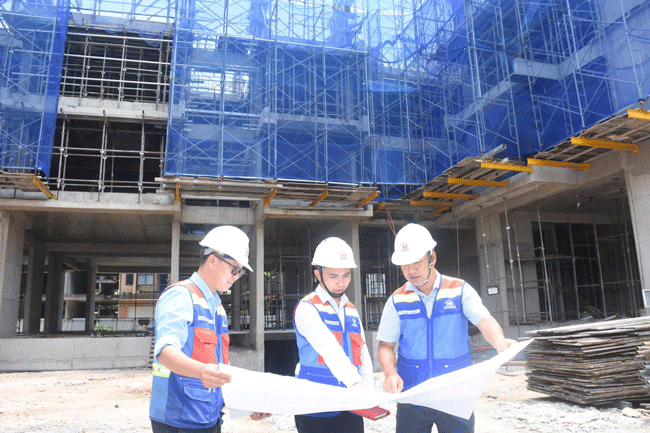
Legal procedures have become increasingly streamlined. In the eastern area of Ho Chi Minh City, several projects that previously faced prolonged obstacles are now being implemented smoothly and are nearing completion for handover to residents. One example is the Eco Home 1 project, developed by Ba Ria–Vung Tau Housing Development Joint Stock Company (HODECO) on Truong Chinh Street in Phu My Ward, which recently held its topping-out ceremony. The investor is accelerating construction to ensure homes are handed over this year.
According to Le Viet Lien, General Director of HODECO, the project previously encountered numerous challenges, including restrictive eligibility criteria for social housing that limited access to buyers, as well as obstacles related to investment approval, sales procedures, licensing, and price appraisal.
These difficulties have largely been resolved following the introduction of more flexible policies. Notably, the Housing Law 2023, effective from August 1, 2024, along with Decree No. 100/2024/ND-CP, which guides its implementation, has expanded the pool of eligible beneficiaries and relaxed conditions for accessing social housing support compared with earlier regulations.
Similarly, the My Xuan B1 social housing project in Phu My Ward, covering approximately 3.37 hectares and providing around 1,200 apartments, officially broke ground on January 16. Le Thanh Tung, Director of IDICO CONAC Company, the project’s investor, said the project had been stalled for years while awaiting approval of the city’s general construction plan. The issuance of an investment policy decision by the Ho Chi Minh City People’s Committee on October 8, 2025, together with approval of the 1/2000 zoning plan and the 1/500 detailed plan, has now enabled the project to proceed in compliance with regulations.
Another long-delayed project, the Le Thanh – Tan Kien social housing development in Tan Nhut Commune, has also recently commenced construction. Developed by Le Thanh Construction and Trading Company, the project had remained idle due to the protracted approval of the 1/500 detailed plan and delays in obtaining a construction permit. Le Huu Nghia, General Director of the company, noted that simplified procedures under the new regulatory framework, particularly the removal of mandatory feasibility assessments by specialized agencies, have allowed investors to self-assess, approve, and take responsibility, enabling construction to start immediately.
Beyond private developers, the Ho Chi Minh City Federation of Labor is also stepping up efforts to secure housing for workers and laborers. At a recent workshop on social housing development, Vo Khac Thai, Permanent Vice Chairman of the Ho Chi Minh City Labor Union, said the organization aims to deliver approximately 50,000 condo apartments by 2030.
To meet this target, the Labor Union has signed a cooperation agreement with Hoa Sen Group to jointly develop around 20,000 social housing apartments during the 2026–2030 period while it is continuing to seek additional strategic partners. According to Permanent Vice Chairman Vo Khac Thai, stronger direction and support from city authorities will be essential to accelerate implementation.
Currently, the Ho Chi Minh City People’s Council has policies in place to subsidize interest rates on loans for social welfare projects, with a maximum of VND200 billion (US$7.64 million) per project. While suitable for small-scale developments, this financial support falls short for large social housing projects spanning 10–20 hectares and requiring substantial capital.
As a result, the city is being urged to consider supporting up to 70 percent of total investment for large-scale social housing developments, alongside further streamlining administrative procedures, to enable investors to accelerate construction and expand housing supply for low-income residents.






)