Speaking at a seminar on social housing development in Ho Chi Minh City held in the city on January 16, Deputy Director of the Ho Chi Minh City Institute for Development Studies, Pham Binh An, said that under the Government’s scheme to invest in the construction of at least one million social housing units nationwide, Ho Chi Minh City has been assigned a target of 199,400 units by 2030, equivalent to about 20 percent of the national goal.
He noted that this represents a significant responsibility and poses major challenges for the city, given limited land availability, high investment costs, and persistent legal and procedural bottlenecks.
During the 2021–2025 period, the city completed nearly 18,000 social housing units, coming close to its target and reflecting substantial efforts by the entire political system. However, he added that the figure still falls well short of actual demand.
According to the results of a large-scale survey, the Ho Chi Minh City Institute for Development Studies has found that housing demand in the 2026–2030 period will be substantial. A significant share of this demand comes from households seeking to rent or lease-to-own social housing, particularly in developed inner-city areas and suburban districts close to industrial parks and export processing zones.
This reality, Pham Binh An said, underscores the need to diversify social housing models, moving beyond a sole focus on for-sale units to prioritize rental and rent-to-own social housing, as well as housing for workers.
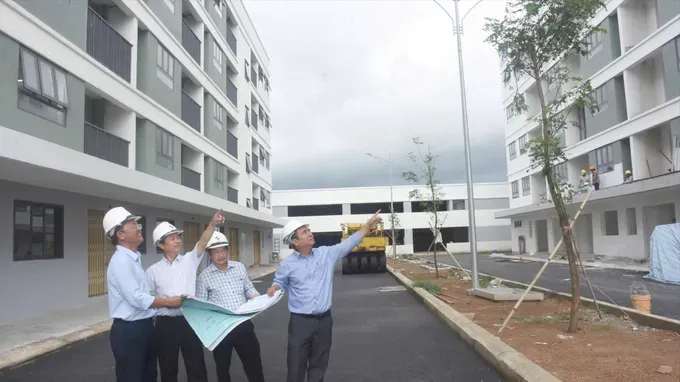
Deputy Director of the Ho Chi Minh City Department of Construction, Pham Minh Man, said that to prepare for housing projects to be completed in the 2026-2027 period, the city is pushing ahead with 58 projects. Of these, 11 projects, comprising about 12,000 units, have obtained construction permits and are either under construction or preparing to break ground, while 47 projects, with a combined scale of roughly 31,500 units, have received in-principle investment approval.
Several measures proposed to accelerate progress

Deputy Director of the Ho Chi Minh City Department of Construction, Pham Minh Man, said that in the period ahead, Ho Chi Minh City will focus on a set of measures to accelerate the implementation of social housing projects.
Firstly, the city will prioritize completing the planning of land reserves for social housing development through 2040, covering a total area of around 2,000 hectares. The Department of Construction will coordinate with the Department of Planning and Architecture to specify zoning plans and locations in key growth areas, particularly along the city’s ring roads, with a view to mobilizing resources and attracting investment in social housing.
Secondly, the city will step up efforts to finalize legal procedures for the 47 projects that have already received in-principle investment approval, with the aim of breaking ground in the first quarter. In addition, it will issue regulations and support mechanisms for developers implementing social housing projects and accelerate the appointment of project developers in line with newly issued regulations.
Thirdly, the city will issue streamlined procedures for social housing investment and construction, aiming to cut overall implementation time by up to 20 percent.
Fourthly, Ho Chi Minh City will restructure and strengthen its Housing Development Fund in line with a national housing fund model. Under this approach, the city will provide charter capital to enable the fund to invest in the development of social housing stock for lease by civil servants, public employees, and workers, while also helping match supply and demand and generate financial resources for social housing development.
Nguyen Quang Thanh, Deputy General Director of the Ho Chi Minh City State Investment and Financial Company (HFIC), said that under the city’s special policy framework, enterprises with 100 percent domestic ownership, cooperatives, and public service units implementing social housing projects will receive full interest-rate subsidies from the state. The maximum loan eligible for interest support is set at VND200 billion per project, with a tenor of up to seven years. To qualify, projects must meet all legal requirements, developers must provide collateral, and the social housing projects must be implemented in Ho Chi Minh City.
Meanwhile, Chairman of Hoang Quan Real Estate Corporation, Truong Anh Tuan, said the company has built and is currently developing four social housing projects comprising around 4,000 units. Looking ahead to 2030, Ho Chi Minh City has tasked the company with delivering an additional 50,000 units.
The goal of developing nearly 200,000 social housing units by 2030 is entirely achievable. To achieve this, the city needs to utilize the existing land reserves owned by businesses to implement social housing projects, Truong Anh Tuan said.
On this issue, Chairman of the Ho Chi Minh City Real Estate Association, Le Hoang Chau, noted that policy bottlenecks in social housing development have now been largely resolved, allowing the city to move onto a “fast track” for accelerated growth.
At the conference, Hoa Sen Group signed a commitment with the Ho Chi Minh City Labour Federation to jointly implement a social housing program for workers and employees, with a target of completing 20,000 units by 2030 in line with the city’s goals.