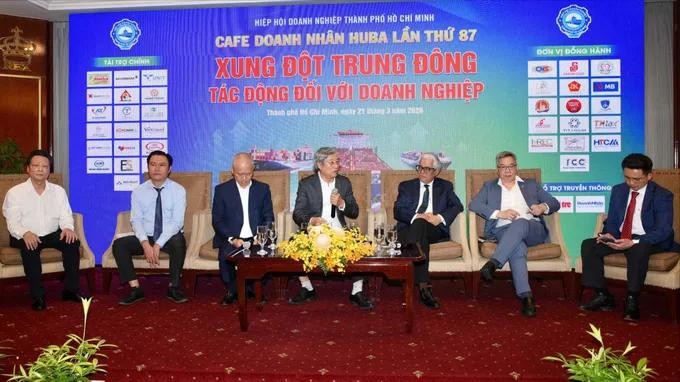
In Ho Chi Minh City, the Ho Chi Minh City Business Association (HUBA) organized the 87th Businessmen's Cafe program with the theme "Middle East Conflict – Impact on Businesses," attracting a large number of businesses, experts, and industry associations.
At the program, opinions were expressed that the conflict in the Middle East is increasing risks to global trade, especially through fluctuations in energy prices, logistics costs, and supply chain disruptions. With its high degree of economic openness, businesses in Ho Chi Minh City are more quickly and clearly affected, not only in terms of costs but also in delivery schedules, contracts, and cash flow.
According to Nguyen Khac Hieu, Chairman of HCMC LPG Business Association, Ho Chi Minh City's export turnover in 2025 is expected to reach approximately US$92.68 billion, accounting for nearly 19.5 percent of the country's total export turnover, reflecting its large-scale participation in international trade. Therefore, if the conflict continues, depending on the industry, export growth could sharply decline by 4-6 percent.
Dao Trong Khoa, Chairman of the Vietnam Logistics Business Association (VLA), added that the conflict is directly affecting the "strategic bottleneck" of global trade, the Strait of Hormuz – the transit point for approximately 25 percent of crude oil transported by sea. When this route is disrupted, the impact spreads through three main channels including energy prices, transportation costs, and supply chain risks.
The VLA survey also shows that 89.8 percent of businesses are affected to a moderate to severe degree, with 42.9 percent citing the sudden increase in freight costs as the biggest problem.

The pressure is not only felt across industries but also at the cost and operational levels. Rising energy prices, escalating freight and surcharges, and extended delivery times are creating a "double risk" for businesses: increased input costs while output is disrupted, leading to increased working capital requirements and cash flow pressure.
Being an expert, Deputy Director Pham Binh An of the HCMC Institute for Development Studies (HIDS) believes that businesses need to shift from a "reactive" to a "proactive" approach, focusing on reviewing the entire supply chain. Specifically, businesses need to diversify their supply sources and markets, avoiding dependence on a single transport route or risky region. They should also develop flexible delivery scenarios to cope with fluctuations.
In addition, strengthening contract risk management, adjusting delivery terms, and proactively working with logistics and insurance partners to update on incurred costs are also key factors. Businesses also need to restructure their cash flow, recalculate costs and delivery times to ensure order retention amidst fluctuating costs.
In the long term, this is also an opportunity for businesses to restructure their supply chains towards a more flexible, multimodal, and sustainable approach, thereby enhancing their resilience to external shocks.