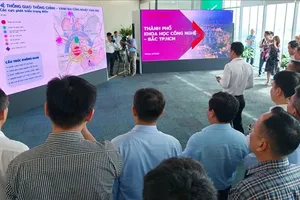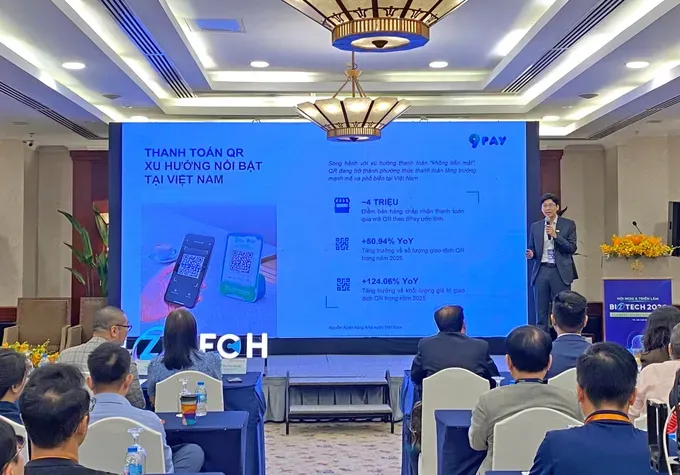
At the seminar on Digital Transformation in Finance and Banking, held within the framework of the annual B2B Digital Transformation Conference & Exhibition for Businesses (Biztech 2026) in Ho Chi Minh City on May 12, organized by the Vietnam Software and IT Services Association (VINASA), experts noted that while domestic transactions now take only seconds to complete, the development of cross-border payment infrastructure is a key step enabling Vietnamese enterprises to expand markets, attract international capital flows, and accelerate digital integration.
According to forecasts, Vietnam could welcome around 25 million international arrivals in 2026. However, most household businesses and small- and medium-sized enterprises still primarily accept domestic payment methods such as domestic QR code scanning or cash. The lack of infrastructure to support international e-wallets and global payment methods has caused many businesses to miss out on significant spending from tourists from China, South Korea, the United States, and Europe.
While cash and credit cards were once the most common options for travelers, both now reveal limitations such as the inconvenience of foreign currency exchange, risks of cash loss, exposure of card information, and high currency conversion fees. In this context, cross-border QR payments are emerging as an effective solution. New payment methods with faster processing speeds and lower costs are reshaping the regional financial infrastructure and promoting deeper economic integration.
Mr. Le Tuan Anh, Sales Director of 9Pay Joint Stock Company, said that the company’s Scan-to-Pay solution enables international visitors to use their domestic e-wallets to scan QR codes at point-of-sale locations in Vietnam. The system automatically converts foreign currencies and transfers payments to merchants’ accounts in Vietnamese dong (VND) in real time.
This solution has been implemented in cooperation with multiple global e-wallet partners, with a focus on the United States, South Korea, West Asia, and Europe. The company is not only providing a QR code, but also offering a secure legal framework that ensures international payment flows are transferred transparently and in full compliance with Vietnamese regulations into merchants’ accounts, Mr. Le Tuan Anh said.
In addition to solutions serving tourism and retail, cross-border payments are also regarded as essential digital infrastructure for export businesses and e-commerce.
Mr. Nguyen Hoang Vu, Business Development Manager at financial technology (Fintech) company, Payoneer, said that in domestic payments, transactions are processed quickly thanks to a fully integrated national banking system. However, in cross-border payments, import–export enterprises face a more complex challenge as they need to connect with multiple financial and banking systems across different countries.
Therefore, the role of intermediary service providers, or aggregators, becomes particularly important. These entities act as a bridge between businesses and international banks, helping to establish a secure, transparent cross-border payment infrastructure that fully complies with anti-money laundering regulations and financial security standards.
Through intermediary service providers, import–export enterprises are no longer required to work separately with each bank or each market. Instead, they can connect through a single gateway to access the global payment network.
This helps save time and costs, reduce procedural complexity, and optimize cash flow management. Intermediaries also support businesses in centrally managing cash flows, ensuring transparent currency conversion, and guaranteeing that transactions are properly monitored in compliance with regulations. As a result, enterprises can focus their resources on production, export activities, and expanding into international markets, Mr. Nguyen Hoang Vu said.