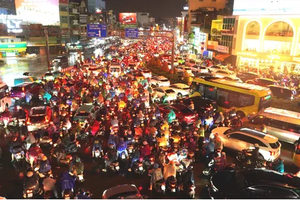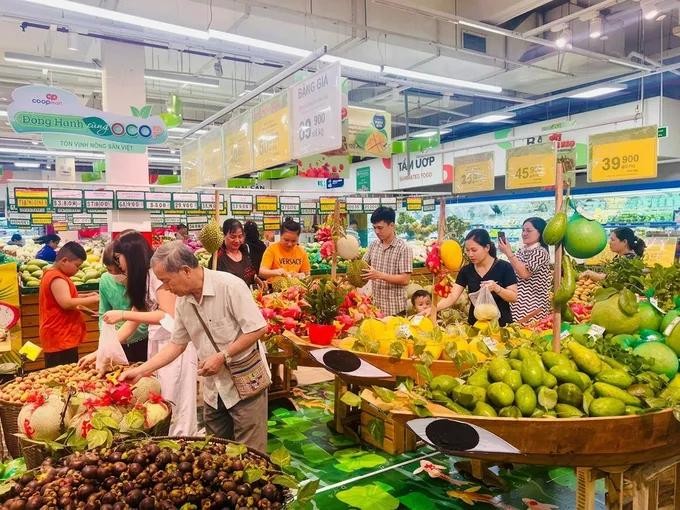
Although gasoline prices have fallen sharply from the peak seen during the Middle East conflict, the prices of many goods and services have remained persistently high. The mismatch is placing growing pressure on both consumers and businesses. Authorities are now being urged to review pricing practices and introduce measures to ensure market prices more accurately reflect declining fuel costs and actual supply conditions.
Market prices remain high
In areas near the city center, a bowl of pho now averages VND45,000 to VND55,000 while takeaway coffee costs between VND20,000 and VND25,000. These rates represent a year-on-year increase of VND5,000 to VND10,000. Many food stalls and eateries raised their prices during the peak of the Middle East conflict when fuel costs soared, but they have failed to lower them since.
Daily services follow a similar trend. Unregulated motorbike parking around Ben Thanh Market in Ben Thanh Ward currently costs VND20,000 per vehicle, doubling the VND10,000 rate from the same period last year. Delivery, laundry, and construction costs also remain elevated.
Construction materials have experienced steep price hikes since the beginning of the year. Le Xuan Hoai, a resident of Long Truong Ward, completed a three-story house in December 2025. In April 2026, his tenant requested an additional door. When contacting the original contractor to maintain architectural consistency, he received a quote of VND15 million for an 8-square-meter door, up from the previous price of VND10 million. The contractor cited rising material costs, forcing Hoai to accept the higher rate.
According to the Ho Chi Minh City Statistics Office, global energy price volatility inflated production input costs, serving as the primary driver for local price hikes during the first four months of the year. The April 2026 Consumer Price Index (CPI) rose 1.4 percent month-on-month and 5.83 percent year-on-year.
For the first four months of 2026, the city's CPI increased by 3.97 percent compared to the same period last year. While this matches the national average of 3.99 percent, the city's inflation is accelerating faster than the rest of the country, jumping from 2.41 percent in January to 5.83 percent in April. Nguyen Khac Hoang, Head of the Ho Chi Minh City Statistics Office, stated that the data indicates persistent and growing inflationary pressures.
Stricter enforcement and market stabilization
In response, the Ho Chi Minh City People's Committee issued a directive ordering state departments to monitor price movements closely, balance supply and demand, and penalize hoarding and unreasonable price hikes. The Department of Industry and Trade must coordinate with businesses to guarantee supplies of fuel, food, and essential goods while expanding market stabilization and promotional programs.
Nguyen Nguyen Phuong, Deputy Director of the Ho Chi Minh City Department of Industry and Trade, noted that the city’s long-standing price stabilization program historically kept local CPI below the national average. However, the market is currently undergoing upward adjustments after an extended period of stable pricing. Despite this, local purchasing power remains strong, market supplies are abundant, and retail channels continue to drive consumption growth.
Through the remainder of 2026, the city will sustain its stabilization program with 66 participating enterprises. These companies will supply 11 categories of essential foods and consumer goods, covering 20 percent to 35 percent of market demand. The city will also launch large-scale promotional campaigns combining in-person and online shopping to stimulate demand and support economic growth.
Concurrently, market surveillance forces are intensifying checks on fuel, gas, and essential commodities. Nguyen Quang Huy, Deputy Director of the Ho Chi Minh City Market Surveillance Department, stated that inspectors are focusing on price listing violations, measurement fraud, hoarding, and consumer deception. In April 2026 alone, authorities inspected 746 cases, uncovered 732 violations, and collected over VND10 billion in fines.
According to the Ho Chi Minh City Department of Industry and Trade, total retail sales of goods and consumer service revenue in the city continued to post strong growth during the first four months of the year, reaching VND639.349 trillion, up 13.2 percent year-on-year. Retail sales of goods alone totaled VND303.563 trillion, rising 16.5 percent and surpassing the average annual growth target.
Several major retail chains reported positive consumer demand, with MM Mega Market recording a 7 percent increase in sales, Saigon Co.op posting growth of over 10 percent, and GO! increasing goods supply by 11 percent. Bach Hoa Xanh forecasts purchasing power in May to rise by around 10 percent. Businesses said supplies of essential goods remain stable and that promotional campaigns offering discounts of up to 50 percent are continuing to stimulate consumer spending.