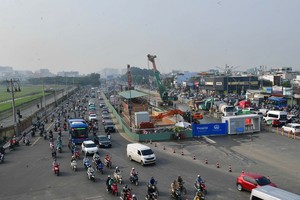
Protecting the legitimate rights of citizens
After the Department of Agriculture and Environment got the nod from the Ho Chi Minh City People's Committee, it has hired a consulting firm to develop land price adjustment coefficients for more than 11,000 roads.
The land price list recently approved by the Ho Chi Minh City People's Council will be applied for the first time from January 1, 2026, as the basis for calculating land use fees and land lease fees. However, according to regulations, before July 1st, Ho Chi Minh City must issue regulations on land price adjustment coefficients to apply to certain cases.
The development of land price adjustment coefficients is based on many factors, including: adjustment coefficients for market fluctuations, adjustment coefficients based on planning, and adjustment coefficients based on other factors affecting land prices; the results of synthesizing and analyzing information on market land prices; and adjustment coefficients based on planning, determined according to each land type and land use coefficient. The land use coefficient is determined according to the regulations of the law on construction.
The adjustment coefficient for land price tables issued before July 1 must ensure a balance of interests among all parties including the State, land users, and investors; especially in promoting compensation and land clearance for hundreds of projects currently underway in Ho Chi Minh City.
In a short period of time, collecting data to build coefficients for tens of thousands of roads with the requirements of scientific accuracy, transparency, and a balance of interests among all parties, promoting socio-economic development, is a significant challenge for those directly involved in this work.
In an interview with reporters, Dao Quang Duong, Head of the Land Economics Division under the Department of Agriculture and Environment, said that the Ministry of Agriculture and Environment has completed the draft decree detailing and guiding the implementation of the National Assembly's Resolution 254 on removing difficulties and obstacles in the implementation of the Land Law.
According to him, the greatest difficulty lies in cases of land allocation under the 2003 Land Law. After numerous requests from the Department of Agriculture and Environment, this content has been incorporated into the draft. Specifically, Clause 3 of Article 63 of the draft has been amended and supplemented as follows: The determination of the land price adjustment coefficient at points b and c of Clause 1 and points b and c of Clause 2 of this Article shall be carried out according to the provisions of Decree No. 71 (amended and supplemented by Decree No. 226).
He revealed that in cases where there is insufficient information to determine the land price adjustment coefficient at the time of actual land handover according to regulations, the consulting unit will determine the specific land price using other land price determination methods stipulated in Decree No. 71 (amended and supplemented by Decree No. 226) and report to the Land Price Appraisal Council for consideration and decision.
In cases where the actual land price determined is lower than the land price in the land price table at the time of land handover, the land price will be applied according to the land price table.
According to Dao Quang Duong, Head of the Land Economics Division, when issued, this regulation will free up hundreds of housing projects currently facing land use fee issues, and tens of thousands of apartments and houses will be granted land use certificates, contributing to socio-economic development and protecting the legitimate rights of land owners.
According to the 2024 Land Law, the land price table is applied to the following cases: calculating land use fees when the State recognizes the land use rights of households and individuals; changing the land use purpose of households and individuals.
Also according to the 2024 Land Law, land price is one of the bases for calculating land use fees and land rent when the State allocates land, leases land, permits the change of land use purpose, recognizes land use rights; and determining the starting price for auctioning land use rights; calculating taxes, fees, and charges related to land use; calculating fines for administrative violations in the field of land; calculating the value of land use rights when equitizing state-owned enterprises according to the law on equitization; exercising the rights and obligations of land users towards the State; and compensation when the State reclaims land.
Meanwhile, the National Assembly- approved Resolution 254 stipulates that land price tables are one of the bases for calculating land use fees and land rent when the State allocates land, leases land, permits land use purpose conversion, and recognizes land use rights; determining the starting price for auctioning land use rights; calculating taxes, fees, and charges related to land use; calculating fines for administrative violations in the field of land; calculating the value of land use rights when privatizing state-owned enterprises according to the law on equitization; exercising the rights and obligations of land users towards the State; and compensation when the State reclaims land.







)