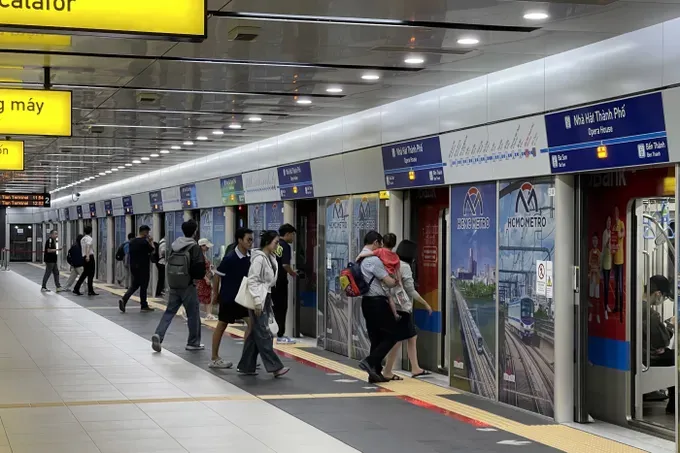
Alongside Metro Line 2 (Ben Thanh – Tham Luong), now under round-the-clock construction, Ho Chi Minh City is preparing to simultaneously roll out a series of new metro lines. The metro system is being positioned as a strategic driver to restructure urban space, strengthen regional connectivity, and sustain economic growth over the coming decades.
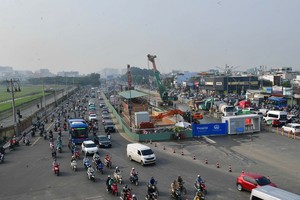
In the final days of April, construction activity along major roads such as Cach Mang Thang Tam and Truong Chinh has intensified, with work on Metro Line 2 continuing day and night. Multiple construction fronts are being deployed simultaneously, from geotechnical surveys and technical infrastructure relocation to traffic reorganization. According to the Management Authority for Urban Railway in Ho Chi Minh City (MAUR), all components are being expedited to ensure the project meets its schedule.
At key underground stations such as S5 at Le Thi Rieng Park and S10 in Pham Van Bach Street, drilling operations for geological surveys are running continuously, primarily at night to minimize disruption to residents and urban traffic. Data collected from subsurface layers will directly support technical design and tunnel construction using tunnel boring machines, a modern method that enhances safety and shortens construction timelines.
Beyond Metro Line 2, the city is advancing multiple new metro projects with urgency. MAUR Deputy Head Bui Anh Huan said the Ben Thanh – Thu Thiem line is identified as a strategic axis linking the existing city center with the new Thu Thiem urban area, home to the planned International Financial Center. The line is expected not only to ease traffic pressure across the Saigon River but also to expand development eastward.
Meanwhile, the Thu Thiem – Long Thanh Airport line is under study, with an accelerated timeline to support connectivity once Long Thanh International Airport becomes operational. Notably, the Bau Bang – Cai Mep – Thi Vai port line is expected to transport industrial goods from key production zones to seaports, easing road congestion and reducing logistics costs.
Several other metro lines are also being prepared for investment, including Line 6 (Tan Son Nhat – Phu Huu) and regional connections such as Binh Duong – Suoi Tien and Thu Dau Mot – Ho Chi Minh City. These lines are designed not only to meet mobility demand but also to connect satellite urban areas, helping relieve pressure on the city center.
Under the master plan, the metro network will expand across the broader metropolitan area with 27 lines totaling more than 1,012 kilometers, including 12 lines in Ho Chi Minh City, 12 in Binh Duong, and three in Ba Ria – Vung Tau. Over the next decade, priority will be given to nine key lines spanning 374.21 kilometers, with total investment estimated at US$37.15 billion, including six lines in Ho Chi Minh City, two in Binh Duong, and one in Ba Ria – Vung Tau.
Metro development is also closely aligned with the regional integration strategy. Lines connecting the city center with Binh Duong, Dong Nai, and Ba Ria – Vung Tau will form an integrated transport network, driving the growth of an urban–industrial–port corridor.
Ho Chi Minh City seeks private capital to power metro expansion
The metro system will require substantial capital, and reliance on public funding alone will be insufficient. The city is therefore working to complete a policy framework to mobilize resources for the entire network, with the private sector expected to play a central role.
Current estimates suggest that the state budget will cover around 30 percent to 40 percent of total investment, primarily for land clearance and technical infrastructure. The remainder will be mobilized through public-private partnerships (PPP), municipal bond issuance, and land value capture.
To facilitate significant involvement from the private sector, MAUR Deputy Head Bui Anh Huan emphasized that the city is in the process of creating risk-sharing mechanisms. Considering the extended payback periods and considerable revenue uncertainty associated with metro projects, it is crucial to implement policies like minimum revenue guarantees or financial support in the early stages. Such initiatives are anticipated to motivate large corporations, including THACO and Becamex, to invest with increased assurance.
In addition, the transit-oriented development (TOD) model is seen as an effective financial lever. By leveraging land along metro corridors and developing integrated urban, commercial, and service hubs around stations, investors can generate additional revenue streams to offset project costs.
Urban experts note that, if implemented in a synchronized manner with appropriate policies, the metro system will generate strong spillover effects expanding urban development space, attracting investment, and improving labor productivity. This will form a critical foundation for Ho Chi Minh City’s goal of achieving double-digit growth in the coming period.
However, to realize this vision, architect Ngo Viet Nam Son emphasized that political will and implementation capacity remain decisive. “With a renewed vision, metro systems are not merely transport infrastructure but strategic development tools linking urban areas, industry, and seaports, and providing the foundation for Ho Chi Minh City to maintain its role as the country’s economic engine and elevate its position in the region,” he said.




)