Party General Secretary and State President To Lam delivered a clear message: caring for workers means, above all, ensuring stable jobs, better incomes, safer working conditions, decent housing, and more accessible education and healthcare.
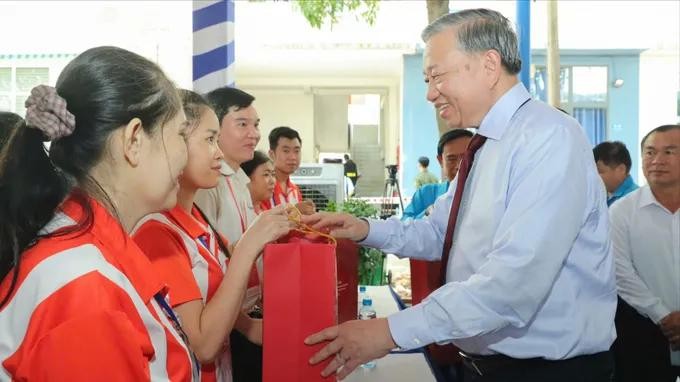
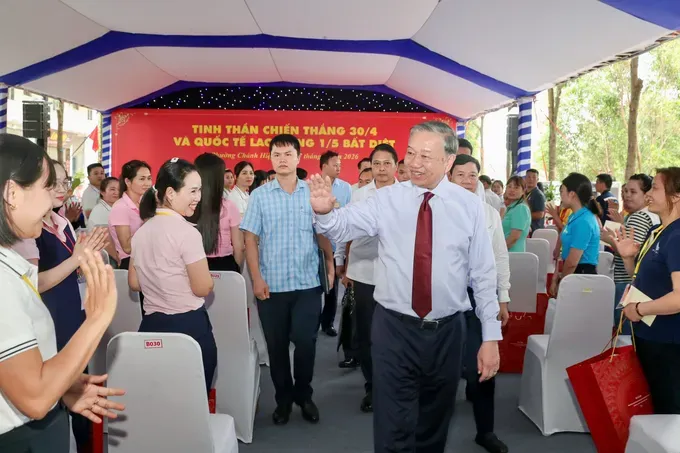
On the morning of April 27, marking the 51st anniversary of the Liberation of the South and National Reunification (April 30, 1975 – April 30, 2026) and International Workers’ Day on May 1, the Party General Secretary and State President accompanied by a central delegation, visited and encouraged workers and laborers in Ho Chi Minh City.
No one left behind
In the warm atmosphere of the meeting, Mr. To Lam expressed deep emotion at the resilience of exemplary workers.
They are individuals who, despite suffering from serious illnesses, remain steadfast and optimistic, continuing to work to support their families. They are also outstanding figures eager to learn, contributing technical innovations that benefit enterprises and help raise national labor productivity.
They include dedicated trade union officials who quietly and tirelessly visit boarding houses and factory floors to understand workers’ hardships and mobilize support in times of need.
As stated by the Party chief and State President, these straightforward narratives illustrate the admirable qualities of contemporary Vietnamese workers which are hardworking, resilient, independent, caring towards their families, and deeply connected to their colleagues, businesses, trade unions, and the nation.
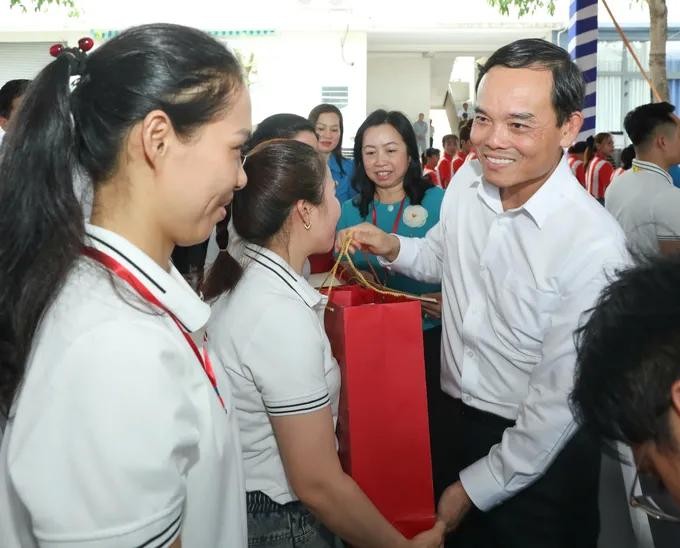
He also expressed satisfaction at the practical efforts made in recent times by Ho Chi Minh City authorities, trade unions at all levels, businesses, and the broader community to improve workers’ living conditions.
Programs providing housing, healthcare, financial aid, support for workers’ children, and assistance for those facing illness or job loss have proved meaningful and humane, even if they cannot resolve every hardship. These efforts reflect the system’s core principle of leaving no one behind.
Alongside these achievements, Mr. To Lam acknowledged the ongoing challenges faced by a segment of the workforce.
He urged ministries, agencies, and local authorities to confront these issues directly, listen carefully, and address them with both responsibility and compassion. The most important aspect of caring for workers, he emphasized, is to create stable employment, ensure adequate incomes, improve workplace safety, and provide decent housing alongside accessible education and healthcare.
A central and enduring political task
Affirming the working class as a vital force in national construction and defense, the Party chief and State President stressed that Vietnamese workers have always been present in the most difficult and demanding circumstances throughout every stage of development.
According to him, in Ho Chi Minh City, the country’s largest economic hub, the quiet sacrifices of migrant workers, every hour of overtime, and every innovation on the factory floor contribute directly to the city’s prosperity.
He therefore called on the city to continue treating the well-being of workers as a long-term political priority.
The city should further review demand for social housing, worker accommodations, schools, kindergartens, healthcare stations, and cultural facilities in industrial and export processing zones. Workers, he said, should not only have jobs but also stable housing, not only income but also the conditions to raise children, care for their families, rest, and improve their quality of life.
He urged trade unions to foster a deeper connection with workers by articulating their concerns and safeguarding their rightful rights and interests. Trade unions should transcend mere organizational efforts to genuinely evolve into a "welcoming home" and a dependable support network, available when workers experience illness, unemployment, or encounter unpaid wages.
Mr. To Lam also affirmed that workers’ recommendations would be fully received. He noted that the country is entering a new stage of development, with not only many opportunities but also significant challenges. Rapid technological change is raising demands for productivity, quality, and professional skills.
He encouraged workers to maintain confidence, solidarity, and determination, to actively pursue vocational training, improve skills, and develop industrial discipline, digital competencies, and foreign language abilities to expand employment opportunities. Each worker, he said, should strive to learn at least one new skill, contribute innovations, improve efficiency, conserve materials, ensure safety, and enhance product quality.
He expressed confidence that, with Ho Chi Minh City’s tradition of solidarity and compassion, and with the responsibility of Party committees, authorities, the Fatherland Front, trade unions, businesses, and society as a whole, the lives of workers will continue to improve.
The Party chief and State President also voiced confidence that workers in Ho Chi Minh City will continue to uphold their traditions of diligence, creativity, solidarity, and compassion caring well for their families while making meaningful contributions to the development of the city and the nation.