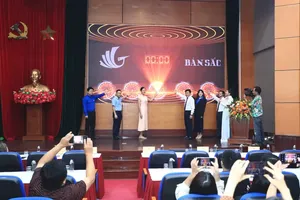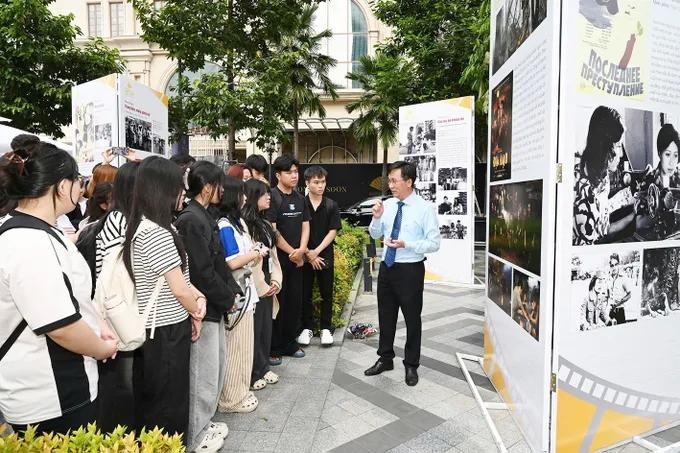
At the ceremony commemorating the 50th anniversary of the Liberation of the South and National Reunification, the Vietnam Film Institute under the Ministry of Culture, Sports and Tourism collaborated with the Ho Chi Minh City Department of Culture and Sports to organize the exhibition named The Echo of the Great Spring Victory 1975 in Cinema on Nguyen Hue Walking Street.
The exhibition featured more than 300 selected photographs extracted from the Institute’s archival film materials, portraying historical moments from the 1968 Tet Offensive to the legendary Ho Chi Minh Campaign.
At the same time, the Institute hosted public screenings of classic Vietnamese feature and documentary films, along with interactive sessions involving film crews and historical witnesses of the April 30, 1975 victory. These events took place across Nguyen Hue Walking Street, Ho Chi Minh City Open University, Ho Chi Minh City University of Culture, and the General Science Library of Ho Chi Minh City.
In late November, during the 24th Vietnam Film Festival held in Ho Chi Minh City, the Institute partnered with local organizations to present the photo exhibition 'Ho Chi Minh City Rising with the Nation through the Lens of Cinema'.
Beyond its 250 striking images depicting Saigon–Ho Chi Minh City from 1945 to 1975, the exhibition impressed audiences with the integration of new technologies such as Mixed Reality and a 360-degree photo booth, offering visitors an immersive experience of cinematic history and urban transformation.
In 2025, the Institute is also expanding its global footprint. It will present nine documentaries and feature films at the Vietnam Film Week in Greece, and participate in the Vietnamese Film Season within the ASEAN Film Week in the United Kingdom, showcasing three classic works including Em be Ha Noi (The Little Girl of Hanoi), Bao gio cho den thang Muoi (When the Tenth Month Comes), and Ganh xiec rong (The Wandering Circus).
Additionally, the Institute will introduce 18 Vietnamese feature films, a record number, at the Three Continents Film Festival in France, offering European audiences a comprehensive view of Vietnamese cinema. It is also engaging international film partners in restoration, exchange, and publishing efforts, a vital part of a long-term preservation strategy in the digital era.
Amid the global shift toward digitalization, the Institute is positioning itself at the forefront of transformation with a clear mission that is to bring Vietnam’s cinematic heritage to the world stage under new standards, innovative approaches, and global partnerships redefining the narrative of Vietnamese cinema internationally.
To date, the Institute has digitized, imported, and exported more than 8,000 reels, hard drives, and tapes, successfully restoring several historically significant works such as some images of the Liberation of Saigon, Nguoi thay giao thuong binh (The Disabled Teacher), Ngay doc lap 2-9-1945 (Independence Day September 2, 1945), and Du kich Cu Chi (Cu Chi Guerrillas).
It is also digitizing film reels and tapes under the project Restoration and Preservation of Film Prints for Long-term Archival Use. So far, the Institute has restored and digitized over 167,000 meters of film, enabling broader distribution and public access.
In addition, the Institute has reached out to major international archives notably the Netherlands Film Archive, which houses rare documentaries about Vietnam, including works by Dutch filmmaker Joris Ivens such as Bau troi mat dat (The Sky and the Earth), Vi tuyen 17 chien tranh nhan dan (17th Parallel- People’s War), Vietnam xa xoi ( Faraway Vietnam), and Gap go Ho Chu tich (Meeting with President Ho Chi Minh) enriching the nation’s cinematic collection.
With a wealth of dynamic activities, 2025 marks a period of vigorous growth for the Film Institute. No longer confined to the role of a mere archive the Institute has played a vital part in laying the foundation for a long-term strategy, positioning cinema particularly heritage cinema as a key pillar of Vietnam’s cultural diplomacy.