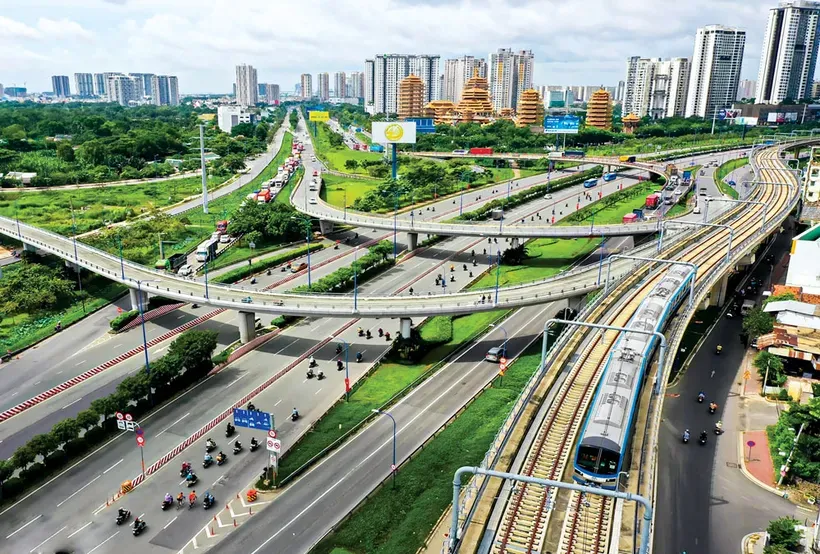
According to the Ministry of Finance, the draft decree on public bond offerings for public-private partnership (PPP) project companies signals a shift toward broader mobilization of social investment for strategic infrastructure development.
Vietnam has identified infrastructure investment as one of its key strategic breakthroughs to support long-term economic growth.
According to the Ministry of Finance, capital demand for infrastructure development in the 2025–2040 period could reach $30 billion – $40 billion per year. Large-scale projects such as high-speed railways, expressway networks, seaports, and digital infrastructure clearly cannot rely solely on the state budget or bank credit.
Against this backdrop, the Ministry of Finance’s move to seek feedback on a draft decree governing public bond offerings by companies implementing projects under the public-private partnership (PPP) model reflects a notable shift in thinking on development financing including opening the door wider for private and social investment to participate more deeply in strategic infrastructure projects.
The draft creates a specific legal framework for long-term infrastructure investors. The draft decree establishes a dedicated legal framework specifically tailored for companies investing in long-term infrastructure projects, recognizing that these businesses possess unique operational and financial characteristics that differ significantly from ordinary manufacturing or commercial enterprises.
Most PPP companies are established solely to carry out a specific project. In the early stages, these firms typically generate little or no revenue and lack a profit track record, while existing bond issuance regulations under the Securities Law require issuers to meet criteria related to financial capacity and business performance. As a result, PPP companies have struggled to access capital markets and have been forced to rely heavily on bank financing.
Infrastructure projects require massive capital investments and feature extended payback periods stretching over decades, whereas domestic bank funding sources remain predominantly in a short term. This fundamental maturity mismatch between short-term bank deposits and long-term lending commitments continues to pose structural risks to the broader financial system.
The country’s goals of modernizing its infrastructure and sustaining high long-term economic growth will face significant hurdles if financing continues to rely heavily on bank loans or public spending alone. As a consequence, developing robust capital markets specifically for infrastructure has shifted from being a supplementary financing option to an unavoidable necessity for the country.
However, lessons from Vietnam’s corporate bond market in recent years also highlight a clear reality that expanding capital-raising channels must go hand in hand with sufficiently strict risk-control mechanisms.
One positive aspect of the draft decree is that it introduces multiple “safety barriers” for PPP corporate bonds offered to the public. Under the proposal, the bonds must include mechanisms ensuring full repayment of both principal and interest. For companies whose projects have not yet begun operations, the bonds must carry unconditional and irrevocable payment guarantees from qualified credit institutions or financial organizations.
Another notable improvement is the requirement for credit ratings. At a time when Vietnam’s bond market still lacks independent and transparent risk assessment standards, mandatory credit ratings would provide an additional and important screening mechanism for issuers.
Even in cases where companies are exempt from credit-rating requirements because their bonds are fully guaranteed, the guarantor itself must still obtain a credit rating. This gives investors a stronger basis for assessing debt repayment capacity and the overall safety of the bonds.
The draft also tightens oversight of cash flows and the use of proceeds. Requirements for escrow accounts, periodic disclosure obligations, separate monitoring of cash flows dedicated to bond repayments, and restrictions on profit distribution before debt obligations are fulfilled all reflect an approach that places investor protection at the center.
This is particularly important for restoring market confidence after a turbulent period for Vietnam’s corporate bond market.
Even so, PPP corporate bonds remain fundamentally tied to long-term and complex infrastructure projects that are heavily influenced by construction progress, traffic volumes, cost fluctuations, and policy factors. For that reason, the effectiveness of the decree will depend not only on issuance conditions but also on the quality of post-issuance supervision and transparency throughout the entire project lifecycle.
At the same time, market principles must be upheld so that investors receive sufficient information to assess risks independently, rather than assuming the bonds are inherently safe simply because the projects involve state participation.
If designed and implemented effectively, bonds issued by PPP project companies could become a new “capital track” for infrastructure development, helping to strengthen Vietnam’s financial market structure, reduce dependence on bank credit, and create a more sustainable foundation for long-term economic growth.