Without decisive implementation of solutions, the target will be difficult to attain.
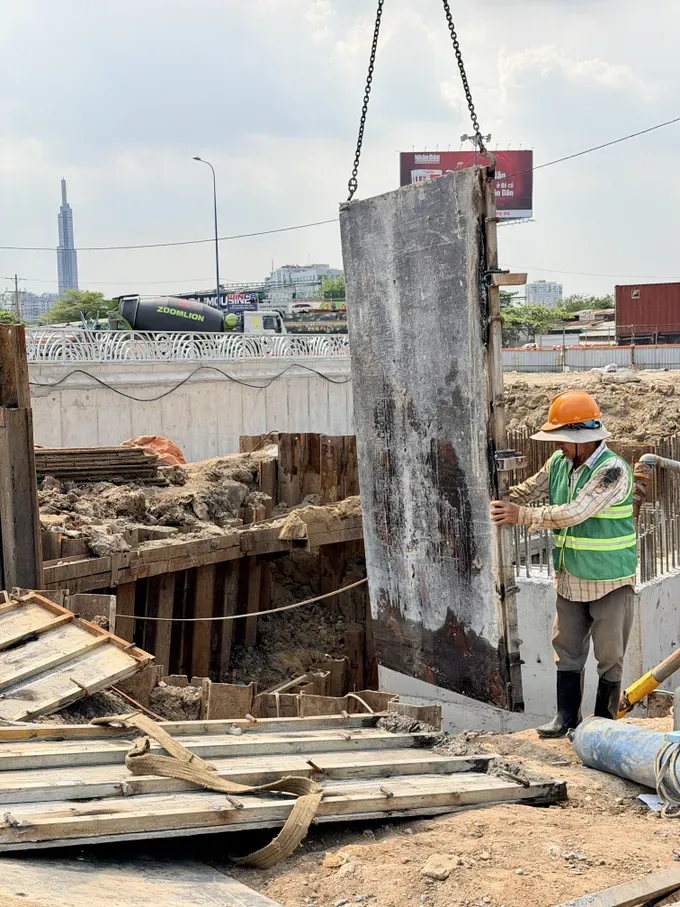
The Ho Chi Minh City Ring Road 3 construction project has been assigned a deadline for full completion and operation before June 30. However, the project investor, the Ho Chi Minh City Traffic Construction Investment Project Management Authority, said the project is currently facing numerous difficulties.
To date, the overall construction volume has reached approximately 76 percent. The biggest challenge at this stage stems from the impact of conflicts in the Middle East, which have caused fuel prices to surge sharply, leading to higher prices for sand, stone, and transportation costs. In addition, shortages of imported bitumen and asphalt concrete have directly affected construction progress. The investor is striving to complete the entire project in sync by the end of 2026.
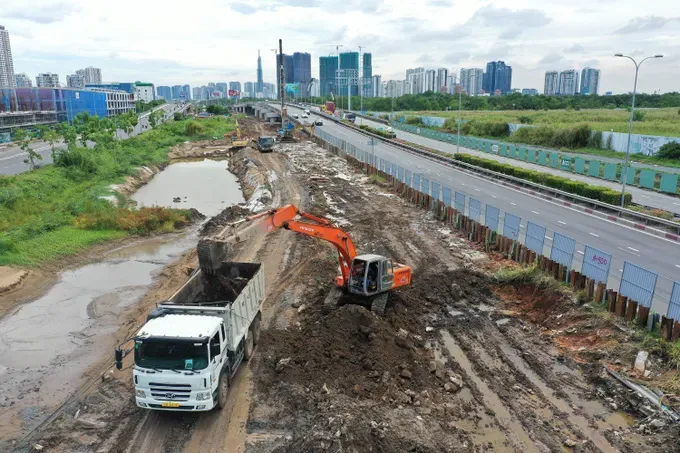
Earlier, the Ho Chi Minh City Urban Infrastructure Construction Investment Project Management Authority, the investor of the Tham Luong-Ben Cat-Nuoc Len canal infrastructure construction and environmental renovation project, said the project’s progress has been hindered by shortages of sand, bitumen, and other construction materials. This is one of Ho Chi Minh City’s key environmental infrastructure projects, with the entire 60km route expected to be opened this year.
In addition to site clearance obstacles, the project has faced difficulties due to shortages and soaring prices of construction materials. By the end of March, supplies of stone and sand met only 50 percent of demand, while bitumen met just 30 percent. By the end of April, the project’s overall progress had reached 66.3 percent.
Director of the Ho Chi Minh City Department of Finance Hoang Vu Thanh said that as of April 30, the city had disbursed more than VND15.5 trillion, equivalent to 10.5 percent of the capital plan assigned by the Prime Minister. Although this result showed more positive progress compared to the same period in 2025, when the disbursement rate stood at 7.2 percent, it remained below expectations and has yet to create a spillover effect on private investment.
In addition to the aforementioned difficulties related to materials and costs, the Ho Chi Minh City Department of Finance noted that 2026 is the first year of implementing the 2026-2030 medium-term public investment plan. As a result, many projects remain in the investment preparation stage and require additional time to complete investment procedures.
Several projects have encountered obstacles in compensation and site clearance work, relocation of technical infrastructure, legal procedures for soil and sludge disposal sites, and disputes involving international contracts. In addition, some newly established wards and communes have been slow in preparing public investment capital disbursement plans for 2026.
Working in three shifts with four crews, arranging green lanes
Under Plan No. 44, issued by the Ho Chi Minh City People’s Committee on promoting double-digit growth in 2026, the city identified investment as a key driver of growth. In particular, public investment is targeted to achieve a 100 percent disbursement rate of the allocated capital plan, equivalent to VND148 trillion.
The Ho Chi Minh City People’s Committee requested that all agencies and units assigned public investment plans for 2026 complete their capital disbursement plans before February 10, including detailed implementation schedules for each related task, specific completion timelines, and monthly disbursement targets for each project. At the same time, the city called for maximizing the effectiveness of special task forces and public investment disbursement teams in order to promptly direct and resolve obstacles under the principle of “on-site decision-making and on-site problem-solving,” particularly in site clearance work.
To ensure the fulfillment of the 2026 public investment capital disbursement target, the Department of Finance has advised the Ho Chi Minh City People’s Committee to direct localities and agencies to thoroughly grasp the goal of achieving a second-quarter disbursement rate of 30 percent-35 percent, identifying this as an especially important political task. Disbursement activities must align with project implementation progress and be carried out under the principle of the “six clarities”: clear people, clear tasks, clear timelines, clear responsibilities, clear outputs, and clear authority.
Additionally, authorities are focusing on mobilizing fuel and construction materials to accelerate project implementation under the “three-shift, four-crew” mechanism, with the aim of increasing workloads by 15 percent to 20 percent compared to the original plan. Within four working days after completed work volumes are recorded, agencies and contractors are required to urgently finalize legal documents, acceptance records, and related procedures for submission to the State Treasury as the basis for inspection, payment, and advance recovery in accordance with regulations.
To address difficulties related to construction materials, localities and relevant agencies will closely monitor market developments and promptly propose solutions to resolve obstacles in ensuring supply and controlling construction material prices. The Ho Chi Minh City Department of Construction will continue compiling a list of key projects and works registered by investors and contractors for implementation under the “three-shift, four-crew” mechanism, together with estimated additional workloads for monitoring purposes.
Based on this, competent authorities will consider and implement several measures, including arranging green lanes for material transportation and allowing vehicles to travel on restricted roads or during restricted hours. Major and priority projects will also be prioritized for capital allocation in order to avoid scattered investment.
Drawing from the practical situation, Mr. Nguyen Khac Hoang, Head of the Ho Chi Minh City Statistics Office, proposed that the city accelerate public investment disbursement. He suggested further improving decentralization and delegation mechanisms by clearly assigning responsibilities to investors and project management boards, while enhancing their proactiveness in implementation, shortening document-processing time, and reducing intermediary procedures, particularly during the process of collecting opinions from relevant agencies.
Regarding site clearance work, Deputy Director of the Ho Chi Minh City Department of Agriculture and Environment Nguyen Thi Bich Thuy said the department had proposed establishing a framework of principles to protect officials carrying out compensation and site clearance tasks. The proposal aims to help officials feel secure in performing their duties and proactively advise on and resolve difficulties and obstacles arising during project implementation.
In 2026, Ho Chi Minh City allocated more than VND33.6 trillion for compensation and site clearance work. As of May 11, more than VND13.4 trillion had been disbursed, reaching 39.82 percent of the planned amount.