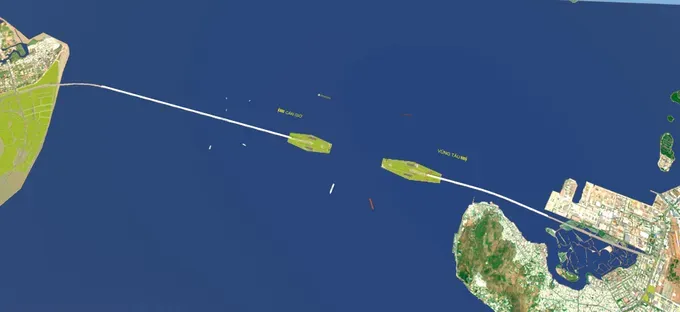
On May 20, the Office of the Ho Chi Minh City People’s Committee issued a notice conveying the conclusion of Vice Chairman of the municipal People’s Committee Nguyen Cong Vinh regarding the progress of the Can Gio – Vung Tau infrastructure connection project, implemented under the public–private partnership (PPP) model with a build–transfer (BT) contract.
According to the conclusion, this is a large-scale project requiring high technical standards and holding particular significance for the inter-regional transport infrastructure development strategy of Ho Chi Minh City. Therefore, relevant departments and agencies have been instructed to mobilize maximum resources and proactively coordinate closely to complete all dossiers and procedures for submission to the city’s People’s Council for consideration in the first week of June 2026.
The Ho Chi Minh City People’s Committee has assigned the Department of Planning and Architecture to urgently provide written opinions on the adjustment and supplementation of the planning for the sea-crossing road connecting Can Gio and Vung Tau. The department is also tasked with guiding relevant localities in completing revisions to subdivision plans affected by the project.
In addition, it is required to review and provide guidance on adjustments to the planning of three land parcels proposed for use as payment under the BT (build–transfer) contract, ensuring consistency with the master plan and improving the efficiency of land fund utilization.
The Department of Agriculture and Environment has been requested to promptly provide its assessment on the conditions and valuation of the land fund expected to be used as counterpart payment for the project’s BT contract.
For the Department of Finance, the Ho Chi Minh City People’s Committee has requested a comprehensive review of the project scale and the state budget capital contribution (if any), as well as a study of relevant opinions issued by the Ministry of Finance regarding financial mechanisms and investment arrangements.
The department is also tasked with monitoring and expediting the implementation progress of relevant units and promptly reporting to the City People’s Committee for the timely resolution of any emerging difficulties or obstacles.
In addition, the Department of Finance is required to urgently develop a detailed implementation plan for the project. This plan must clearly define specific tasks, lead agencies, timelines, and deliverables for each assignment, ensuring compliance with the city’s directive on the project’s commencement schedule.
The Ho Chi Minh City People’s Committee has requested the Ho Chi Minh City Department of Public Security to continue coordinating with the Ministry of Public Security to promptly provide professional opinions on matters within the sector’s management scope related to the project.
Regarding implementation arrangements, the City People’s Committee has instructed relevant departments and agencies to proactively develop detailed plans and scenarios for each phase following approval of the investment policy by the Ho Chi Minh City People’s Council. These plans must clearly define key milestones for each stage to ensure synchronized and continuous implementation, without delays in the project schedule.
The Ho Chi Minh City People’s Committee has also noted that the organization of the architectural design competition shall only be carried out after the investor selection process has been completed in accordance with regulations.
For interchanges and landmark structures, authorities are required to carefully study design solutions to ensure a balance between functionality, aesthetics, and symbolic value.
Relevant units have also been tasked with proactively preparing necessary conditions for the project’s groundbreaking ceremony to be held on schedule. At the same time, they are to consider the feasibility of early implementation of certain components—such as land clearance and leveling, transport connectivity, and other preparatory technical works—in compliance with applicable legal regulations.


)