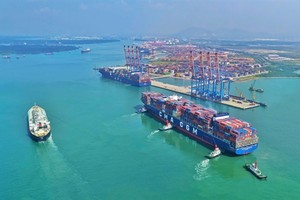
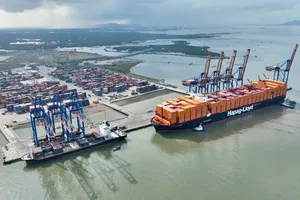
In the first weeks of 2026, the Cai Mep - Thi Vai port cluster in Ho Chi Minh City recorded positive growth as ships continuously sailed abroad, or directly to Europe and both sides of the US. This positive trend continues as many strategic infrastructure projects are nearing completion, attracting more cargo areas and major shipping lines.
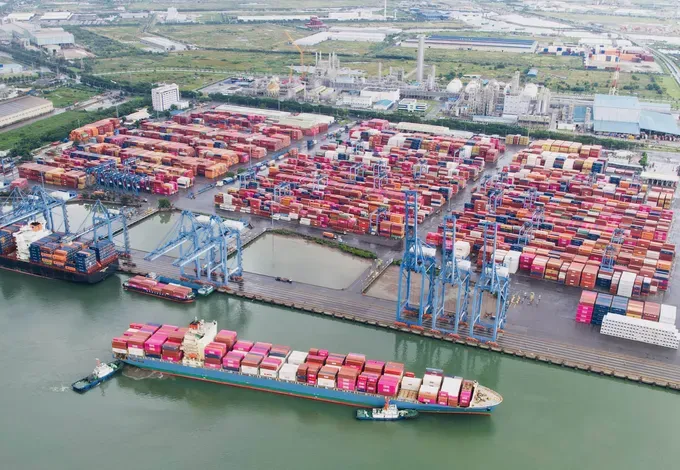
As reported by the Vietnam Port Association (VPA), in January 2026, the mainline container throughput at Cai Mep port amounted to 711,429 TEU, reflecting a 9 percent increase compared to the same timeframe in 2025. The growth was primarily observed at key berths, which significantly contributed to the overall performance of the port cluster; for instance, Gemalink achieved 198,905 TEU, marking a 24 percent increase; Cai Mep International Terminal Company (CMIT) recorded 114,635 TEU, representing a 26 percent increase; and SSIT reached 98,617 TEU, indicating a 15 percent increase.
The Cai Mep - Thi Vai port complex currently extends over approximately 20 kilometers and consists of around 35 operational berths, which include container ports, general cargo ports, bulk cargo ports, and specialized ports. Approximately 20 units or joint ventures are directly engaged in operations. This complex serves as a central hub for significant container handling units, fulfilling a crucial role as Vietnam's primary international trade gateway. The leading entity in market share is Saigon Newport Corporation (SNP), which manages two container ports such as Tan Cang - Cai Mep International Port (TCIT - a joint venture with Mitsui O.S.K. Lines, Wan Hai, and Hanjin) and Tan Cang - Cai Mep Thi Vai Port (TCTT). The total volume of container cargo processed through the complex is anticipated to surpass 10.8 million TEU in 2024 and approach nearly 13 million TEU in 2025.
Currently, major global shipping lines such as Maersk, MSC, CMA CGM, Hapag-Lloyd, ONE, and ZIM maintain direct routes at the Cai Mep - Thi Vai port cluster with 48 international container routes per week, including more than 20 routes with mother vessels going directly to Europe and both sides of the US.
Cao Hong Phong, Deputy General Director of Gemalink, said that Gemalink is one of 19 large seaports in the world capable of receiving vessels of 24,000 TEU. After 5 years of operation, the port has achieved a total throughput of 6.5 million TEU; in 2026 alone, it is expected to reach 2.1 million TEU.
These achievements are the result of the ports' efforts to "modernize" themselves to compete with other ports in the region. Ms. Le Thi Ngoc Dung, Deputy General Director and Business Director of CMIT, emphasized that despite the high volume of goods, the port has ensured smooth cargo flow, preventing congestion at berths and maintaining stable service quality for trans-Pacific and Asia-Europe shipping routes. Meanwhile, Mr. Truong Tan Loc, Chairman of the Board of Directors of TCIT, stated that the port has proactively expanded its hinterland connections with the ICD system and satellite yards, promoted the digitalization of processes, shortened handling times, reduced yard pressure, and contributed to maintaining stable growth.
Deputy Minister of Construction Nguyen Xuan Sang stated that the unique advantage of the Cai Mep - Thi Vai port cluster lies in its deep-water port system, with channel depths ranging from -14m to -15.5m. This allows for the accommodation of container ships exceeding 200,000 DWT (in practice, ships of up to 234,000 DWT have already been received), including the latest generation of mother ships. In terms of long-term vision, the early implementation of the Cai Mep - Thi Vai port planning will not only significantly contribute to the growth of Ho Chi Minh City specifically and the southern key economic region generally, but it will also foster the development of a modern port-industrial-logistics ecosystem capable of competing with major transshipment hubs in the region.
Infrastructure boost
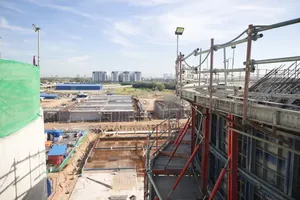
The Cai Mep - Thi Vai port cluster currently handles a large volume of goods being consolidated and unloaded in waterway transport. The role of the port cluster will become even stronger when the connecting infrastructure is completed. This includes Phuoc An Bridge, scheduled for completion in 2027, connecting Phu My Ward of Ho Chi Minh City with Phuoc An Commune of Dong Nai Province.
This is a crucial link connecting the Cai Mep - Thi Vai port cluster with the Ben Luc - Long Thanh expressway. Goods from the Mekong Delta will be able to go directly to the port without having to detour via the overloaded National Highway 51.
In particular, the Bien Hoa - Vung Tau expressway, expected to be completed in the second quarter of this year, will be a lifeline connecting industrial zones in Dong Nai Province and Ho Chi Minh City with the port cluster. Transporting goods from Bien Hoa to the port cluster will be cut from two hours to just 45–60 minutes. The completion of these infrastructure projects will shorten transportation times, reduce logistics costs, and enhance the competitiveness of national goods.
Speaking about the development potential of the port system in the eastern part of Ho Chi Minh City, Pham Anh Tuan, General Director of Portcoast Consulting and Design Joint Stock Company, assessed the potential of Cai Mep - Thi Vai as very large, both in terms of its strategic location, planning scale, and ability to adapt to the trend of smart port development in the digital age.
Concerning the planning aspect, the Cai Mep Ha region is structured in a "comb" configuration, facilitating the incorporation of nearly 18 kilometers of new container berths, which will enhance capacity by around 40 million TEU. The comprehensive plan is developed using a digital model, enabling the simulation of operational processes, traffic management, and incident response, thereby enhancing the management efficiency and competitiveness of the port cluster.