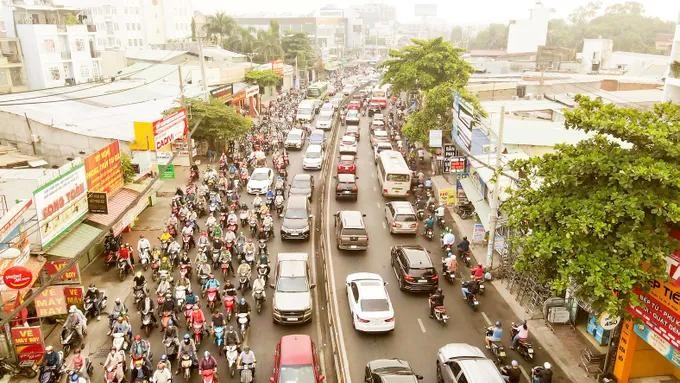
National Highway 13 is 6km long, but the road surface is narrow and traffic is heavy. For many years, residents have complained about frequent traffic jams and flooding on this section of road. The government has also planned to expand and upgrade the road, and the procedures are being expedited by relevant agencies.
A decades-long bottleneck
The prolonged traffic congestion on National Highway 13, from Binh Trieu Bridge to Binh Phuoc intersection, has been a long-standing bottleneck, especially during peak hours. Meanwhile, this is a vital transportation route connecting Ho Chi Minh City to the Central Highlands – a strong growth hub in the South. Since 2002, Ho Chi Minh City had a plan to upgrade this highway from 32m to 53m.
However, due to funding limitations, the project could not be implemented. By 2005, the BOT (Build-Operate-Transfer) investment model was proposed, but it also stalled due to high land compensation costs. In subsequent years, many options were studied, including expanding the route to 8-10 lanes and constructing multi-level interchanges. Several private enterprises also proposed participating in BOT investment, but the issue of toll booth placement and the ability to recoup investment proved to be major obstacles.
In 2017, the National Assembly Standing Committee issued Resolution 437, requiring a temporary suspension of the BOT model on existing roads. Therefore, the plan to expand National Highway 13 shifted to using the state budget. Two years later, the project was calculated with a total investment of nearly VND10 trillion (US$378.86 million), to be implemented from 2019-2023.
Subsequently, in September 2023, the city approved the investment plan for expansion; simultaneously, to ensure a shorter project lifecycle and attract investors, the consulting unit proposed a 70 percent budget contribution (land acquisition), with 30 percent from investors. Construction costs would be covered under a BOT or public-private partnership (PPP) model.
HCMC advances National Highway 13 expansion with feasibility report submitted
Recently, in an interview with a reporter from SGGP Newspaper regarding the upgrade and expansion project of National Highway 13, a representative from the Ho Chi Minh City Department of Construction stated that they have completed the submission for appraisal of the feasibility study report for component 2 and submitted it to the City People's Committee for consideration and approval.
The project is divided into two components. Component 1, concerning compensation, support, and resettlement, uses 100 percent budget funding, with a total cost of over VND14,600 billion. To date, the surveying, counting, and legal verification work has been basically completed, and compensation payments are expected to be made in the near future to facilitate project implementation. Component project 2 involves upgrading and expanding the road with a total investment of approximately VND6,300 billion, mobilized by the investor.
According to the preliminary financial plan, the toll collection period for capital recovery is expected to be approximately 18 years and 6 months, and this may be adjusted after auditing.
According to the plan, after the investment plan is approved, the City's Project Management Board for Investment and Construction of Transportation Works will issue tender documents on the national bidding network to select an investor under the public-private partnership (PPP) model, BOT contract. The bidding and investor selection process is expected to be completed in the second quarter of 2026. "The project will commence in the fourth quarter of 2026 and be completed in 2028," a representative from the Department of Construction stated.
According to Director Pham Minh Hai of the Transport Development Consulting Center under the Ministry of Construction, National Highway 13 serves as a critical transport corridor, particularly along the route connecting central Saigon Ward to Binh Duong Ward, Ho Chi Minh City, where numerous industrial zones and new urban areas are concentrated. If the project continues under conventional procedures, it risks being prolonged for many years, potentially slowing the region’s overall socio-economic development.
Proposing a faster path forward, Director Pham Minh Hai of the Transport Development Consulting Center, said applying a special emergency mechanism to the National Highway 13 expansion project would be appropriate given the sustained strain on regional transport infrastructure.
He noted that such a mechanism could streamline key procedures, including project approval, land clearance, and contractor selection, thereby accelerating construction and enabling the project to become operational sooner.
According to the plan, the expansion project of National Highway 13 will upgrade the existing 4-6 lanes to 10-14 lanes, with a width of approximately 60 meters. The highlight of the project is a viaduct section that is about 3.5 kilometers long, featuring 4 lanes with a design speed of 80 km/h; on either side, there will be parallel roads with 8-10 lanes, designed for a speed of 60 km/h. The route will include 10 intersection points, comprising 2 grade-separated interchanges and 8 at-grade intersections, along with pedestrian bridges, drainage systems, lighting, and greenery.