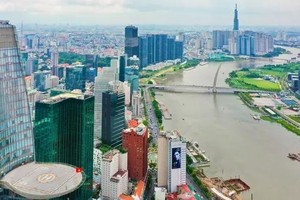
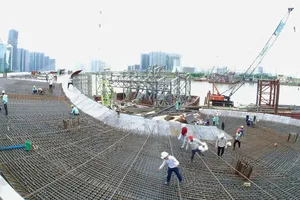
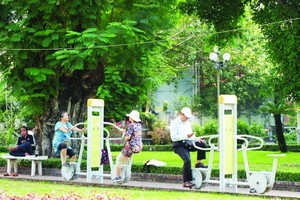
Recently, social media has seen the spread of misleading claims about Ho Chi Minh City's policy of limiting the development of new high-rise apartment buildings in the city's central core.
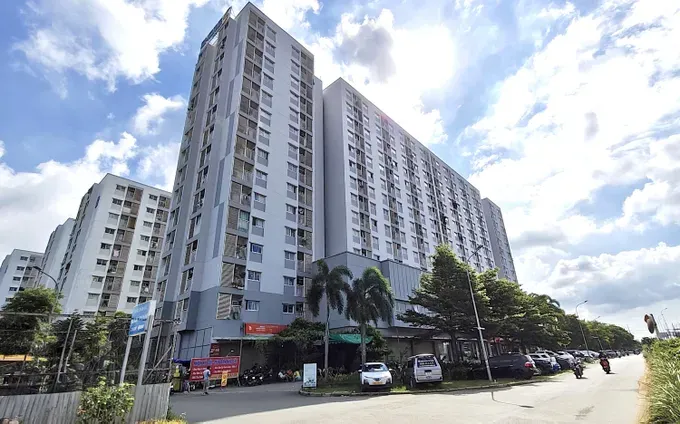
These claims distort the facts and are entirely inconsistent with the Ho Chi Minh City Master Plan to 2040, with a vision to 2060, approved by the prime minister.
HCMC addresses urban space management
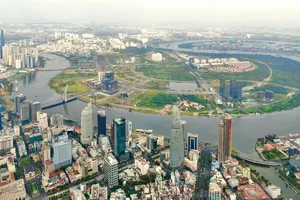
According to Director Truong Trung Kien of the Ho Chi Minh City Department of Planning and Architecture, the city's master plan envisions Ho Chi Minh City developing under a multi-center urban model. Under the plan, the existing central area will remain the city's historic, administrative, commercial, service, cultural and tourism core.
Within this central core, the city will prioritize urban renewal, redevelopment, preservation of architectural heritage, and the expansion of green spaces and public areas. A key objective is to keep population growth in line with the capacity of technical and social infrastructure.
Against this backdrop, the policy of limiting additional high-rise apartment developments in the central core must be viewed within the broader planning framework. The primary objective is to reduce pressure on transport networks, schools, hospitals and other social infrastructure that are already operating beyond capacity. One example is the city's decision to cancel investment plans for the Nha Rong-Khanh Hoi Complex and instead develop a public park and Ho Chi Minh Cultural Space, reflecting its commitment to improving residents' quality of life.
Vu Son, an expert at the Institute for Regional Development Research under the University of Economics Ho Chi Minh City, said it is important to distinguish between urban spatial planning and housing supply.
According to expert Vu Son, city leaders have emphasized that limiting additional high-rise apartment projects in the central core is an urban planning measure designed to achieve a more balanced population distribution. It is not a policy to restrict housing development or to "force workers out of the city," as claimed in false information circulating online.
Experts urge integrated infrastructure to support housing development
Experts also said limiting high-rise apartment buildings in the central core will not reduce the city's overall housing supply. According to the director of the Ho Chi Minh City Department of Planning and Architecture, high-rise residential projects and rental housing will instead be prioritized in areas with adequate infrastructure, including new urban centers, transit-oriented development (TOD) areas, corridors along metro lines, public transport routes and other locations with development potential.
Director Truong Trung Kien said claims that the city is "forcing workers to relocate" are entirely unfounded. On the contrary, the city is expanding development under its multi-center model while prioritizing social housing, rental housing and urban areas connected to public transport.
The strategy is intended to create more opportunities for residents to access affordable housing while reducing pressure on the central core. The city's objective is to achieve a more balanced population distribution across the metropolitan area, rather than pushing workers farther away from the city center.
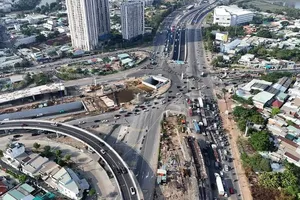
In recent years, numerous housing projects have been launched along Metro Line 1, National Highway 13, Ring Road 3, Ring Road 4 and other major transport corridors. Investment in social infrastructure has also accelerated.
In the healthcare sector, a series of large-scale hospitals has been built or is under construction. The network of specialized healthcare services is also being expanded under a multi-center model through cooperation between leading hospitals and medical facilities in gateway areas and satellite urban centers. In education, many new schools have also been built.
Nguyen Thi Thanh Thuan, a resident of Di An Ward who commutes daily on Metro Line 1 to work on Vo Van Tan Street in Xuan Hoa Ward, said buying a home farther from the city center has given her family a larger living space at an affordable cost, while public transportation has made commuting convenient.
Huynh Thanh Dien, an economist, said homebuyers' preferences are also changing significantly. Instead of concentrating in the densely populated urban core, more people are choosing well-planned areas with convenient access to metro lines and expressways, a better living environment and more affordable housing.
Under Decision No. 6708/QD-UBND issued by the Ho Chi Minh City People's Committee approving the 1:2,000-scale zoning plan for the city's existing central area covering 930 hectares, Ho Chi Minh City will limit population growth in the central area and appropriately rebalance high-rise development within the existing urban core.