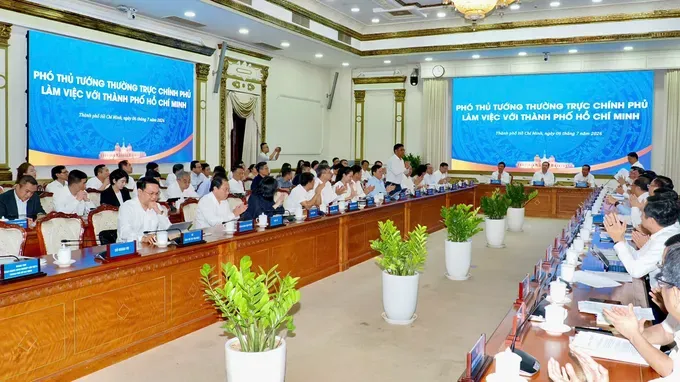
Also attending the meeting were leaders of the Government Office and deputy ministers from the Ministries of Finance; Industry and Trade; Agriculture and Environment; Construction; and Justice.
Representing Ho Chi Minh City were Chairman of the Ho Chi Minh City People's Committee Nguyen Van Duoc, Chairman of the Ho Chi Minh City People's Council Vo Van Minh, and Vice Chairmen of the Ho Chi Minh City People's Committee Nguyen Manh Cuong, Hoang Nguyen Dinh, and Nguyen Cong Vinh.
At the working session, Standing Deputy Prime Minister Pham Gia Tuc congratulated Ho Chi Minh City on its achievements during the first six months of 2026. He emphasized that, contributing approximately 24 percent of the country's GDP, Ho Chi Minh City plays an exceptionally important role in overall economic growth.
The Standing Deputy Prime Minister noted that while the city's growth rate is currently above the national average, it has yet to meet its target. He therefore called on the city to thoroughly analyze the underlying causes, accurately identify existing bottlenecks, and propose sufficiently robust solutions to achieve double-digit economic growth in 2026.
He also stressed that Ho Chi Minh City has a long-standing tradition of dynamism, innovation, and creativity and has consistently taken the lead in piloting new mechanisms and development models. In the new development phase, particularly following the administrative restructuring and expansion of its development space, the city needs to comprehensively assess the emerging requirements related to infrastructure, population, the environment, resource mobilization, and regional connectivity.
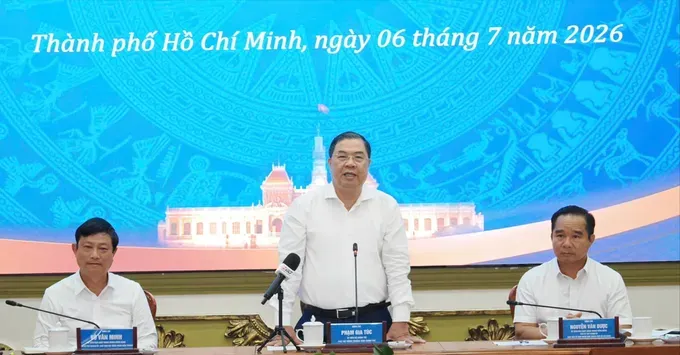
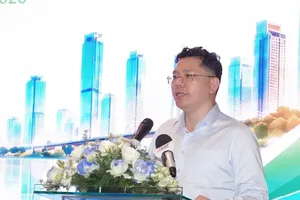
 "Chairman of the Ho Chi Minh City People's Committee Nguyen Van Duoc speaks at the working session with Ho Chi Minh City. (Photo: SGGP)")
At the working session, Chairman of the Ho Chi Minh City People's Committee Nguyen Van Duoc proposed that the central authorities allow the city to take the initiative in studying the development of an energy center in Long Son Commune, covering approximately 1,000 hectares. The proposed complex would include crude oil and LNG (Liquefied Natural Gas) storage facilities, processing plants, and supporting infrastructure to develop it into a national energy hub.
Ho Chi Minh City also called on the central authorities to provide support in attracting major investors to participate in the project. In addition, the city proposed being authorized to proactively review and handle land and property assets managed by central agencies but currently unused in order to make more effective use of land resources to support socio-economic development.
Regarding the agriculture and environment sector, Chairman of the Ho Chi Minh City People's Committee Nguyen Van Duoc said the city aims to renovate canal-side areas and relocate approximately 50 percent of houses along canals and waterways. This year alone, Ho Chi Minh City targets the relocation of about 40,000 houses—equivalent to roughly 10 percent of all canal-side homes—on the basis of securing public consensus.
According to the Ho Chi Minh City People's Committee, the canal-side housing renovation and relocation program requires an estimated VND150 trillion (US$5.7 billion). The city therefore proposed that the central authorities provide additional financial support, including climate change response funding, to complement the local budget and gradually resolve the long-standing issue of housing along canals and waterways.
Ho Chi Minh City also proposed that the central authorities address shortages of construction materials for key projects by facilitating the licensing of suitable material mines or allowing city-owned enterprises to participate in mineral extraction to ensure a stable supply. In addition, the city called on the central authorities to continue simplifying administrative procedures to facilitate project implementation for both local authorities and businesses.
Responding to the city's proposals, Standing Deputy Prime Minister Pham Gia Tuc urged Ho Chi Minh City to continue strengthening its role as the country's economic locomotive while aligning its development with the broader development of the region and the nation.
He emphasized that the city's proposals should be firmly grounded in practical needs, focused on key priorities, and supported by sufficient justification to enable the central authorities to consider and resolve them, thereby creating additional momentum for Ho Chi Minh City to accelerate growth in the remaining months of the year.




)