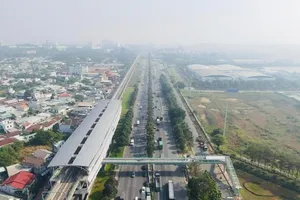
"An Phu Interchange, one of Ho Chi Minh City's key infrastructure projects (Photo: SGGP)")
On July 7, the Ho Chi Minh City Department of Construction announced that it had submitted a report to the Ministry of Construction on the supply and demand of common construction materials in the city, while proposing measures to address regulatory bottlenecks in mineral extraction to ensure adequate material supplies for key infrastructure projects.
According to the report, the city has proactively implemented a range of measures under the special mechanisms provided by the 2024 Law on Geology and Minerals, the 2025 Law amending and supplementing several provisions of the Law on Geology and Minerals, and the Government’s Resolution No. 66.4/2025/NQ-CP. These mechanisms have helped ease shortages of construction materials and facilitate faster implementation of numerous state-funded infrastructure projects.
Regarding construction stone, the city has licensed mining activities in three designated areas with total reserves of nearly 492,000 cubic meters. It has also approved higher production capacity at the Thuong Tan 3 and Nui So quarries, adding approximately 690,000 cubic meters of construction materials annually.
The city has also designated 13 construction stone mining areas exempt from auction procedures, with combined reserves of approximately 113.6 million cubic meters. Of these, four sites are expected to be directly allocated to strategic investors under a special regulatory mechanism.
Regarding construction sand, the Department of Agriculture and Environment is coordinating with the Ministry of Agriculture and Environment to designate a non-auction extraction zone at Dau Tieng Reservoir, containing an estimated 16 million cubic meters of sand for use in public investment projects.
As for fill material, the city has issued nine mining licenses and one mineral recovery license, covering total reserves of more than 70 million cubic meters. These resources are intended primarily to support the Can Gio Coastal Reclamation Urban Tourism Development Project.
Regarding fill soil, the city has designated 28 extraction areas with combined reserves of nearly 5 million cubic meters. It has licensed mining operations at eight sites, providing approximately 1.35 million cubic meters of material for major infrastructure projects, including the Ho Chi Minh City Ring Road 3, the Ho Chi Minh City–Thu Dau Mot–Chon Thanh Expressway, the Vung Tau–Binh Thuan Coastal Road, and several other transport projects. Another eight mining applications, with estimated reserves totaling 2.26 million cubic meters, are currently under review.
According to the Department of Construction, these special mechanisms have enabled the city to proactively secure construction material supplies at an early stage, streamline administrative procedures, accelerate public investment disbursement, and ensure a stable supply of materials for key infrastructure projects.
However, the implementation process has encountered a number of challenges. Many businesses have been reluctant to make use of the special mechanisms because the extracted materials are permitted only for state-funded projects and cannot be sold commercially.
At the same time, mining operations generate a wide range of material products, while infrastructure projects typically require only certain types, leaving surplus materials that are difficult to utilize or market.
In addition, some project developers have yet to proactively coordinate with mining companies to register their material requirements, reducing the overall effectiveness of the policy.
In light of these challenges, Ho Chi Minh City has urged the Ministry of Construction to consider allowing surplus materials that are not fully utilized by public investment projects to be sold commercially or reallocated to other key infrastructure projects. The city also called for streamlined procedures covering mineral resources, land, environmental, and investment approvals to shorten project preparation timelines.
The city further proposed the introduction of a special regulatory mechanism for sand extraction from reservoirs, irrigation lakes, and dredging areas with exploitable potential, with the aim of expanding material supplies to meet the growing demand of upcoming infrastructure projects.