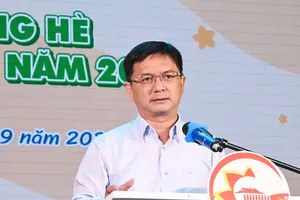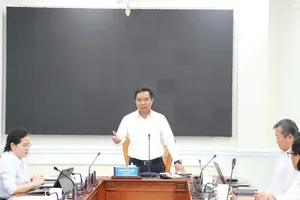
Chairman of the HCMC People’s Committee Nguyen Van Duoc commented that after more than half the journey of implementing Resolution 98, HCMC has achieved certain results. However, in the new development space, some mechanisms and policies are no longer suitable and need to be expanded to create better momentum for the city’s investment environment and service development.
Therefore, HCMC has painstakingly researched and proposed that the Central Government amend and supplement breakthrough mechanisms. The city only asks for mechanisms, not money, and is ready to be a pilot site, a “laboratory” for new policies, particularly economic development models.
The draft resolution presented to the National Assembly (NA) is the fruitful result of decisive leadership from the Party Central Committee, NA, and Government, alongside HCMC’s focus on this critical task. If approved today, the amended Resolution 98 will be a powerful tool for the city to achieve outstanding development in the coming time.
In the next phase, the city will restructure its development space towards a “multi-polar – integrated – connected” direction. This involves completing the task of establishing and adjusting the city’s master plan in 2026, adhering to the orientation of forming “3 Regions – 1 Special Zone – 3 Corridors – 5 Drivers” to leverage regional strengths. For this task, the amended Resolution 98 contains crucial content of decentralizing authority to the HCMC People’s Committee to establish and adjust the general city planning.
With this mechanism, the city is determined to complete the master plan in 2026 to attract investment and contribute to expected growth. HCMC leadership also commits to ensuring that immediately upon NA approval, the city will deploy these measures to create breakthrough development steps.
NA Delegate Nguyen Hai Dung from Ninh Binh Province agrees with the amendments and supplements to Resolution 98, which aim to resolve bottlenecks, accelerate investment speed, and empower the city.
Notably, establishing a strict legal framework for the HCMC Free Trade Zone (FTZ) will help operate it effectively, creating new momentum. Therefore, it is necessary to empower the city to execute procedures for establishing, expanding, and adjusting FTZ boundaries, and to allow land allocation/leasing without auction or bidding for investment projects within the zone (excluding commercial projects) to accelerate infrastructure development.
NA Delegate Ha Sy Dong from Quang Tri Province also showed his support to the amended Resolution 98. In addition, he stressed that it must be done with focus, targeting mechanisms that truly create development momentum. Among these, the Transit-Oriented Development (TOD) policy is a vital breakthrough. Allowing the city to decide on mixed-use construction investment (housing, commercial services, public works) directly on traffic land and stations is an open policy that can effectively exploit land values.
However, amendments must ensure substance and prevent policy risks or loopholes for group interests. He therefore proposes the Government evaluate thoroughly, separate land types, and build a specific technical standard set for the TOD model. The TOD mechanism should never become a shield for easy conversion of public land into residential land.
Talking about the future of HCMC, Chairman Johnathan Hanh Nguyen of Imex Pan Pacific Group (IPPG) focused on building “seeds” for a green FTZ model. HCMC’s planning of 4 FTZs in the communes of Can Gio, An Binh, Bau Bang, and Cai Mep Ha demonstrates vision, aiming to form a green logistics corridor aligning with global economic trends. He expects the new Resolution 98 to provide a legal framework strong enough to operate FTZs at international standards.
The key condition is allowing the city to apply mechanisms exceeding standard frameworks regarding tax, customs, investment, and land; exempting tax for goods within the FTZ; and building a unified electronic service portal. Granting superior mechanisms for HCMC to effectively implement this breakthrough model will significantly contribute to integrating Vietnam into the global value chain.
However, simultaneously deploying all 4 FTZs may disperse resources. Therefore, the city should consider piloting 1-2 strategic FTZs, prioritizing Can Gio and Cai Mep Ha to create “seeds” for a green-digital-integrated FTZ model before replicating it after 2030, once the railway and Long Thanh International Airport are synchronously formed.