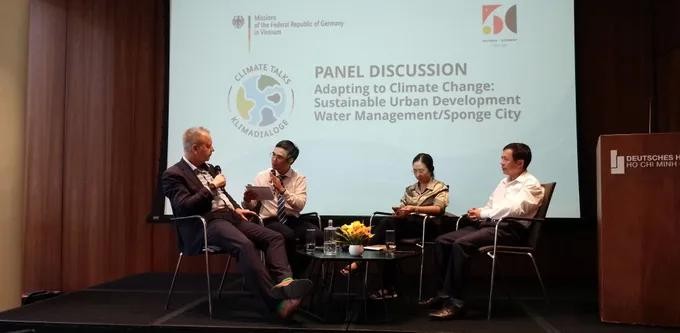
The German Consulate General in Ho Chi Minh City yesterday held a seminar titled “Adapting to Climate Change: Sustainable Urban Development; Water Management/Sponge City” featuring the participation of experts from both Germany and Vietnam.
At the event, speakers provided an overview of the flooding situation in Ho Chi Minh City. Due to its location downstream of the Dong Nai–Saigon River system, the city faces multiple causes of inundation. The first cause is heavy rainfall. The number of large rain events causing widespread flooding (over 60mm) has increased sharply, averaging 3.6 events per year compared to just 1.5 before 2009. Rainfall volume has also risen significantly, with an annual increase of 22mm.
The second factor is tidal flooding and sea-level rise resulting from climate change. River and canal water levels are rising at a rate of 1.5cm per year. The frequency of high tides exceeding alert levels has increased in Ho Chi Minh City, with several instances approaching or surpassing historic records particularly at the Phu An Station on the Saigon River.
Finally, there is a risk of flooding from river discharge. Along the Saigon River, flooding can occur when upstream reservoirs including Dau Tieng, Tri An release water exceeding 200 cubic meters per second during periods of high tide.
Currently, the city’s anti-flood infrastructure primarily covers central wards, including the left and right embankment systems of the Saigon River and tidal control sluices developed under Decision 1547/QD-TTg (2008), known as Plan 1547. Meanwhile, the drainage system under Decision 752/QD-TTg (2001), or Plan 752, has become outdated, as its design parameters no longer match current rainfall and water levels and do not account for climate change or sea-level rise.
To address flooding, Ho Chi Minh City is implementing a comprehensive strategy that combines both structural and non-structural measures. Based on current infrastructure conditions and flood-risk zoning, the city has formulated a “Four-Zone, Three-Layer” anti-flood strategy.
According to Pham Hoai Trung, Deputy Head of the Technical Infrastructure Planning Division of the Department of Urban Planning and Architecture of Ho Chi Minh City, the protection layer focuses on completing embankment systems and floodgates outlined in Plan 1547 to shield low-lying areas from tides and high water levels, with flood-protection elevations ranging from 2.5 to 3.2 meters. For areas outside the dike, the city plans to develop eco-urban zones capable of adapting to periodic flooding.
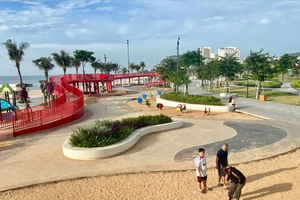
The adaptation layer includes nature-based and blue green infrastructure (BGI) solutions, along with the “Sponge City” concept introduced by German expert Frank Pogade, Managing Director of Water Solutions South-East Asia Company. These measures include retention ponds, riverfront parks with flood storage capacity, rain gardens, permeable pavements, and underground reservoirs.
Finally, the mitigation layer aims to minimize damage from extreme flooding events that exceed design standards through real-time flood risk warning systems. Additional solutions discussed included improving drainage capacity, applying new technologies, enhancing regional cooperation, and attracting investment through supportive policies.
Speaking at the seminar, German Consul General in Ho Chi Minh City Andrea Maria Suhl emphasized that like many rapidly developing urban centers, Ho Chi Minh City faces growing challenges from extreme weather and sea-level rise. She noted that “effective water management is not merely an environmental issue, it is fundamental to economic stability, public health, and overall quality of life in the city”.









)