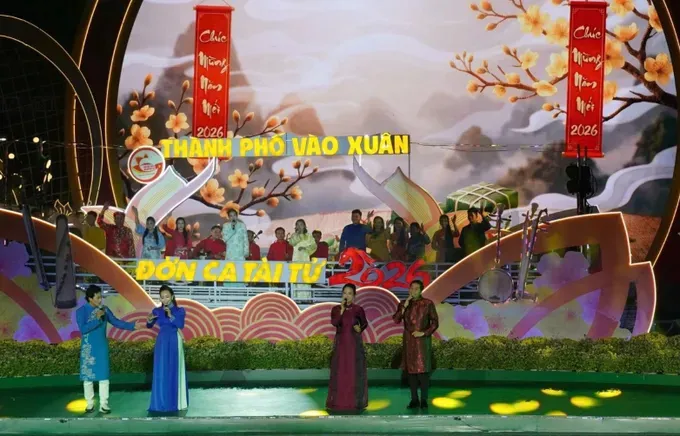
Ho Chi Minh City is finalizing two projects aimed at safeguarding intangible cultural heritage: one dedicated to Don ca tai tu (the Southern amateur music tradition), and another covering intangible cultural heritage elements included in the national inventory.
At a consultation session on the two projects organized by the municipal Department of Culture and Sports in late October 2026, artists, club leaders, and grassroots cultural officials highlighted challenges in preserving and promoting heritage values, including remuneration for instrumental instructors, stable venues, training successor generations, and standardized documentation.
A home for traditional music
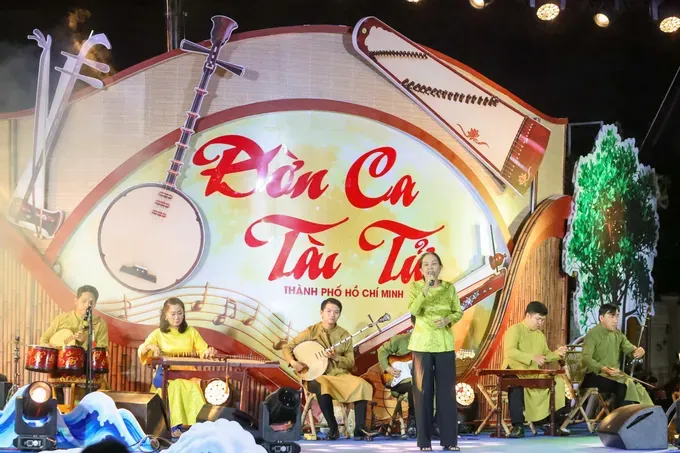
Following the merger of Binh Duong Province and Ba Ria-Vung Tau into Ho Chi Minh City, the city now has 282 Don ca tai tu clubs with 3,190 participants, including five People’s Artists and 26 Meritorious Artists. However, these figures do not fully reflect the difficulties threatening the survival of this traditional art form.
According to the Ho Chi Minh City Department of Culture and Sports, club membership is aging rapidly. The number of people capable of performing traditional repertoire has declined significantly, while artists proficient in instruments such as the two-string fiddle, moon lute, 16-string zither, and monochord are becoming increasingly scarce.
These concerns are evident across individual clubs. Artisan Thanh Huong of the Phu Lam Ward don ca tai tu Club said the club meets four times each month. At each gathering, members contribute about VND500,000 to pay two instrumental instructors. The sound system provided by the ward in 2001 has long since broken down, forcing the club to purchase a small portable speaker for rehearsals.
Similarly, artisan Thanh Liem of the Binh Trung Dong Ward don ca tai tu Club said conditions such as venues, sound systems, lighting, and utility services have improved. However, there remains no support policy for the cost of hiring instrumental instructors, leaving clubs dependent entirely on contributions from participants.
According to Associate Professor Nguyen Thi My Liem, Vice Chairwoman of the Ho Chi Minh City Music Association, the challenge stems from the nature of the art form itself.
“Training a performer of traditional instruments requires four to six years of intermediate-level study, followed by about four more years at university, while vocal training takes much less time. I know many students of traditional instruments who must perform at parties and even funerals to supplement their income. Under such circumstances, it is difficult to prevent the gradual decline in the sound of traditional instruments,” she said.
A reality facing don ca tai tu practice in Ho Chi Minh City is the shrinking availability of performance and training spaces. Ton That Can, Vice Chairman of the Ho Chi Minh City Theater Association, said instructional classes in Can Gio once attracted more than 200 students. However, after cultural centers were converted into Public Service Supply Centers, many clubs and community groups lost stable venues for their activities.
Director Le Dien, former director of the Southern Arts Theater and currently a specialist at the Ho Chi Minh City Union of Literary and Arts Associations, said many suburban clubs have suspended activities because of inadequate venues and funding. In some cases, club leaders have had to pay expenses out of their own pockets to keep operations running.
In addition, the training and transmission of Don ca tai tu face obstacles because there is still no unified curriculum or standardized set of materials to preserve the authentic essence of the heritage.
Meritorious Artist Huynh Khai, former head of the Faculty of Music at the Ho Chi Minh City Conservatory of Music, said the 20 foundational compositions are the soul of don ca tai tu and were standardized through recordings in 2013 and 2014.
Nguyen Minh Nhut, Deputy Director of the Ho Chi Minh City Department of Culture and Sports
Prioritizing resources to preserve heritage authenticity
The initiative is divided into two main areas. For heritage elements already recognized by UNESCO or the Ministry of Culture, Sports and Tourism, the department will review existing practices, standardize data and document rituals, repertoires and traditional practices. These measures aim to ensure consistency in preservation efforts and prevent the distortion of cultural heritage.
The city is also considering initial funding for newly established clubs, alongside annual operational support to help sustain their activities. At the same time, efforts are being made to address outstanding issues surrounding the eligibility timeline for artisans to receive official benefits.
For heritage elements that have yet to be formally recognized, the city will conduct an inventory covering the six categories stipulated in the Law on Cultural Heritage, including culinary knowledge. Don ca tai tu has been identified as a priority, serving as a model for targeted investment and broader preservation efforts.
The central objective is to protect the essential values of each heritage form while ensuring its appropriate promotion. Commercialization, in particular, must not come at the expense of authenticity or alter the heritage's original character.
HCMC prevents breaks in cultural transmission
The difficulties are not limited to Don ca tai tu. Challenges are also evident across many other forms of intangible cultural heritage. According to the draft project on the management, protection, and promotion of nationally recognized intangible cultural heritage in Ho Chi Minh City, the city currently has 15 heritage elements on the national inventory, distributed across 25 wards, four communes, and one special administrative area.
Some heritage elements, including Vovinam, lion-dragon-unicorn dance, and Tan Khanh Ba Tra martial arts, continue to attract young people. Others, however, such as the Khai Ha-Cau An Festival at the Tomb of Marshal Le Van Duyet, Tuong Binh Hiep lacquer craftsmanship, the Ba Phi Yen death anniversary ceremony, the Dinh Co Festival, and the Nghinh Ong Thang Tam Festival, are facing a shortage of younger practitioners.
Tan Khanh Ba Tra martial arts provides a clear example of the risk of losing original knowledge. Martial arts master Ho Tuong said the discipline originated in Binh Duong Province in the early 18th century and is now taught at nearly 70 locations across numerous provinces and cities.
However, elderly masters are gradually passing away. During the five years since the school was added to the national intangible cultural heritage inventory, practitioners have relied on mobile phone video recordings to preserve techniques and forms. Professional documentation and systematic scientific archiving have yet to be carried out.
According to martial arts master Ho Tuong, martial arts represent a form of knowledge embodied in the skills and experiences of practitioners. Heritage inventories therefore should not stop at recording names or participant numbers, but must also document techniques, procedures, routines, and the individuals who preserve this knowledge.
The Can Gio Nghinh Ong Festival is closely tied to the beliefs of coastal residents and the tradition of settlement and land reclamation. Although the festival is more than 113 years old and has been nationally recognized for over 13 years, a project to preserve and promote its value and to restore the Ong Thuy Tuong Tomb and Ba Shrine has yet to be implemented.
Even efforts to connect the festival with the Nghinh Ong Thang Tam Festival as part of a coastal tourism product chain have prompted experts to warn that traditional rituals and the community roles of each heritage holder must be preserved, as the two festivals still have many distinctive characteristics.
Another obstacle to preserving and promoting intangible cultural heritage values lies at the grassroots level.
Nguyen Ngoc Thach of the An Hoi Dong Ward Public Service Supply Center said the locality maintains three heritage forms, while the official responsible for cultural affairs must simultaneously oversee industry and trade, natural resources and environment, and tourism matters, making it difficult to closely monitor heritage activities.
A cultural official from Binh Hoa Ward added that unless project funding is allocated directly to Ward and Commune levels, local authorities will lack the resources needed for implementation. Under such circumstances, the target of developing three to five artisans each year is unlikely to be achievable.
These realities show that heritage preservation cannot rely solely on occasional performances or inventory statistics. Funding must reach the communities where heritage is actually practiced; instructors must receive appropriate compensation; stable venues must be secured; accurate reference materials must be provided; and coordination must be strengthened among the cultural sector, educational institutions, local governments, and professional associations.
When policies are shaped by the voices of the communities that safeguard heritage, these traditions will not merely remain names on an inventory but will continue to thrive within the contemporary life of the city.
At a time when don ca tai tu is struggling to attract new talent, introducing the art form to children and incorporating it into school programs is an important step toward nurturing the next generation of performers.
One notable example is the children's traditional amateur music club in Phu Nhuan, which has been running for 11 years thanks to the dedication of artists Le Tu and Ha Nhu. Similarly, classes led by People's Artisan Thanh Tuyet at Bui Thi Xuan High School and Nguyen Thai Hoc Primary School have been held for more than a decade, helping pass this traditional art form on to younger generations.