Unique data source
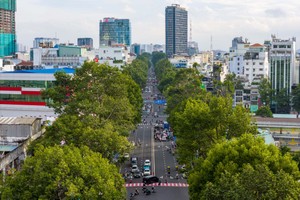
As almost six decades have slipped by, a multitude of war remnants have been buried beneath the relentless march of time and urban sprawl. However, in the minds of the eyewitnesses, the haunting images of mass graves and the lingering subterranean traces haven’t faded in the slightest. It’s exactly these enduring memories that serve as a uniquely vital data source, effectively helping to stitch back together a crucial segment of the nation’s historical truth.
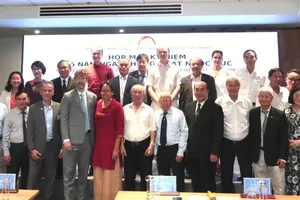
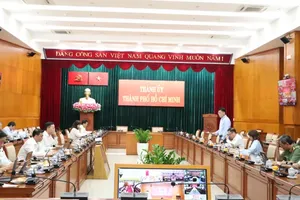
The National Steering Committee for the Search, Recovery and Identification of Martyrs’ Remains (Steering Committee 515) and the Ho Chi Minh City People's Committee on June 8 jointly held a conference to verify and assess information concerning martyrs and martyrs' graves in the area of the former Chi Hoa–Cho Quan Cemetery, now the site of Le Thi Rieng Park.
The conference was chaired by Deputy Prime Minister Pham Thi Thanh Tra, who also serves as head of Steering Committee 515; Nguyen Van Gau, Deputy Minister of National Defence and Deputy Head of Steering Committee 515, and Nguyen Van Duoc, Chairman of the Ho Chi Minh City People's Committee.
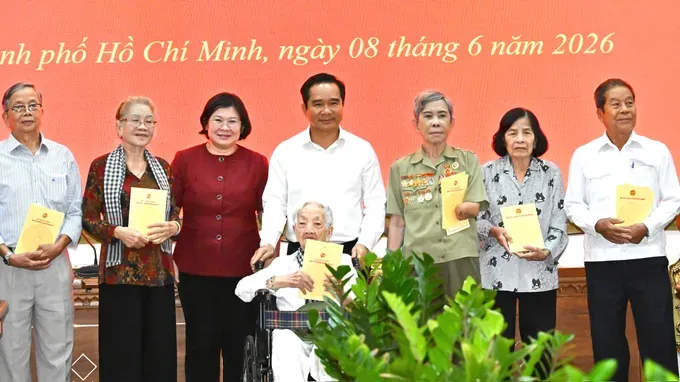
Among seminar attendees, HCMC resident Phan Van Mua stands out as a proactive eyewitness assisting efforts to pinpoint the mass grave’s exact location. He mentioned being entirely familiar with this area since childhood. Between 1972 and 1973, while at Do Thanh Cemetery, he heard elders recount that numerous individuals were buried next to a water pit. That stark image has been deeply etched into his memory.
Drawing from firsthand experiences and archives, he firmly believes this was a centralized burial site for countless soldiers who died during the 1968 Tet Offensive. Mr. Mua recounted that within the vicinity, locals previously unearthed human bones alongside tattered clothing, ammunition belts, rubber sandals, and a hand grenade. These grim remnants starkly indicate that this isn’t a run-of-the-mill burial plot.
He personally helped to collect and meticulously clean the discovered remains, saying that “through this, we can actively contribute to the search and ultimately bring these heroes and martyrs back to their comrades and families.”
Mr. Nguyen Thanh Phuoc is also one of the very few surviving eyewitnesses who directly observed the mass burial of fallen soldiers at Chi Hoa Cemetery. Born in the Bac Hai area, he was merely 12 when he witnessed the grim interment. Later, he dedicated over 20 years to Le Thi Rieng Park, working from Captain of the Greenery Squad to the organization department until retirement.
“The engineering corps excavated three massive pits, but only utilized two,” Mr. Phuoc recalled. “Bodies were transported via trucks and fire engines, subsequently laid to rest in heavily stacked layers.”
According to Mr. Phuoc, during the 1983 clearance of Chi Hoa Cemetery, only graves boasting tombstones or physical mounds were exhumed. It appears the mass grave area had already been entirely leveled off, leaving it completely untouched. Zoning off the precise perimeter desperately needs anchoring to surviving topographical landmarks, such as the Bac Hai Residential Area’s water tower and the old morgue. These are crucial reference points to systematically pinpoint the exact zone slated for rigorous surveying and excavation.
The seminar also featured American veteran Robert Ambrose Connor, who witnessed fierce firefights during the 1968 Tet Offensive near Bien Hoa Airbase. He expressed profound emotion over Vietnam’s modern development and relentless national efforts to search for and repatriate martyrs. According to Connor, despite the passage of time, underground remnants have not vanished and can be detected using advanced scientific methods. He remains confident this grueling operation will yield fruitful results.
Responsibility and moral duty
Vice Chairman Nguyen Manh Cuong of the HCMC People’s Committee firmly asserted that for the city, determinedly repatriating martyrs’ remains is a critical political mandate and a profoundly sacred responsibility embodying the moral belief of “He who drinks from the well should remember the digger.”
HCMC will focus on finalizing legal procedures and meticulously prepping conditions to seamlessly facilitate surveying, probing, and excavation in accordance with prevailing regulations. The city is providing optimal conditions regarding site clearance, logistical infrastructure, specialized equipment, and robust funding to propel the sweeping mission.
“HCMC explicitly commits to inter-agency coordination and aggressively mobilizing resources to successfully wrap up locating martyrs’ remains at Le Thi Rieng Park, fulfilling the aspirations of grieving families,” Vice Chairman Nguyen Manh Cuong stated.
Deputy Prime Minister Pham Thi Thanh Tra evaluated that archival materials, US declassified aerial shots, field surveys, and eyewitness accounts collectively forged a highly objective data ecosystem. These independent information streams highlight striking consistencies regarding the exact location and mass burial of soldiers who perished during the 1968 Tet Offensive. This provides a formidable foundation to assert with high reliability the existence of a mass martyr grave within Le Thi Rieng Park, kicking off sanctioned excavations.
“This is a phenomenally consequential breakthrough after nearly six decades; it’s the sheer byproduct of unwavering perseverance and profound gratitude towards those who fell,” she articulated.
The Deputy prime Minister demanded authorities heavily focus on pinpointing the grave’s exact coordinates. They must orchestrate massive surveys, excavations, remains repatriation, and DNA forensics to identify the martyrs, incrementally bringing these heroes back to their loved ones. This endeavor must inextricably fuse archived documents and tactical maps with cutting-edge methods, relentlessly exploiting breakthroughs in applied physics and digital tech to accurately lock onto the site.
Furthermore, she warned the mission must be executed with blazing urgency, yet remain thorough and cautious, guaranteeing strict search requirements while keeping disruptive fallout on surrounding residents to an absolute minimum. Every single maneuver must be grounded in unwavering responsibility and deep gratitude.
Deputy Prime Minister Pham Thi Thanh Tra explicitly tasked the HCMC People’s Committee with urgently taking the helm to draft a sweeping master plan for the subsequent phases, strictly dictating that the entire operational blueprint must be finalized incredibly soon to kick off the massive excavation by early July 2026 at the absolute latest, perfectly aligning with the 79th anniversary of War Invalids and Martyrs Day.
Leveraging technology to hunt down subterranean traces
Evaluating the research dossier, Colonel Dr Bui Yen Tinh, Deputy Director of the Operations Department under the General Staff of the Vietnam People’s Army, noted the team fiercely gathered materials like historical aerial photographs and tactical maps. They deployed diverse methods, establishing the rigorous analysis of aerial shots as their core operational tactic.
According to Colonel Tinh, coupled with decoding coordinate systems to successfully narrow the search perimeter and definitively pinpoint the mass grave, cross-referencing wartime aerial and satellite imagery against topographic maps and archives is a highly scientific and reliable methodology.
To bolster the survey phase, he recommended bringing in Ground Penetrating Radar to deeply probe geological strata, prioritizing non-destructive methods before heavy-duty excavation.
The martyr search journey by numbers
- 930,000 martyrs’ remains searched for and successfully repatriated nationwide between 1975 and 2012;
- Over 22,000 remains seamlessly gathered from 2013 to the present day;
- Initial breakthroughs from the “500 Days and Nights of Aggressively Ramping Up the Search, Repatriation, and Identification of Martyrs’ Remains” campaign successfully yielding 1,682 remains definitively repatriated and accurately identified so far;
- Roughly 175,000 fallen heroes’ remains still tragically unaccounted for.

)