In the early days of 2026, while many residents of Ho Chi Minh City took advantage of the New Year break to rest, reunite, or travel, the atmosphere at several key transport construction sites remained vibrant and industrious.
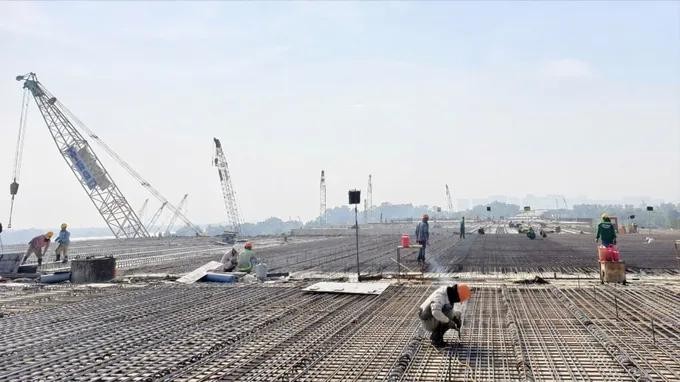
On the morning of January 2, at Package XL5 stretching through Truong Thanh and Hiep Binh wards, the installation of steel structures for the elevated section was being expedited. Massive steel bundles were hoisted into place precisely as designed.
Despite the intense pace, work was organized methodically, adhering strictly to technical and safety protocols. Engineers stationed on-site continuously inspected each component, preparing for the critical concrete pouring phase, which will determine both the quality and overall progress of the package. Representatives from the XL5 Project Management Board emphasized that completing the elevated steel structure ahead of schedule is essential to enable subsequent phases to proceed simultaneously and shorten construction time during the upcoming peak period.
At the “non-sleeping” construction site
The An Phu traffic interchange has become one of the city’s “non-sleeping” sites during this New Year holiday. At the underground tunnel areas where precision and concentration are paramount, engineer Nguyen Thanh Dat noted that subsurface works are technically complex and cannot be delayed for long; whenever weather and ground conditions permit, teams work continuously.
Construction worker Tran Van Tuan, who is part of the tunnel team, shared that tunnel work demands constant focus. “If the conditions are right, we start immediately—holiday or not. Meeting the project deadline is both our duty and our pride. When we drive through here in the future, we’ll know we helped build it. That’s meaningful,” he said.
According to Le Ngoc Hung, Deputy Director of the Ho Chi Minh City Transport Construction Investment Project Management Board, the agency is overseeing two component projects. The first spans 47.3 kilometers—14.7 kilometers through the former Thu Duc area and 32.6 kilometers through Cu Chi, Hoc Mon, and Binh Chanh areas. The project features a four-lane expressway with total investment exceeding VND22.4 trillion.
The Deputy Director outlined key milestones, explaining that by April 30, the entire elevated section in the Thu Duc area and the main expressway section through Cu Chi, Hoc Mon, and Binh Chanh are expected to open for technical traffic. Full completion including parallel roads his scheduled for June 30 this year.
To date, the ten main construction packages have achieved approximately VND11.645 trillion in realized value, or about 70.1 percent of total construction volume. The Thu Duc section alone has reached nearly 78 percent, while the Cu Chi–Hoc Mon–Binh Chanh segment is at roughly 62 percent.
At the An Phu interchange, many key components have been completed and are already in operation, delivering noticeable improvements in traffic flow. Ba Dat Bridge has reached 96 percent completion, with one branch opened alongside N2 Bridge on December 31, 2025. Giong Ong To Bridge is 95 percent complete, awaiting connection with other branches for synchronized traffic circulation.
Tunnel HC1-01 was finished and opened in June 2025, helping reduce congestion and improve traffic safety. N2 Bridge is nearly 99 percent complete and already serving the public. Meanwhile, other structures are advancing rapidly; for instance, Tunnel HC1-02 is about 84 percent finished and expected to open by the end of January 2026, while the N1.1 and N1.3 bridge branches are around 20 percent complete.
The An Phu interchange project is expected to be fully operational by the end of June 2026, marking another milestone in Ho Chi Minh City’s push to modernize its transport infrastructure.
For the Ring Road 3 project, contractors have mobilized a total of 194 construction teams, more than 2,400 engineers and workers, and 586 pieces of equipment and machinery of various types. The An Phu intersection project has approximately 300 workers and engineers and 80 pieces of equipment and machinery.
At the construction site of the Ho Chi Minh City Ring Road 3 project, the section in Dong Nai Province's Nhon Trach Commune, many machines, vehicles, and personnel are accelerating the construction progress of the parallel road sections, with some locations having basically completed the road surface.
According to the Dong Nai Provincial Investment and Construction Project Management Board, at component project 3 of the Ho Chi Minh City Ring Road 3 project, during the 4-day holiday, construction teams maintained approximately 130 pieces of equipment and machinery and nearly 300 engineers and workers, closely adhering to the set progress targets.