Technological "belt"
In Phu Hoa 9 Neighborhood, once considered a security “hotspot” of Phu Loi Ward, quiet changes have created a completely different appearance, with fewer violations and a returning sense of safety in daily life.
In the evening, as streetlights cover small alleys, residents automatically close doors and lock vehicles carefully. In the Zalo chat group of Team 3, notifications about security and fire safety appear regularly.
Some days, the team leader sends images extracted from a resident’s camera showing a stolen bicycle, reminding everyone to be vigilant. On other days, when strangers appear in the alley, nearby residents immediately share more images from their cameras. These messages and small actions knit together a “vigilance network” shared by the entire neighborhood.
Along Nguyen Thai Binh and Nguyen Thi Minh Khai streets, messy garbage scenes have been replaced by images of bins placed correctly, not blocking paths or creating fire risks. Tidiness from every household transforms the entire route into a cleaner, safer space.
In Phu Loi 4 and 5 neighborhoods, peace has returned. Quach Lam, Head of Phu Loi 4 Neighborhood Executive Committee, notes that security requires community participation, not just police action. Residents utilize Zalo for crime warnings, while militia and grassroots forces conduct nightly patrols. This coordination ensures a secure environment where the elderly exercise and children play safely, proving that safety is a collective effort.
Many neighborhoods in Thu Dau Mot, Chanh Hiep, Thuan An wards also witness changes originating from the community itself. At markets, small traders remind each other to check electrical wires. In residential areas, neighbors gently knock on doors to remind each other to lock the gas before sleeping or are ready to support when someone needs first aid. All are voluntary because everyone understands that collective safety begins with the small actions of each family.
In central HCMC, a dense security camera network now monitors streets and alleys 24/7. These “magic eyes,” combined with citizen reports, have helped solve crimes ranging from robbery to abuse, significantly boosting public security, particularly at night.
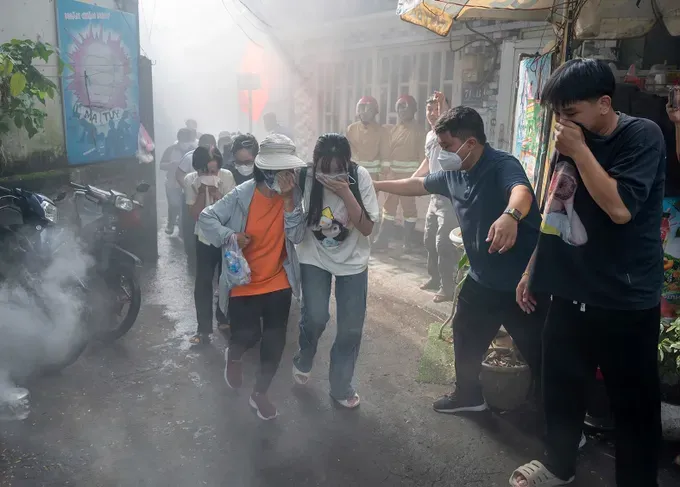
Parallel to this technological shield, a safety mindset is taking root in boarding houses and apartment blocks. Landlords now proactively equip extinguishers and clear escape routes, making fire safety a daily routine for residents.
Slogans throughout the city such as “Proactive fire prevention – safety maintenance,” “Preventing fire and explosion is the happiness of every home” reinforce that safety extends beyond police duties to individual responsibility. Through these small, consistent actions, a cohesive safety culture is forming, making HCMC a more secure and livable city.
Towards modern governance
Dr Nguyen Quang Giai of Thu Dau Mot University argues that urban safety culture cannot be built by administrative orders alone. It requires a long-term process where the State provides the legal foundation, but sustainability relies on socializing awareness through families and communities.
True safety emerges when citizens behave out of culture and civic duty rather than fear of sanctions. Ultimately, a smart city depends less on technology and more on responsible people whose daily actions contribute to a civilized, humane, and sustainable peace.
Sociologist Nguyen Tran Phuoc views HCMC as a “complex social ecosystem” that cannot rely on reactive incident handling. He argues that safety must evolve into a sustainable development criterion where communities are empowered to protect themselves, transforming safety into a collective cultural standard.
He highlights the 2025-2030 Resolution’s target of reducing risks by 5 percent annually as evidence of a shift toward modern, proactive governance. He asserts this is not just a technical statistic but a strategic message that safety culture must be the foundation of development, requiring the active participation of every household and business, rather than being the sole responsibility of public authorities.
It can be affirmed that a livable city is not just about wide roads, tall buildings, and convenient services, but more importantly, the safety feeling of being able to travel in peace, protected by the community, supported during incidents, and living in a kind environment.
Quiet changes in every neighborhood and alley are creating HCMC’s “social immune system”: early prevention, shared vigilance, and community responsibility. When every household knows how to keep themselves safe, every neighborhood becomes a stable belt, and every person lives responsibly toward those around them, HCMC not only approaches the annual risk reduction goal but also steps firmly on the path to building a humane, civilized, and livable city.
Towards “safe – livable” HCMC
The Resolution of the 1st HCMC Party Congress, tenure 2025-2030, sets strong goals:
- Reduce social order crimes and traffic accidents by at least 5 percent annually.
- Strive to reduce grade-III and above fires by 5 percent annually.
- Strive to reach and exceed the target of 50 percent drug-free communes, wards, and special zones, and 100 percent not complicated by drugs.
These are specific political commitments demonstrating the requirement to shift from response to prevention, from handling individual cases to building a safety culture in every residential area and alley. A modern city cannot just develop fast; it must develop safely in equal measure.
In his directive speech at the Congress, General Secretary To Lam emphasized that HCMC is the city named after Uncle Ho, where national elites harmonize and three dynamic development poles converge. HCMC must define the goal of building a city with a green, safe, and livable environment, building a secure, safe, and happy society for all citizens.