Footsteps in the night
This “safety belt” is made not just of armor and sirens, but of the vigilant eyes of landlords, messages in resident groups, neighborhood propaganda sessions, and clear paths for authorities to access timely. Drug criminals change tactics daily, but when the community stands with functional forces, the hazard will be blocked at the root.
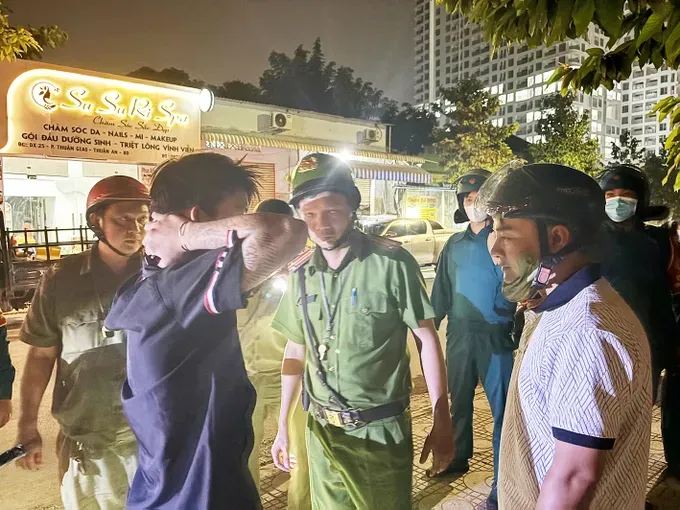
At 9:00 p.m. on December 1, Thuan Giao Ward Police initiated a patrol targeting security hotspots like the Thuan Giao and Viet Sing residential areas. On Thuan Giao 25 Street, the team intercepted a suspicious motorbike driven by 20-year-old Huynh Van Minh T. A rapid on-site test confirmed T. was positive for drugs.
Pressing on, officers raided a smoke-filled game shop deep in the residential zone. Amidst nearly 40 teenagers, the team screened suspicious individuals and discovered Nguyen Duong V., born in 2008 coming from An Giang Province, also tested positive.
According to Thuan Giao Ward Police, drug control in the area is always under pressure, especially with over 3,100 boarding facilities serving workers. The large immigrant population and rapid movement make it easy for criminals to infiltrate if forces don’t control tightly. Therefore, besides propaganda in boarding and residential areas as well as managing drug subjects, Thuan Giao Ward deploys a Mobile Drug Test Team model, timely detecting many positive cases right during patrols.
Night patrols don’t always detect drug-positive subjects. According to a patrol officer, a night with no positive cases is also a success, because the frequent presence of patrols prevents drugs from taking root in the residential area. And when residents accompany, report news, and support functional forces, the ward can maintain stability and reduce the risk of forming complex hotspots.
Every neighborhood as safety belt
In recent years, Phuoc Thang Ward has been forming a solid “community shield” in drug prevention and control. From small alleys near the sea to residential areas near markets, grassroots drug prevention models have created clear changes. Residents are more vigilant, police forces more proactive, and each neighborhood group is transforming into a true “safe zone.”
Phuoc Thang Ward combines intense propaganda with weekly meetings, empowering previously hesitant residents to report suspicious activity. Alongside prevention, 2025 combat efforts have proved robust. Authorities handled 18 cases, fined 70 individuals totaling VND116 million ($4,550), and sent 134 addicts to rehabilitation, effectively tightening community security.
Phuoc Thang Ward also boasts 70 drug-free neighborhood groups, a testament to silent household coordination in the “Neighborhood Group Without Social Evils” movement. Yet, risks persist as criminals increasingly target youth with synthetic drugs and disguised e-cigarettes.
Police Chief in the ward Nguyen Minh Phuc asserts that drug prevention relies on unity; when residents proactively report ill activities, criminals struggle to operate. Consequently, the ward is intensifying night patrols and reintegration support, transforming every citizen into “eyes and ears” of the police and every neighborhood into a fortress against crime.
Meanwhile, Dat Do Commune is aggressively pursuing its “Drug-Free Commune” goal for 2025-2030. Despite managing numerous drug users and post-rehab individuals, the locality has fostered positive grassroots changes through the “Hamlet Without Drug Evils” model. Residents sign commitments and proactively report suspicious activity, supported by “Self-Management Teams”, groups of households monitoring each other that serve as the community’s “magic eye.”
This network enables early detection, preventing the formation of dangerous hotspots. Beyond prevention, police have dismantled 12 cases involving 44 subjects, while local unions actively support social reintegration.
Chairman of the Dat Do Commune People's Committee Tran Thanh Huyen affirms that achieving a drug-free status requires total community involvement, not just police effort. Consequently, the commune plans to tighten management and replicate these successful self-management models, ensuring no opportunity remains for drugs to return.
From boarding houses near industrial zones to small hamlets, the story repeats the same rhythm: patrol – report – area control – returning misguided people to a decent life. There is no magic, only the persistent discipline of functional forces plus the consensus of the people, step by step tightening the gaps so drugs cannot infiltrate.
A safe city is where every risk is seen early and intervened early; where every neighborhood becomes a “soft yet resilient fortress,” and peaceful life is the collective achievement of the entire community.
Accelerating construction of drug-free areas
- 2024: HCMC Police handled 3,174 cases with 7,975 subjects, an increase of 49.5 percent in cases and 75.8 percent in subjects compared to 2023.
- First 9 months of 2025: HCMC Police detected 3,890 cases (up over 13 percent) and arrested 10,673 subjects.
- 2024-2025 Period: HCMC successfully transformed 4 communes into drug-free and crime-free areas, becoming a foundational model for replication.
- 2025: 39 communes, wards, and special zones continue to be selected to deploy “drug-free” area construction under the Prime Minister’s Decision 28.
- HCMC is tightening prevention from the root, creating a foundation to approach the goal: 50 percent “drug-free” communes/wards and 100 percent of areas not complicated by drugs.