Training grounds: Securing every second of life
The boundary between life and death in a fire is often measured in minutes. For the Fire Prevention, Fighting, and Rescue Police force, this is not just a professional reality but the reason for every drop of sweat shed on the training grounds daily.
On a Monday morning in December, the city seemed more peaceful than usual. The 114 hotline was silent, yet within the over 1,000m2 campus of the HCMC Fire Prevention, Fighting, and Rescue Police Division, the force’s characteristic “hot rhythm” had been echoing since early morning. Whistles, engines, running footsteps, and decisive commands blended into a familiar soundscape that every firefighter knows by heart.
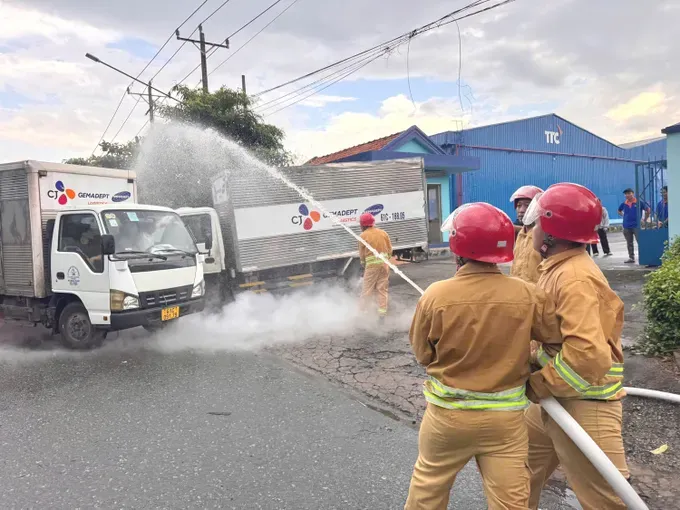
On the field, squads were practicing coordination in protective gear soaked with smoke and sweat. This was not a basic guide for grassroots forces or residents, but where professionals perfected every move. As the fire truck stopped and cabin doors swung open, soldiers rushed into position: deploying nozzles, checking pump pressure, operating ladders. Every movement interlocked like a machine honed to reflexive precision.
Alongside them, firefighting robots were put into operation. In a confined space simulation area, another group practiced structural entry skills: wearing breathing apparatuses, moving in limited visibility, and handling simulated scenarios. They must master the priority order when approaching a real fire, because in reality, every error is paid for with time, the most precious asset in rescue operations.
Beyond headquarters, specialized teams across HCMC are also practicing high-rise rescues while training grassroots forces on essential response protocols. Concurrently, city-level drills are simulating extreme scenarios like structural collapses to test coordination.
These diverse efforts form a cohesive 24/7 system. When alarms sound, every formation immediately takes position, leveraging rigorous preparation to race against time, ensuring readiness to act without wasting a single minute.
Senior Colonel Tran Van Hieu, Head of the HCMC Fire Prevention, Fighting, and Rescue Police Division, stated that all major fires stem from small sparks. For firefighting, the “golden time” to extinguish a fire is no more than 10 minutes from ignition.
Therefore, maximizing force mobilization immediately upon occurrence according to the “4 on-the-spot” motto “Forces within the people – Means within the people – Logistics within the people – Command within the people” is a crucial issue to deploy.
“Recently, HCMC Police have always focused on promoting the role of on-the-spot fire forces to detect and handle fires timely, minimizing human and property damage. Moving forward, to further enhance proactivity in fire safety across HCMC, the city’s Fire Prevention, Fighting, and Rescue Police force will continue to attend to and guide professional skills for grassroots forces, and thereby maximizing the grassroots role in prevention, enhancing the 'golden time' impact in firefighting, contributing to reducing major fires causing serious human and property damage,” he stressed.
Building fire safety awareness from community
While professional training hones life-or-death reflexes, residential fire safety begins with small daily habits. At a recent Fire Prevention, Fighting, and Rescue event at Vietnam National University-HCMC, 150 students have learned vital safety lessons for collective living.
Lieutenant Colonel Hoang Quoc Viet used the occasion to warn against “seemingly harmless habits” that often spark fires, such as overloading sockets, using cheap devices, or failing to disconnect power when leaving. The education made a tangible impact.
Student Pham Thuy Tien shared that she now proactively checks escape routes and extinguishers, and strictly follows rules against cooking in her room. Her experience illustrates how community engagement transforms safety slogans into practical, life-saving routines for young residents.
Tam Long Ward adopts a tailored approach to fire prevention, starting with the Go Cat 6 Social Housing Complex. Addressing blocked balcony escape routes, ward police patiently visited every apartment to explain the risks, successfully convincing residents to clear obstructions and restore safety systems.
Lieutenant Colonel Duong Quang Quy, Deputy Chief of the Ward Police, asserts that citizen awareness is the decisive factor. “Forces only help change perception; if people aren’t self-aware, safety is difficult,” he noted.
Consequently, the ward encourages households to self-equip extinguishers and maintains patrols in high-risk areas like boarding houses and markets. Rather than waiting to penalize violations, officers proactively guide residents to replace overloaded sockets and clear exits. These brief, direct interactions act as an effective fire prevention “vaccine,” ensuring safety habits penetrate every corner of the community.
In Eastern and Southeastern HCMC, fire incidents dropped significantly in 2025, though risks persist. Lieutenant Colonel Nguyen Thi Hanh highlights the success of community-centric approaches, particularly “Inter-household Fire Safety Groups.” These groups act as “strong shields” in hard-to-access alleys, where neighbors serve as the first line of defense to detect smoke and contain flames before professionals arrive.
She observes that these models transform fire prevention from a slogan into a daily habit. By fostering citizen self-awareness and cohesion, the new formula of “Quick detection – Early handling – Community connection” ensures many fires are neutralized early, effectively protecting neighborhoods from within.
HCMC fire safety situation – First 11 Months of 2025:
- 362 fires happened, causing 27 deaths and 19 injuries; a decrease of 243 fires compared to the same period in 2024.
- Functional forces rescued 107 people, guided 3,511 people to self-escape, and protected thousands of houses, workshops, and assets worth thousands of billions of dong.
- On-the-spot fire forces controlled 81 grass/trash fires and 109 electrical short/cooking negligence incidents from the start.
- 45/361 fires (12.5 percent) were completely handled on-the-spot, protecting about 4,500m² of housing and assets.
- On-the-spot forces coordinated to handle 17 cases, moving assets before the Fire Prevention, Fighting, and Rescue Police arrived.
These figures show that when fire prevention is implemented practically, right at every household and risk point, HCMC has a solid foundation to approach the goal of reducing grade-III and above fires by 5 percent annually.