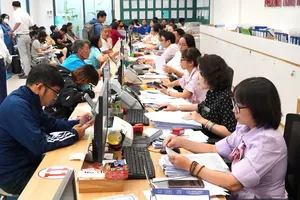
From midnight patrols on the streets to an AI-powered control center watching over more than a thousand cameras, Ho Chi Minh City is redefining urban safety shifting from reactive incident response to proactive prevention through a seamless blend of people and technology.
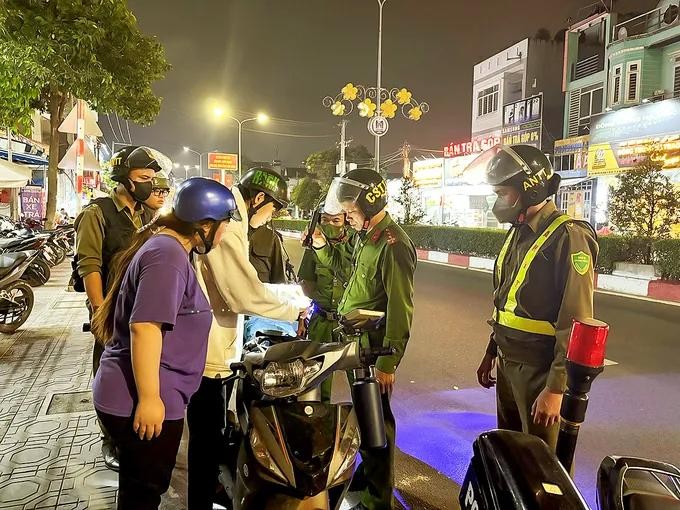
On the frontlines are the tireless footsteps of officers patrolling through the night; behind them, a digital “brain” monitors city traffic through over a thousand cameras, forecasting congestion in real time. Together, human vigilance and technological precision are transforming Ho Chi Minh City’s security model from reactive response to proactive prevention.
Late at night at the Di An Ward Police Station in Ho Chi Minh City, phones ring continuously. Just minutes after a resident reports a group of young men behaving suspiciously near the Di An–Tan Dong Hiep ward border, a patrol team arrives within ten minutes, swiftly surrounding the group and escorting them with weapons to the station for verification.
Captain Nguyen Hoai Vu, duty officer at Di An Ward Police, said that during each shift, the station receives and handles dozens of reports, most of them from rental housing areas, especially on weekends. With over 227,000 residents and more than half being migrant workers living in boarding houses, Di An is the most populous ward in Ho Chi Minh City.
According to Major Nguyen Minh Quang, Deputy Chief of Di An Ward Police, security-related incidents in these densely populated, high-transience areas are always prioritized. “In the past, residents had to call the ward’s hotline, but now with the SOS app, just one tap sends both the alert and the exact location, allowing officers to respond immediately,” he explained.
To promote this tool, the Di An Police launched outreach teams visiting local neighborhoods and boarding houses to help residents install the app. Resident Khuong Duc Thang from Thong Nhat 2 Quarter shared: “With SOS, if anything unusual happens, I just use my phone to report it. The police arrive quickly. It’s very practical and much faster than searching for phone numbers.”
Beyond the officers, locals also feel safer thanks to nightly patrols. Le Thi Lan, who runs a late-night food stall at Rach Dua Market, said, “Whenever there’s a problem, I call the hotline and within minutes, the police are there.” Lieutenant Colonel Tran Viet Trung, Chief of Rach Dua Ward Police, affirmed that maintaining public order requires continuous coordination between police and local security forces. “We maintain 24/7 patrol coverage and adjust our deployment flexibly based on real-time situations,” he said.
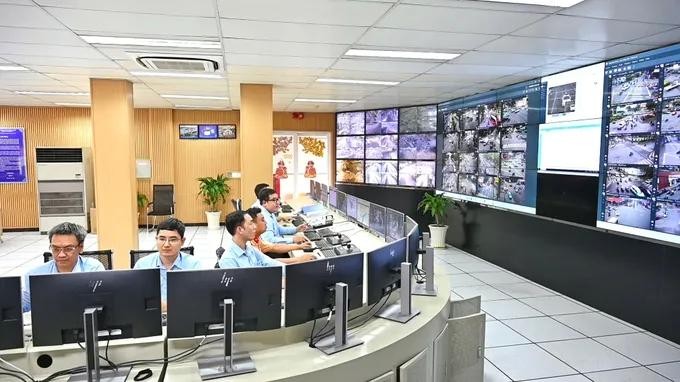
Stepping into the Operations Room at the Ho Chi Minh City Traffic Monitoring and Control Center feels like entering a miniature version of the city within 200 square meters. On the glowing blue screens, every lane, intersection, and shift in the flow of 41 million daily trips is displayed in real time. The steady hum of the servers blends with radio chatter, creating the pulse of a city constantly in motion.
Nguyen Ky Nam, Head of the Traffic Surveillance Operations Team, explained, “The center operates 24/7 without holidays. Each day is divided into three eight-hour shifts with four teams rotating, ensuring both rest and focus.” Each shift includes 14 staff including 13 operators and one shift leader. Every 15 minutes, operators scan the entire camera system, which covers 1,021 citywide observation points. This includes 793 surveillance cameras, 153 traffic volume sensors, and several specialized units, all working to detect accidents, breakdowns, or congestion hotspots.
Behind the operators lies the true powerhouse, an artificial intelligence (AI) server system functioning as the “secondary brain” of the city’s Intelligent Transportation System (ITS). The AI supports five key functions including surveillance, traffic light management, simulation, forecasting, and real-time traffic information.
These continuous efforts, both human and technological, are delivering measurable results. Incident detection time has fallen from 2 to 5 minutes to under 60 seconds at 50 high-risk locations. Traffic flow efficiency has also improved. “After just three months, we’ve observed a 15 percent decrease in vehicle congestion at major intersections,” Nam shared. “It’s an encouraging start.”
The Operations Room at the Ho Chi Minh City Traffic Monitoring and Control Center is more than a technological hub, it’s a symbol of trust and commitment. It stands as living proof that the synergy between artificial intelligence and human dedication is gradually transforming the city’s urban landscape, paving the way for smoother traffic, safer streets, and a more livable metropolis.
Five notable security developments in Ho Chi Minh City
- More than 30,000 surveillance cameras with over 4,200 recording devices have been deployed across the city.
- Eighteen public security models are operating effectively at 1,080 locations, including nine standout initiatives such as the “Security Surveillance Camera Network” and “Community Patrol Teams.”
- Drug hotspots have been dismantled and risks significantly reduced, narrowing areas of concern.
- For consecutive years, the city has maintained an average 8 percent reduction in crime, reflecting sustained progress in public safety.
- Street robberies are no longer escalating in complexity, while incidents of public disorder or conflicts following traffic collisions are being promptly addressed.