Resolution 36/2026/NQ-CP, issued on July 31, 2026, which stipulates the simplification of administrative procedures for growing area codes and packing facility codes, is gradually unblocking the durian export market toward a more transparent and efficient management approach. This serves as a positive signal for durian farmers as well as purchasing and exporting enterprises.
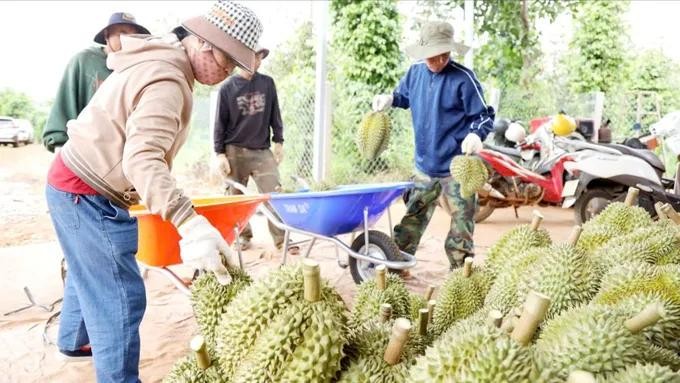
Dak Lak accelerates the issuance of growing area codes to meet export demands
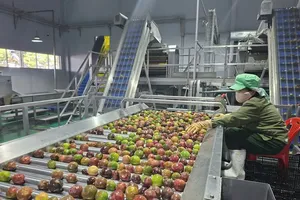
As a province with a relatively large durian cultivation area of approximately 41,000 hectares, Dak Lak has entered its peak harvest season with an estimated 2026 production of about 500,000 metric tons, generating approximately US$1.5 billion in exports. However, the entire province currently has only 280 growing area codes issued, corresponding to about 7,500 hectares, alongside 42 packing facility codes. In Lam Dong, a locality with over 45,000 hectares of durian, the area granted growing area codes and the number of packing facility codes issued to serve exports remain quite low.
To accelerate the issuance of growing area codes, enhance traceability efficiency, and serve exports during the peak season, the People's Committee of Dak Lak Province recently issued a plan to implement a peak campaign titled "30 Days and Nights" which lasts from August 7 to September 7, 2026 to digitize, update, and connect durian growing area and packing facility data with the Agricultural Product Traceability System which tracks goods from farms to global markets.
According to the plan, the province is building a synchronized digital database integrated into the Dak Lak Agricultural Digital Map and connected to the Agricultural Product Traceability System of the Ministry of Agriculture and Environment under the principle of "one-time declaration, multiple-time usage."
Chairman Do Huu Huy of the People's Committee of Dak Lak Province stated that the province is promoting linkages among farmers, cooperatives, enterprises, processing facilities, logistics providers, distributors, and importers toward forming a professional and sustainable durian ecosystem. Among these efforts, developing deep processing, frozen durian, and market diversification are considered important directions.
Nguyen Van Muoi, Deputy Secretary-General of the Vietnam Fruit and Vegetable Association, stated that Vietnamese durian exporters hold an overwhelming competitive advantage regarding fresh supply for the Chinese market. In the first seven months of 2026, China spent over US$1 billion importing fresh and frozen durians from Vietnam, an increase of approximately 43 percent compared to the same period the previous year. Additionally, India has officially authorized the import of fresh Vietnamese durians. Currently, Vietnamese durians are exported to more than 20 countries. The fruit and vegetable industry aims for durian export value to exceed US$4 billion in 2026.
According to the Ministry of Agriculture and Environment, by the end of July 2026, the country had 1,201 operating durian growing area codes and 120 packing facility codes, with 1,166 growing area codes and packing facilities awaiting approval by the General Administration of Customs of China. In 2026, the country's durian cultivation area, concentrated in the Central Highlands and Southern region, is approximately 200,000 hectares, of which the productive area is about 129,500 hectares, with an expected output reaching 2.08 million metric tons.
The new policy helps unblock agricultural export markets across the country
Deputy Minister of Agriculture and Environment Nguyen Hoang Hiep stated that Resolution 36 on simplifying administrative procedures related to growing area codes and packing facility codes shifts the focus strongly from pre-inspection to post-inspection to remove bottlenecks in the export of durian in particular and agricultural products in general.
The breakthrough point of the resolution is the transition to executing full procedures in a digital environment. To apply for a code, citizens and enterprises can declare online via the electronic information portal instead of processing numerous paper documents. Following code issuance, management agencies will conduct post-inspections and monitor conditions according to regulations, which must be maintained throughout operations.
Evaluating the positive signals from Resolution 36, Director Nguyen Thi Huong of the 001 Ea Knuec Import-Export Agricultural Cooperative expressed expectations that it will facilitate the establishment and expansion of production areas meeting export standards. This also serves as a condition for enterprises to boldly invest in raw material regions, packing facilities, and processing, thereby enhancing the value of durian, generating more employment, increasing people's incomes, and contributing to the socio-economic development of the locality.
Leadership of the Vietnam Fruit and Vegetable Association also acknowledged that simplifying procedures helps shorten the time required to apply for growing area codes and packing facility codes, increasing competitiveness as durian enters its peak season, particularly in competition with Thailand, which has a large durian cultivation area in the region.
According to the Ministry of Agriculture and Environment, as of August 5, the General Administration of Customs of China had approved 50 Vietnamese testing laboratories for durians and jackfruit exported to the Chinese market. The combined capacity of these operational laboratories is approximately 13,000 samples per day for cadmium and 10,000 samples per day for Auramine O (or Basic Yellow 2).