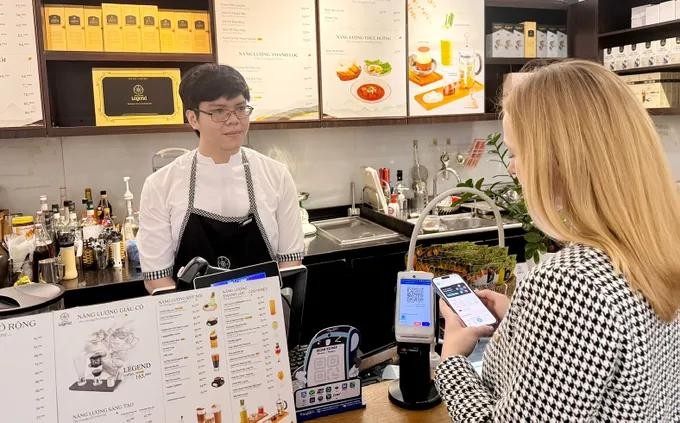
Thanks to the connection of cross-border payment systems, international visitors to Vietnam can easily use applications from their home countries, creating significant opportunities for numerous domestic businesses, stores, and household enterprises.
Foreign tourists embrace QR payments in Vietnam
During a business trip to Ho Chi Minh City in May 2026, Lee Wei Loong, a Singaporean tourist, still had to carry a credit card and exchange a small amount of cash for spending. However, on a recent family vacation, Mr. Loong was able to use LiquidPay, Aleta Planet, and DCS DeCard to scan QR codes for payments at various restaurants, markets, hotels, and shopping centers in Ho Chi Minh City.
"The exchange rate is displayed directly on the application before transaction confirmation, so I feel secure making payments without needing to carry cash or exchange foreign currency," Mr. Loong shared.
Since early August 2026, Lu Suan, a tourist from Beijing (China), has also been able to use WeChat and WeChat Pay to directly scan VietQRGlobal codes for payments at a Japanese restaurant inside the Vincom shopping center in Saigon Ward, Ho Chi Minh City.
Consequently, she almost no longer needs to exchange cash or carry credit cards every time she visits Vietnam. Not only tourists from China and Singapore, but visitors from South Korea, Laos, Cambodia, and Thailand can also use QR code payment methods connected with Vietnam.
According to the National Statistics Office under the Ministry of Finance, in the first 7 months of 2026, Vietnam welcomed approximately 13.9 million international visitor arrivals, an increase of 6.6 percent over the same period last year. Using familiar payment applications from home to scan QR codes at sales points is becoming a popular choice for this group of travelers.
The National Payment Corporation of Vietnam (NAPAS) stated that in the first 8 months of 2026, the number of transactions by Thai, Lao, and Cambodian tourists in Vietnam increased by nearly 8 times, while transaction values rose 6 times compared to the same period in 2025.
In the opposite direction, the number of transactions by Vietnamese people in these 3 markets increased by nearly 5 times, and transaction values surged by 4 times compared to the same period in 2025. Specifically, transactions by Chinese tourists using Chinese payment applications to scan VietQRGlobal codes in Vietnam increased by 3 times in volume and 4 times in value compared to April 2026.
QR payments bring global customers to local vendors
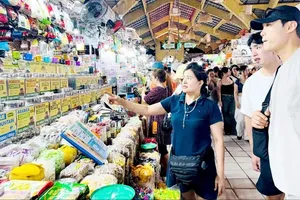
The cross-border QR code payment method is also gradually appearing in traditional markets and souvenir stalls. More than 20 banks and payment intermediaries in Vietnam have participated in promoting cross-border payments.
Viet Capital Commercial Joint Stock Bank (BVBank) has integrated the WeChat Pay payment method into VietQRGlobal codes. Chinese visitors can use WeChat and WeChat Pay to directly scan VietQRGlobal codes at BVBank's payment acceptance points.
When a transaction occurs, the system automatically deducts Chinese yuan from the customer's WeChat Pay wallet, converts it according to the exchange rate at the time of the transaction, and credits Vietnamese dong to the household enterprise's account. As a result, sellers do not need to equip additional POS machines (card-swiping devices) or prepare foreign currency small change.
According to a representative of Saigon Thuong Tin Commercial Joint Stock Bank (Sacombank), Chinese tourists can use Alipay wallets to scan VietQRGlobal codes and make payments at many of the bank's acceptance locations.
Ms. Duyen, the owner of a food stall at Ben Thanh market in Ben Thanh Ward, Ho Chi Minh City, stated that about 70 percent of her customers choose cashless payments; for young customers, this rate reaches 80 percent to 90 percent. International visitors, especially Asian customers, are increasingly paying via QR codes. This payment method helps retain customers who previously might have walked away simply because they did not carry cash, Ms. Duyen said.
Pham Tien Dung, Deputy Governor of the State Bank of Vietnam:
Cross-border payments connect to drive the economy
Cross-border payments are not just a matter of technology. More importantly, they are about the economic value created through payment connectivity. Visitors to Vietnam, as well as stores and household businesses, can conveniently make payments using funds in their bank accounts or e-wallets. Payment infrastructure is only the starting point; economic connectivity is the ultimate goal we seek to achieve.
The State Bank of Vietnam has implemented bilateral retail payment cooperation through QR codes between Vietnam and Thailand, Laos, Cambodia, China, South Korea, and Singapore, while continuing to expand cooperation with several other countries in the region and additional partners.
This connectivity not only provides residents and tourists with more convenient payment options, but also expands access to international customers for small businesses and household enterprises.