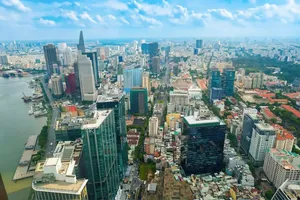
House owners cut prices to pay off bank loans leading to dropping prices for apartments and landed properties in several areas of Ho Chi Minh City. However, high lending interest rates, cautious credit policies, and a wait-and-see attitude among buyers keep transaction volumes low.
Debt-strapped property owners slash prices as high interest rates freeze demand
On the secondary market, many property owners, especially those using leverage, are adjusting their asking prices to find buyers. Nevertheless, price cuts have not provided enough momentum to boost transactions, as buyers remain concerned about borrowing costs.
In early 2025, Thanh Thuy, a resident of Hanh Thong Ward, HCMC, took out a bank loan of VND2 billion (US$77,000) to buy a 54-square-meter apartment in Binh Thoi Ward for VND3.8 billion. Her monthly principal and interest payments total more than VND30 million. Amid the real estate market downturn, Thuy listed the apartment for sale at VND3.5 billion, unable to continue bearing the high interest rates.
Similarly, in 2021, a resident in HCMC, purchased a one-bedroom apartment at a project in Phu Loi Ward for nearly VND1.3 billion, expecting to sell it for around VND1.5 billion. However, the apartment is currently listed for a little over VND1.1 billion with no takers.
He noted that debt service pressures are forcing some real estate borrowers to slash prices. His family currently owes more than VND637 million for the apartment purchase.
His monthly principal and interest payments have risen to over VND8.8 million, up from over VND6 million previously. As a result, he is considering dropping the price or seeking alternative funds for early repayment.
At a land plot project covering over 40 hectares in Phuoc Hoa Commune, HCMC, transactions remain negligible despite fully developed basic infrastructure, legal documentation, and amenities. The lowest price for a plot in the project dropped from VND13 million per square meter in early 2026 to VND11 million per square meter, yet many prospective clients have refrained from signing contracts.
Le Ngoc Duong, a resident of Di An Ward, HCMC, mentioned that he visited the project but has no intention of purchasing at this time. Current borrowing rates are high, while preferential rate periods are short; once shifting to floating rates, interest rates could reach 12 to 14 percent per year depending on the bank. He does not dare borrow money to buy property right now.
A land plot of over 3,000 square meters belonging to Nguyen Dieu Thuy's family in Chau Duc Commune was once valued by prospective buyers at around VND4 billion. In urgent need of funds, she put it up for sale at VND2 billion, half of its previous valuation.
Surveys in Vung Tau Ward and Rach Dua Ward show that asking prices for older two-bedroom apartments ranging from 70 to 74 square meters in central areas have dropped by about VND200 million to VND300 million per unit compared to six months ago.
High borrowing costs and credit tightening keep property market recovery elusive
Chairman Le Hoang Chau of the HCMC Real Estate Association (HoREA) observed that housing prices show signs of slowing down and falling in some segments, yet purchasing power remains weak due to high borrowing rates and limited credit accessibility. This directly impacts the cash flow and liquidity of real estate enterprises. The market continues to face a shortage of products serving real housing demand, especially commercial housing and rental housing priced affordably for middle- and low-income earners, as well as social housing.
Vo Hong Thang, Deputy General Director of DKRA Group, further analyzed that September surveys show no clear recovery in liquidity across HCMC and neighboring areas, with demand remaining cautious.
The main reason is high prevailing interest rates, which increase capital costs and repayment burdens for buyers. Currently, common preferential rate packages at banks range from 8.2 to 10.8 percent per year for the first one to two years, after which floating rates can reach 13 to 15 percent per year. Therefore, when choosing apartments with interest rate support or grace periods on principal repayments, buyers must carefully evaluate their repayment capacity throughout the entire loan term and prepare an appropriate financial plan.
According to lecturer Huynh Thanh Dien at Nguyen Tat Thanh University, the decline in secondary market apartment prices and low liquidity in recent times stem not only from a lack of buyers but also from heavy credit impacts. Rising interest rates and increased bank caution regarding property lending create difficulties for buyers relying on leverage, leading them to adopt a wait-and-see posture.
In addition, ongoing reviews and adjustments to policies concerning land and real estate taxation make investors cautious, prompting them to temporarily hold back on investments.
Naturally, cooling property prices represent a positive signal. To bring housing prices down to levels more accessible to the public, long-term policies are needed to curb speculation, direct capital flows into production and business, and increase housing supply aligned with real demand. Among these, developing social housing and rental housing serves as a key solution, giving low-income earners and those without homes greater opportunities to secure housing.
Supply begins to rise
According to HoREA, resolving obstacles for hundreds of real estate projects in Ho Chi Minh City has brought about a marked shift in the property market. In the first seven months of 2026, 37 real estate and commercial housing projects met the requirements to mobilize capital, supplying 27,374 housing units (comprising 21,165 apartments and 6,209 low-rise houses)—a 1.64-fold increase compared to 2025.