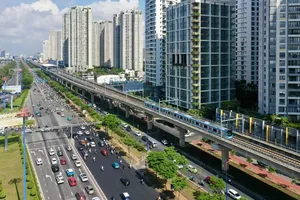
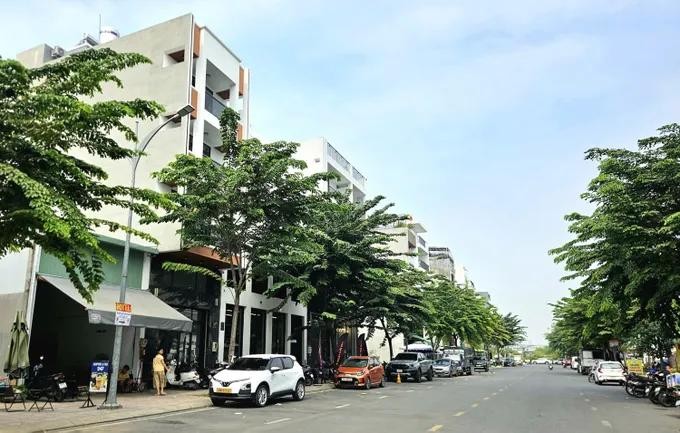
From a once desolate stretch of land, the resettlement zone for households affected by the Thu Thiem New Urban Area project in Ho Chi Minh City’s An Khanh Ward has transformed into a vibrant neighborhood filled with high-rise homes, lively shops, and bustling restaurants - a testament to the city’s commitment to protecting residents’ rights and livelihoods.
Settling in a new land
Covering about 1.8 hectares, the resettlement site accommodates 198 of 331 households formerly located outside the Thu Thiem New Urban Area planning boundary. Along Pham Van Ngon, Bach Dong On, D5, and Road No. 8, rows of modern townhouses now stand, forming a lively community.
Among the early settlers is Mrs. N.T.Y., whose family was affected by the project. In 2011, after agreeing to hand over their land to the State, they temporarily relocated to an apartment near Binh Khanh Market. To make ends meet, Mrs. Y. rented a small space on Luong Dinh Cua Street to open a grocery store.
By 2020, under a new supplementary policy, the city allocated her family a 70-square-meter plot with an approved plan for a house featuring a ground floor, mezzanine, three upper levels, and a rooftop. With prompt support from local authorities in securing construction permits, her family soon built a comfortable new home.
A 56-year-old resident, one of the first to build a home in the area, now enjoys a settled and comfortable life. After receiving state compensation, his family spent a few years renting both a house and a small business space. When the land-swap policy came into effect, they decided to put down roots and build their own home — a choice he calls ‘the right move’. Since then, property values have soared, with land prices once hitting nearly VND300 million per square meter. “Getting in early saved us from years of high rent,” he said with a smile.
Policies that work for local inhabitants
Many households affected by the Thu Thiem project and the adjacent 4.39-hectare land plot have also expressed satisfaction with the city’s compensation and resettlement efforts.
For instance, Mr. D.H.T. received a land-use rights certificate and home ownership title in mid-2023. Around the same period, Ms. N.T.G. was granted an apartment in the An Phu–Binh Khanh complex, while Ms. P.T.T.H. and Mr. N.T.T. received residential plots in other designated zones. Mr. T., whose family once owned over 90 square meters in Binh An Ward, received a 62-square-meter plot but opted to pay extra for an 80-square-meter one to better suit their needs.
Since the Government Inspectorate’s 2018 Notice No. 1483, Ho Chi Minh City has accelerated compensation and legal procedures, frequently updating policies to ensure fairness and transparency. To date, more than 99 percent of affected households have handed over their land. In the 4.39-hectare area, over 88.8 percent of residents have agreed with the city’s plans.
Resettlement areas such as Nam Rach Chiec, Cat Lai, and An Phu–Binh Khanh have been developed to provide residents with modern infrastructure and improved living environments.
According to the Ho Chi Minh City Department of Agriculture and Environment, the city’s compensation and resettlement policies are designed to ensure the greatest possible benefit to residents. Most recently, Decision No. 70/2025 introduced supplementary policies aligned with current market conditions.
The new regulations ensure that resettlement plots match the size of the original holdings, without restricting the number of plots or apartments. The Department continues to monitor implementation closely, urging An Khanh Ward’s People’s Committee and relevant agencies to expedite reviews and streamline administrative processes.
According to the Land Compensation Board of Thu Duc City under the Department of Agriculture and Environment of Ho Chi Minh City, the Thu Thiem New Urban Area, with over 14,000 cases requiring relocation spanning multiple periods of the Land Law, presents an extremely complex problem. Nevertheless, policies have been applied to the maximum extent possible to benefit the people. These include support for land price differences of VND12 million-VND16 million per square meter for residential land, and increased compensation for agricultural land.
Furthermore, encroachments on rivers and canals that occurred before October 15, 1993 — when the 1993 Land Law came into effect — though not eligible for compensation, are still being considered for resettlement in apartments at standard resettlement prices. Even those that took place after that date may still receive housing support if the affected families have no other place to live.