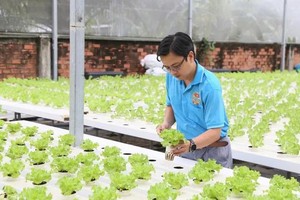
According to the Ho Chi Minh City Division of Rural Development, cooperative production models have significantly raised productivity, stabilized prices, and increased farmers’ earnings by up to 1.5 times, with some products now meeting export standards for markets such as the United States, South Korea, and Japan.
The Ho Chi Minh City Division of Rural Development reports that linked production models are delivering tangible benefits, including higher productivity, standardized product quality, stable prices, and incomes rising 1.1 to 1.5 times for farmers and cooperatives. Several products have already met export standards for demanding markets such as the United States, South Korea, and Japan.
Cooperation for Development
At Cho Ben Cooperative in Long Dien commune, the shrimp harvest is in full swing, marking the success of years of transformation. With more than 200 hectares under cultivation, An Thanh hamlet has become known as the region’s high-tech shrimp farming capital. Traders are paying VND230,000–VND240,000 per kilogram of fresh whiteleg shrimp and this price is nearly VND60,000 higher than the August 2025 season. This year, the cooperative harvested 11 ponds of about 1,000 square meters each, yielding close to three tons per pond and generating profits of around 25 percent of total revenue.
In the 2024–2025 season, Cho Ben Cooperative received support in pond liners, equipment, machinery, and over 13 tons of shrimp feed. According to Luong Tuan Hai, Vice Chairman of the Long Dien commune Farmers’ Association, the cooperative’s integrated production model is being implemented under Resolution No. 21/2020/NQ-HDND of the former Ba Ria–Vung Tau provincial People’s Council, laying the groundwork for sustainable growth.
Cho Ben Cooperative is now applying the “CP.Biotic Farming” biosafety shrimp model, which improves water quality control, reduces disease risks, shortens farming cycles, and boosts profits. The approach not only stabilizes incomes for cooperative members but also creates steady jobs for local workers, gradually building a concentrated aquaculture zone and overcoming the challenges of fragmented, small-scale production.
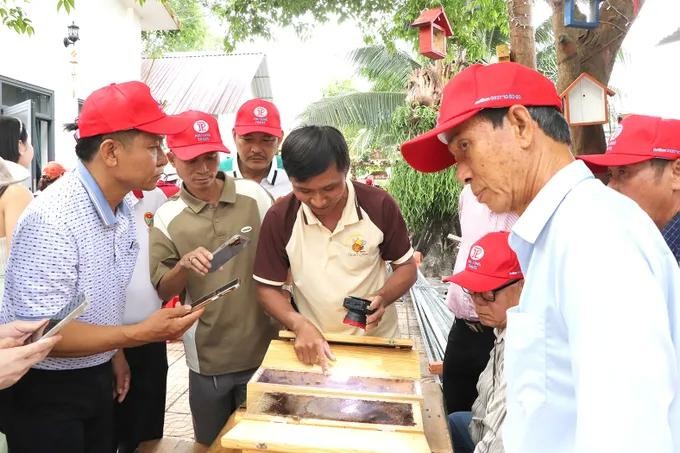
In Kim Long commune, with an area of over 1,500 square meters, Win’s Farm, invested in by Nguyen Thi Ngoc Phuong, has developed a model of stingless bee farming combined with tourism. More than 300 wooden beehives are designed in many unique styles. According to Ms. Ngoc Phuong, while many stingless bee farmers only focus on honey production, at Win’s Farm, the wooden hives are decorated attractively to both harvest honey and serve as a scenic feature, creating a highlight for the outdoor space.
The communes of Chau Duc, Kim Long, and Xuan Son are home to abundant fruit orchards and natural flowers, creating favorable conditions for stingless bee farming. To expand production, more than 20 households have joined together to establish the Chau Duc Beekeeping Agricultural–Commercial–Service–Tourism Cooperative, with each member earning about VND150 million (US$5,809) annually.
In line with policies supporting production linkages and enhancing product value, the cooperative recently received a honey moisture reduction machine with a capacity of 60–100 liters per batch, along with a bottling and packaging machine from the Ho Chi Minh City Division of Rural Development, helping complete the processing chain and improve product quality.
Ho Chi Minh City extends policies promoting agricultural cooperation and market linkages
At its sixth meeting of the tenth term, the Ho Chi Minh City People’s Council approved Resolution No. 496/NQ-HDND on December 10, 2025, extending the application of Resolution No. 21 previously issued by the People’s Council of Ba Ria - Vung Tau province (formerly) on policies to promote cooperation and linkages in the production and consumption of agricultural products following restructuring.
Under the resolution, cooperatives, enterprises, and farming households across the city will continue to benefit from a broad package of support measures, including investment in infrastructure, access to machinery, technology transfer, certification of quality standards, brand promotion, and market development.
A representative of the Ho Chi Minh City Division of Rural Development stated that in the coming time, it will continue to conduct field surveys and advise the Department of Agriculture and Environment and the municipal People's Committee on effectively implementing support policies for agricultural cooperatives and building a synchronized value chain; while also calling for investment in deep processing plants to enhance the value of agricultural products.
Vu Ngoc Dang, Head of the Ho Chi Minh City Division of Rural Development, emphasized that continuing the implementation of Resolution No. 21 of the former Ba Ria–Vung Tau provincial People’s Council will pave the way for linkage models geared toward a circular economy and high-tech agriculture, harnessing regional strengths. He noted that when farm economies are systematically organized, collective economies are reinforced, and policies are applied in sync, agriculture can become a key driver in building Ho Chi Minh City into a sustainable and balanced urban–rural area.