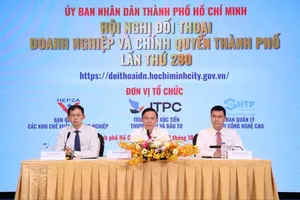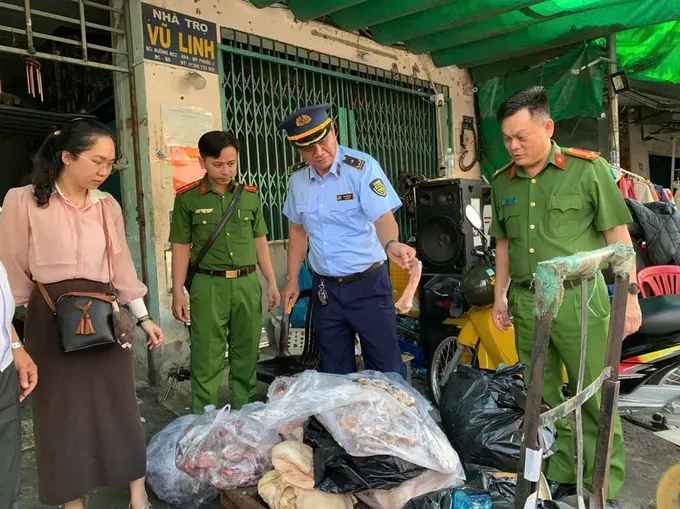
Chairwoman of the HCMC Food and Foodstuff Association Ly Kim Chi shared that her 15-year-old grandson often orders unbranded, obscure sausages online simply because they are advertised as “delicious.” Products of this nature even appear publicly near school gates, targeting children’s curiosity. She stated that the major weakness currently lies in the ambiguity of e-commerce platforms.
Many such platforms act solely as intermediaries with loose control processes over sellers. Traders only need to provide an ID card, without any mechanism to verify the actual quality of goods. Meanwhile, violators continuously change websites, accounts, and use “hide-and-seek” tactics to evade tracking.
Nguyen Thuan Dat, representing Imex Pan Pacific Group (IPPG), said the group distributes 138 genuine international brands in Vietnam. Their products all have valid invoices, brand barcodes, and official distributor codes.
Conversely, products of unknown origin and quality are easily bought and sold online at shockingly cheap prices. Not only do legitimate businesses suffer heavy damage, but major international brands may also assess Vietnam as a high-risk market for intellectual property, affecting the national reputation.
From a state management perspective, Le Thi Ha, Head of the E-commerce Management Division at the Vietnam E-commerce and Digital Economy Agency (Ministry of Industry and Trade) stated that in the past year, 47,800 products showing signs of being counterfeit or imitation were detected, and by December 2, 2025, over 13,700 violating stalls had been removed. However, the battle remains very difficult as violations become increasingly sophisticated, cross-border, and unpredictable.
To stop the scourge of counterfeit goods in cyberspace, many opinions suggest a stronger “sweep,” starting with tightening the legal framework and increasing the responsibility of e-commerce platforms. According to Le Thi Ha, the key point of the new E-commerce Law focuses on a mandatory identification mechanism for sellers, ending the situation where stalls can easily change names, disappear, or “evaporate” after violations.
She emphasized that sales livestreaming, currently “fertile ground” for low-quality functional foods and counterfeits, will also be tightened. Trading platforms must authenticate the identity of the livestreamer and bear clear responsibility for promotional content.
Furthermore, large-scale cross-border platforms or those owning “.vn” domains must also have legal entities and legal representatives in Vietnam to serve as points of contact for handling violations, rather than evading responsibility as they have in the past.
Meanwhile, many businesses argue that the current violation handling process is too slow and cumbersome, while the online environment changes rapidly. In the digital era, combat solutions cannot be separated from automated filters and mechanisms for quickly handling violating links; the responsibility of e-commerce platforms needs to be tightened, rather than viewing them merely as technical intermediaries.
Regarding fundamental solutions, Chairwoman of the High Quality Vietnamese Goods Association Vu Kim Hanh noted that the human factor remains key. Without a team of integrity-driven enforcers, the fight against counterfeits easily becomes a futile effort.
Agreeing with that Vice Chairman of the Vietnam Essential Oils, Aromatherapy and Cosmetics Association Nguyen Van Minh emphasized the role of media in creating “smart consumers,” as community boycotts can sometimes be a much stronger deterrent than administrative fines.
Director of the HCMC Department of Food Safety Pham Khanh Phong Lan informed that the country is currently building an interconnected data system between Market Management, Police, Tax, and Customs, expected to operate by July of this year. Only when data is connected and post-inspection is carried out through unannounced checking as well as direct market sampling can the loopholes that violating businesses often exploit be effectively plugged.






)