The Year of the Horse begins with a fresh mindset in Ho Chi Minh City. For the first time, the city steps into spring under a two-tiered local government model following its merger, while also embarking on the implementation of the Resolution of the 14th National Congress and the inaugural Resolution of the Ho Chi Minh City Party Committee. The 2025–2030 term sets ambitious goals, demanding not just commitment to the “spirit of the resolution” but a swift transformation into its “product”—visible in daily life and measurable in progress.
In the early days of the new year, the city's rhythm seems more vibrant, not only because of the colorful flowers on the streets, but also because of a shared expectation that Ho Chi Minh City will continue to play a leading role, maintaining stability and peace while accelerating development –setting an example and pioneering in implementing resolutions. The most important thing now is to translate the high level of consensus from the Congress into concrete actions, with tangible results, and with the satisfaction of the people and businesses.
Pivotal year opening new development cycle
Looking back at 2025, it can be considered a "pivotal year" for the city. This is not just a year of economic growth or the implementation of major infrastructure projects, but the year the city enters a new qualitative development cycle.
To summarize, 2025 is the year the city is granted autonomy to develop as a city of international stature. The first highlight of 2025 is the full and substantive implementation of the special mechanisms. With Resolution No. 98/2023/QH15 of the National Assembly, issued on June 24, 2023, and Resolution No. 260/2025/QH15 amending it, Ho Chi Minh City gains expanded authority to decide on critical matters of investment, finance, land, wages, and public–private partnerships.
The shift marks a departure from the traditional “request-and-grant” mechanism, opening the way for self-reliance, accountability, self-responsibility, and proactive development.
Alongside this institutional breakthrough, the city is witnessing the launch of its International Finance Center. This is the second highlight, positioning Thu Thiem as a future hub of Vietnam’s financial sector. With its legal framework and governance model established, Thu Thiem is poised to emerge as more than just a new urban area. The area is expected to evolve into Vietnam’s financial hub, laying the groundwork for Ho Chi Minh City to integrate more deeply into regional and global capital flows.
The third highlight is the transportation and logistics infrastructure, which is beginning to unleash its long-suppressed development potential. Ring roads, metro lines, and expressways connecting the region not only address long-standing bottlenecks but also expand development space, helping the city gradually function as a truly modern metropolis with strong connections to the surrounding areas.
The fourth highlight is the shift in the growth model. With Resolution No. 57 and Resolution No. 68, the city places science and technology, innovation, digital transformation, and the private sector at the center. The city no longer relies primarily on real estate or outsourcing, but is moving towards a knowledge-based economy, high technology, and high added value.
The fifth highlight is that 2025 marks a new stage of development in the economic space. The linkages between Ho Chi Minh City and other localities in the region are becoming increasingly close, forming an urban-industrial-seaport-financial center region. It can be said that 2025 is not the year of completion, but the year the city receives the key to unlock the door to the future.
Immediate priorities for Ho Chi Minh City
The spring atmosphere often signals new beginnings, and for Ho Chi Minh City, 2026 marks the start of a new term. This beginning carries a clear demand to turn resolutions into reality through concrete programs, detailed plans, and measurable outcomes. The Resolution of the 1st City Party Congress sets out 30 main targets, three strategic breakthroughs, and ten key tasks and solutions. The decisive factor is not the number of goals or the wording of documents, but their implementation.
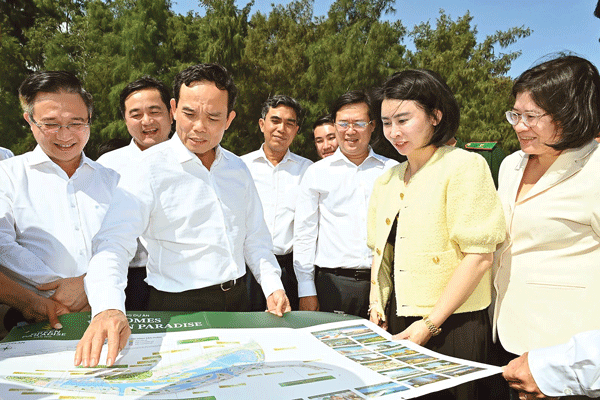
In this term, the city faces two central tasks. The first is to safeguard peace and security, ensuring political stability and social order while remaining a safe, attractive destination for investment and a livable environment for citizens and businesses.
The second major task is to concentrate all resources on accelerating development, ensuring Ho Chi Minh City continues to lead and serve as a growth pole for the nation. Immediate priorities include clearing long-standing obstacles in infrastructure, planning, and administrative procedures, as well as addressing stalled projects that have fueled public dissatisfaction. The guiding principle is to place the legitimate interests of citizens and businesses at the forefront.
At the same time, the city must reorganize its development space following the merger. Each area carries its own history, strengths, and potential, and the challenge lies in connecting these advantages within a unified plan supported by synchronized infrastructure. The new city must function as a cohesive entity, built on a shared vision, aligned interests, and coordinated development.
Ho Chi Minh City’s greatest and most valuable resource is not its capital or infrastructure. The city’s strength comes from its officials and citizens, dynamic individuals who dare to think boldly, act decisively, and take responsibility for the common good.
Ho Chi Minh City faces mounting challenges, from global economic fluctuations to a reluctance among officials to take risks and assume responsibility. Without strong political will and a decisive shift in mindset and methods, the city’s major goals will remain out of reach. Leaders and Party members at every level are urged to embrace the spirit of daring to think, knowing how to act, and taking responsibility.
Officials must stay close to the people, listen to citizens and businesses, and respond quickly to correct mistakes rather than allowing public concerns to fade. Difficult tasks cannot be avoided, delayed, or passed on in the name of collective responsibility.
For Ho Chi Minh City, 2026 is not a year of trial runs. It is a year of genuine thought, genuine action, genuine accountability, and genuine measurement so that results are real, tangible, and bring genuine satisfaction. Only then can the city look back with pride on achievements that are visible and measurable.
To achieve the goals of building and developing Ho Chi Minh City, the Resolution of the first Congress of the Ho Chi Minh City Party Committee identified 30 main targets, three strategic breakthroughs, and 10 key tasks and solutions. Among these, the three strategic breakthroughs include policies and institutions, infrastructure development, and human resource development.
- On the policy front, Ho Chi Minh City is moving to resolve long-standing issues tied to projects, construction, and land management. The city is also piloting a self-governing urban model that grants high autonomy in planning, smart city management, and budget allocation. The aim is to secure resources and ensure the effective implementation of development goals.
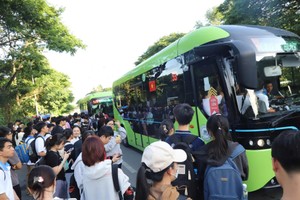
- Regarding infrastructure development, Ho Chi Minh City promotes regional connectivity through an external road system connecting Ho Chi Minh City with the provinces of Dong Nai, Tay Ninh, Dong Thap, and Lam Dong, including ring roads, expressways, national highways, main urban arterial roads, coastal and riverside roads, and traffic junctions. Ho Chi Minh City is developing an urban railway system. The seaport system is linked to the logistics system. Simultaneously, the city is developing intelligent and green transportation systems, applying artificial intelligence and big data in management and operation.
- Regarding human resource development, Ho Chi Minh City is promoting comprehensive and substantive innovation in the education and training system towards standardization, modernization, and international integration. Simultaneously, it is implementing the development and application of digital technology and artificial intelligence in education. It is implementing specific mechanisms and policies to train, attract, reward, and retain talent in key sectors. Ho Chi Minh City is also promoting the application of modern governance models, building a system of public service KPIs, linking individual responsibility to output results; and implementing personnel rotation and placement in line with the development strategy of each sector and locality.
(Compiled by Van Minh, according to Resolution of the First Congress of the Ho Chi Minh City Party Committee)