While the problem of businesses encroaching on roadways and sidewalks was once considered difficult to address, many localities in Ho Chi Minh City are now adopting new management approaches. Rather than relying primarily on penalties, local authorities have shifted their focus toward public awareness campaigns, community mobilization, and the application of technology to build public consensus and restore urban order sustainably.
“Soft first, firm later” approach
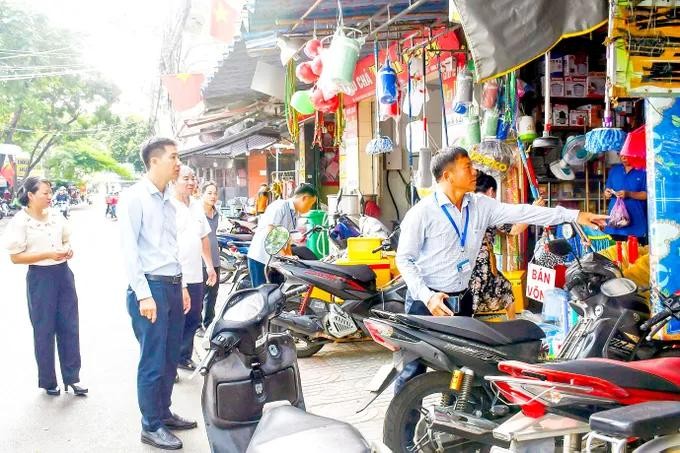
Early in the morning on Do Luong Street in Phuoc Thang Ward, Ho Chi Minh City, while many shops remain closed, members of the urban order task force move from one storefront to another, reminding residents to remove canopies, tables, chairs, and materials encroaching on sidewalks.
Rather than relying solely on fines as in the past, local authorities have adopted a “soft first, firm later” approach by prioritizing public outreach and community mobilization to build consensus before taking enforcement measures against violations.
During these efforts, Chairman Nguyen Viet Dung of the Phuoc Thang Ward People's Committee has frequently accompanied functional forces directly to each business household to communicate and guide citizens to voluntarily dismantle canopies and relocate misplaced tables, chairs, and billboards. However, for cases that have been reminded multiple times but still deliberately repeat violations, the locality will strictly handle them to terminate the prolonged sidewalk encroachment. This shift is generating positive signals in re-establishing local urban order.
Do Luong Street is one of the urban order hotspots in Phuoc Thang Ward. The route is approximately 1.6 kilometers long, gathering around 600 cases of street vending and trading. Before launching enforcement operations, the ward measured the land use boundaries of around 250 households fronting the street to determine the violating areas, providing a legal basis for enforcement work. Household businesses were requested to sign commitments to comply with regulations on roadway and sidewalk order.
To date, many households have proactively dismantled violating structures and moved goods out of encroached areas. Vu Van Mung, a business owner on Do Luong Street who is dismantling a canopy extending onto the sidewalk, stated that upon receiving dissemination and mobilization from the ward functional forces, his family agreed to comply.
Many citizens living around the area also recognize positive changes in urban order recently. According to Nguyen Thi Lan, a resident living near Do Luong Street, the situation of trading and encroaching on the roadway was previously quite common, especially during peak hours, causing traffic obstructions and affecting urban aesthetics. She said that since the ward intensified regular inspections and reminders, the streets are much more open. Walking and exercising for residents have become more convenient and safer.
Leaders of Phuoc Thang Ward stated that the ward continues to maintain regular patrol forces while installing surveillance cameras at key areas to promptly detect and handle cases of re-encroaching on sidewalks and roadways, heading toward the goal of sustainable urban order.
Digital licensing eases sidewalk management in Ho Chi Minh City
In the downtown area, managing roadways and sidewalks is always under heavy pressure, particularly in bustling commercial locations such as An Dong Market in An Dong Ward. Following the implementation of the two-level local government model, the managed jurisdiction expanded, but the specialized Urban Order Management Team was discontinued, leading to a recurrence of sidewalk and roadway encroachment. The task was assigned to the ward police, yet with thin forces, patrolling and controlling on a large scale faces numerous difficulties.
In response to the situation, An Dong Ward developed the “An Dong Roadway and Sidewalk Licensing” software which was officially launched on May 15, 2025. The platform is designed to ease administrative pressure on local authorities, who have faced mounting workloads, limited staffing, and the shortcomings of manual management methods.
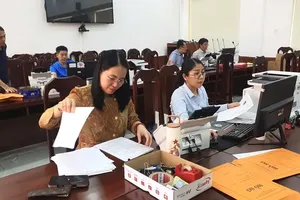
Luong Quang Nhat Minh, an expert from the Economics, Infrastructure, and Urban Department of An Dong Ward and a member of the software development team, stated that citizens can register or extend temporary sidewalk usage right on their phones without visiting the ward People's Committee headquarters. This system operates online, independent of administrative hours or holidays, and integrates cashless payments to make the process transparent and limit negative issues or extra-regulatory costs.
The “An Dong Roadway and Sidewalk Licensing” software not only helps reduce management pressure for the locality but also aims to arrange roadway and sidewalk usage activities more methodically, creating fairness among business households and contributing to a tidier, more civilized urban appearance.
"The locality expects the core efficiency achieved by this initiative to be a change in social awareness and behavior. Instead of continuing the cycle of 'punishing to clear', the software will act as a flexible tool to adjust the habit of using roadways, sidewalks, and public spaces for the correct purpose. The ultimate destination is to re-establish discipline, engineering a safe urban civilization that brings common benefits to the community", expert Luong Quang Nhat Minh said.
Since the beginning of 2026, Ho Chi Minh City Police have carried out more than 24,000 patrol and inspection operations targeting the illegal occupation and use of roadways and sidewalks. Authorities recorded over 33,000 violations, imposing fines totaling more than VND28 billion.
Police also resolved public-order issues at more than 1,200 of the city’s 1,765 identified hotspots and complicated locations. In addition, authorities organized 35,879 public awareness and outreach sessions, while mobilizing 34,129 businesses and establishments to sign commitments pledging not to encroach on roads and sidewalks for trading activities.




)