Ho Chi Minh City’s fisheries sector plays an important role in the marine economy, but is now under urgent pressure to shift away from destructive fishing practices, conserve marine resources and improve overall value.
According to Mr. Nguyen Thanh Loc, Chairman of the Ho Chi Minh City Fisheries Association, most fisheries activities remain spontaneous, lacking long-term planning and not fully matching the sector’s potential. A major bottleneck is the absence of a large-scale fisheries center capable of connecting the entire value chain. He noted that while fisheries are a vital livelihood for coastal communities, sustainable development requires integrated planning and a long-term vision. Early implementation of structured planning would help stabilize fishermen’s livelihoods, develop the marine economy, and contribute significantly to the broader economy.
Restructuring marine exploitation
After decades of intensive development, particularly with trawl fishing, marine resources around Ho Chi Minh City have declined significantly, affecting the livelihoods of many fishermen. In response, some fishermen have proactively sought new directions to continue offshore fishing in a more efficient and sustainable way.
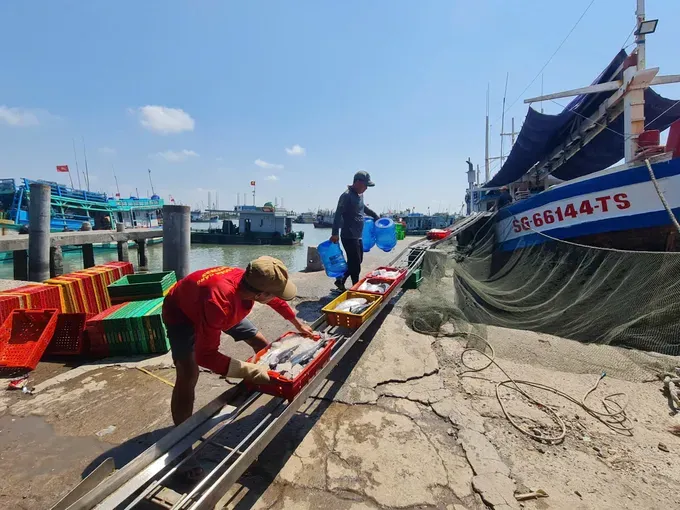
A gradual transition toward offshore fishing has reduced the size of the fishing fleet. Ho Chi Minh City currently records 4,445 vessels, a decrease of more than 2,000 compared to 2021, including 2,217 offshore-operating boats.
The city is also restructuring fisheries toward fewer vessels but higher quality and added value, shifting from spontaneous exploitation to responsible fishing associated with resource conservation and restoration. Combating illegal, unreported, and unregulated (IUU) fishing remains a key priority.
Joint efforts to restore marine ecosystems
According to Ho Chi Minh City’s fisheries transformation plan for 2025–2030, the period from 2025–2027 will focus on converting vessels that are no longer eligible for operation, while 2027–2030 will expand conversions based on fishermen’s needs.
Specifically, 100 percent of nearshore trawlers will be converted to line fishing; 50 percent of inshore vessels will switch to gillnets; and 20 percent of offshore vessels will transition to methods such as gillnetting, line fishing, purse seining, and trap fishing. The city also encourages fishermen to shift toward aquaculture, fisheries logistics services, or other occupations to reduce pressure on natural stocks.
In the Ba Ria–Vung Tau area, there are 4,802 offshore and inshore fishing vessels, with annual catches of around 374,000 tons. However, the fisheries value chain, including capture, aquaculture, logistics and processing, remains fragmented, with small-scale ports, anchorage areas, and support services lacking infrastructure connectivity.
Local authorities said pilot models will be implemented in Vung Tau Ward and Long Hai Commune during 2025–2026, with the target of scaling up later.
At the same time, Ho Chi Minh City will continue restocking programs to replenish marine resources, restore ecosystems, and raise public awareness on marine conservation.
Ms. Pham Thi Na, Deputy Director of the Ho Chi Minh City Department of Agriculture and Environment, emphasized that sustainable fisheries development requires joint efforts between authorities and fishermen, strict compliance with regulations and the elimination of destructive fishing methods.
The city will continue strengthening monitoring of fishing activities, linking occupational transition with resource protection, and aiming for a modern, efficient, and sustainable fisheries sector. She stressed that protecting endangered and rare marine species not only preserves biodiversity but also ensures long-term livelihoods for fishermen.