Floating plastic bags, foam boxes and household waste continue to clog waterways across Ho Chi Minh City, undermining years of costly canal rehabilitation projects aimed at restoring cleaner urban waterways.
At Hy Vong Canal in Tan Son Ward, particularly near Alley 102 on Phan Huy Ich Street, garbage was seen floating in large quantities on the water surface. Mr. Nguyen Van Chinh, a local resident, said that the canal quickly becomes polluted again after each cleanup campaign. Just a few days after the ward organizes garbage collection, trash starts piling up again.
A representative of Tan Son Ward People’s Committee said waste accumulation along Hy Vong Canal becomes especially severe after heavy rain and high tides. Since July 2025, the ward has coordinated four cleanup operations at the Phan Huy Ich drainage culvert area, collecting around 20 tons of waste each time.
Similar pollution has been recorded along Canal 19/5 (May 19) running through Binh Hung Hoa and Tan Son Nhi wards. The canal is regularly dredged and cleaned four times a month by the city’s Center for Traffic and Technical Infrastructure Management, but trash rapidly reappears due to dense residential areas and spontaneous markets along the canal banks.
Meanwhile, Tan Vinh Loc Commune currently has 92 canals and creeks, with 10 showing signs of serious pollution. According to Vice Chairman of the Tan Vinh Loc Commune People’s Committee Truong Ngoc Thanh Nhan, the commune has installed floating trash barriers and strengthened enforcement measures. Since July 2025, authorities have fined 18 cases of illegal dumping and burning of waste, totaling VND65 million (US$2,468), using patrols and surveillance camera footage.
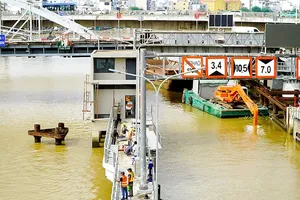
 "Workers collect garbage along Doi Canal in Ho Chi Minh City’s Phu Dinh Ward.")
Mr. Nguyen Ngoc Tuan, Director of the Ho Chi Minh City Inland Waterway Management Center under the municipal Department of Construction, said that the city has organized garbage and water hyacinth collection on seven major canals, including Te Canal, Doi Canal, Tau Hu Canal, Ben Nghe Canal, Nhieu Loc–Thi Nghe Canal, Lo Gom–Ong Buong Canal and Ong Lon Creek, with cleanups conducted every one to two days.
The average amount of waste collected reaches 56 tons per day. With collection costs estimated at VND4 million (US$152) per ton, the city spends a substantial amount from its annual budget on canal cleanup operations.
Authorities say stricter penalties are needed to curb illegal dumping. Mr. Truong Ngoc Thanh Nhan noted that littering cases in Tan Vinh Loc Commune have dropped by about 40 percent thanks to surveillance cameras and written commitments from violators not to reoffend.
Similarly, Mr. Nguyen Ngoc Anh, Chairman of An Nhon Ward People’s Committee, said that local authorities have identified and fined 15 cases of dumping waste into Chin Xieng and Ong Bau canals through camera monitoring systems. Offenders are required not only to pay fines but also clean up the affected areas and commit to avoiding repeat violations.
According to the Ho Chi Minh City Department of Agriculture and Environment, stronger public awareness campaigns should be combined with regular dialogues with residents, online management systems, and the city’s 1022 hotline to receive environmental complaints and address illegal dumping hotspots more effectively.
Mr. Pham Viet Thuan, Director of the Ho Chi Minh City Institute of Economics and Environment, said that current regulations under Decree 45/2022 prescribe fines of between VND1 million (US$38) and VND2 million (US$76) for littering canals and rivers, though authorities face difficulties in catching offenders in the act.
He proposed stronger measures, including wider installation of surveillance cameras, the use of citizen-submitted footage for administrative fines and mandatory community service penalties for offenders.
Mr. Nguyen Ngoc Tuan of the Inland Waterway Management Center added that authorities collected an average of 6.8 tons of waste daily from the Nhieu Loc–Thi Nghe Canal in 2025, rising to about 7.5 tons per day during the first months of 2026.
The main cause is still a lack of public awareness, while current penalties are not strong enough to deter violations, he said.





)