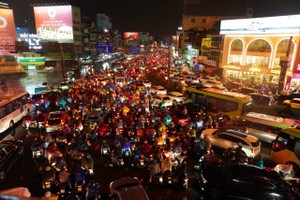
Initial observations indicated significant improvements in traffic conditions across the corridor, particularly at major congestion points such as the Hoang Hoa Tham overpass, the Cong Hoa–Ap Bac intersection and the entrance to Terminal 3 of Tan Son Nhat International Airport.
During the morning rush hour, vehicles traveling in both directions, toward the city center and toward An Suong, moved relatively smoothly. At the Hoang Hoa Tham overpass area, which has experienced severe traffic congestion for years, vehicles were able to move continuously without the usual bottlenecks or gridlock.
Along the section from Ut Tich intersection to Truong Chinh Street, traffic police officers worked alongside youth volunteers and related agencies to regulate traffic remotely and guide motorists under the new traffic arrangement. Although many drivers were surprised by the earlier-than-expected trial, traffic quickly stabilized thanks to clear lane guidance and traffic control measures.
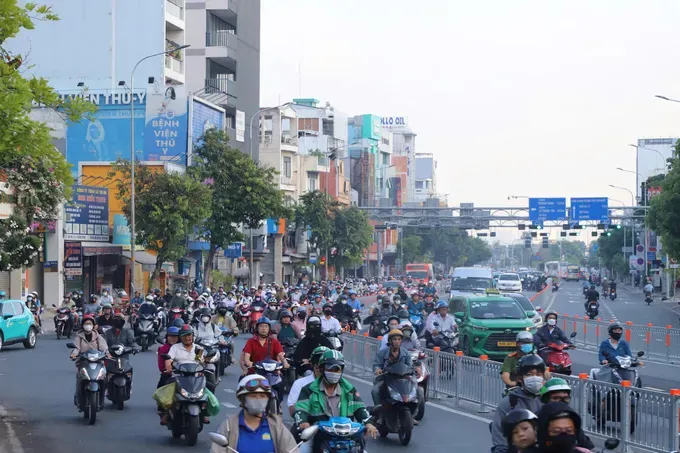
Traffic heading from the city center toward An Suong remained heavy but continued moving at a stable speed. No prolonged congestion was recorded at the Cong Hoa–Ap Bac intersection or near the military barracks entrance. Meanwhile, traffic pressure from Truong Chinh Street toward the city center was also significantly reduced compared to previous days.
However, some localized traffic conflicts still occurred during the trial period, particularly at the Cong Hoa–18E intersection near the entrance to Terminal 3 of Tan Son Nhat Airport. Authorities attributed the issue mainly to vehicles stopping at traffic lights, while a 200-meter section between this intersection and Ut Tich intersection has yet to be fully equipped with lane dividers for the reversible lane system. As a result, traffic slowed down and mild congestion appeared at certain times.
To minimize traffic conflicts, officers from the Tan Son Nhat Traffic Police Team remained on duty at the Cong Hoa–18E intersection to direct vehicles. A traffic police officer noted that although many residents were initially unfamiliar with the new traffic arrangement, most drivers complied with instructions, helping the pilot operation proceed smoothly.
According to the city’s plan, beginning May 15, the 2.5-kilometer long section of Cong Hoa Street from Ut Tich intersection to Truong Chinh Street will officially operate under the reversible lane system.
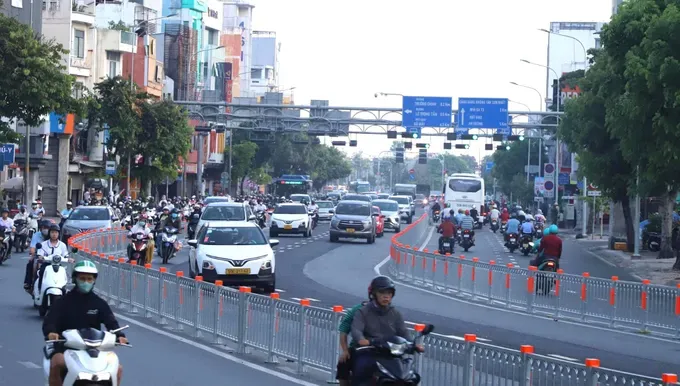
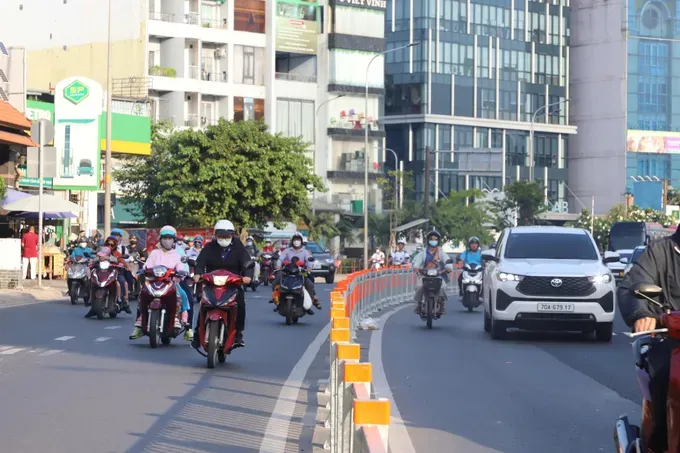
The Ho Chi Minh City Department of Construction said the solution is intended to optimize the existing road infrastructure and improve traffic capacity on this key transportation corridor connecting the city’s northwestern area with Tan Son Nhat Airport. Authorities view the initiative as a short-term solution to ease chronic congestion without immediately expanding the roadway.
During the initial phase, the reversible lane barriers will be operated manually. Authorities will continue monitoring and evaluating the system’s effectiveness before considering automation in the future, aiming to build a more flexible traffic management model based on traffic volume during different times of the day.