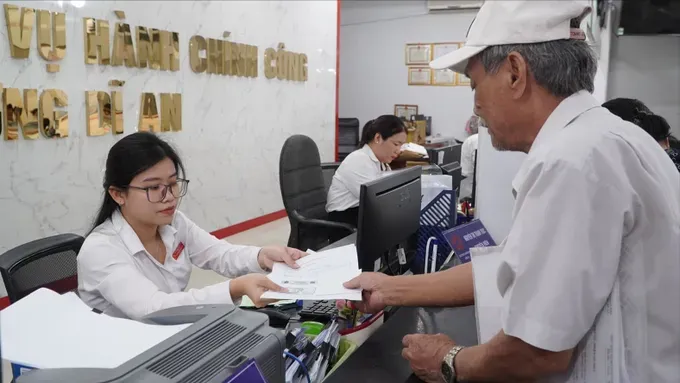
In mid-May 2026, 67-year-old Dang Trung Khien, residing in Thong Nhat 1 Neighborhood of Di An Ward, visited the Di An Ward Public Administration Service Center for civil status procedures. Right after entering, support staff seated him and guided him through submitting his application online. Thanks to this thoughtful assistance, the man completed his procedures much faster, sidestepping the need to return multiple times.
Resolving administrative procedures at the communal level is an absolute necessity for him, given expanding urban spaces, so citizens don’t have to commute to city center offices. “The service is commendable; I hope staff continue upgrading their expertise to serve better,” he expressed.
Di An Ward has a population of around 234,000 people, and every day, the ward’s Public Administration Service Center handles roughly 400 to 500 dossiers to resolve administrative procedures. Just nine months after putting the two-tier local government model into motion, the center has successfully received and transferred over 36,300 dossiers for resolution. The rate of applications resolved early and on time reached a staggering 99.9 percent, while the citizen satisfaction rate hit a flawless 100 percent.
Similarly, 62-year-old Dang Thi Kim visited the Ba Diem Public Administration Service Center to process the renewal of her land use rights and attached property certificate, though she was not familiar with the steps. “Initially, I didn’t know how to prepare my documents, but after an official gave me detailed instructions on each component of the dossier, I fully understood and prepared everything thoroughly,” Ms. Kim shared.
Ba Diem Commune reportedly ranks among the most populous areas in HCMC, accommodating over 204,000 residents. On average, the commune processes roughly 200 citizen dossiers every single day. Director of the Commune Public Administration Service Center Nguyen Van Hau stated that despite the massive workload, the team stays laser-focused on processing documents. Alongside administrative reform models, the commune runs an electronic portal that empowers people to execute online procedures.
Leaders from several wards and communes shared that the current civil servant payroll remains constrained compared to the mounting workload. Consequently, these localities petitioned the city to devise viable solutions.
Specifically, Hiep Binh Ward leaders proposed that the city push IT applications, synchronize resolution apps, build flexible coordination mechanisms between departments, and pay closer attention to salary policies for grassroots civil servants to meet demands.
Meanwhile, Tang Nhon Phu Ward leaders urged the city to persistently focus on supplementing human resources and allocating appropriate payroll quotas for densely populated areas, alongside ramping up thorough training. Simultaneously, it’s vital to perfect digital infrastructure to ensure stable, seamless administrative apparatus operations.
Deputy Director Ngo Gia Dai of the Di An Ward Public Administration Service Center informed that the unit merely has 16 payroll slots and two non-specialized workers. The workload pressure is immense, but the center bends over backwards so that if citizens submit their paperwork in the morning, they get their results that very same morning.
As a result, a single civil servant currently juggles multiple tasks across a variety of fields. To get the ball rolling, the center has also invited interns or fresh graduates to pitch in while simultaneously learning the ropes. Every week, the center organizes training sessions to impart fresh knowledge to its staff members, enabling them to tackle a larger volume of work at a much brisker pace.
Over in Hiep Binh Ward, the government bloc consists of 69 civil servants serving over 225,500 residents, meaning each official caters to more than 3,200 citizens. The Ward Public Administration Service Center receives and resolves between 350 and 400 dossiers daily, with one specialist serving about 40 visits a day. The specialist team directly handles around 200 files per day.
According to Chairman Vo Thanh Binh of the Hiep Binh Ward People’s Committee, even though the workload is swelling and demands for public service are climbing higher, the ward’s cohort of cadres continuously upholds a profound sense of responsibility and dedication to the people. They actively propose innovative solutions to upgrade service quality and expedite task resolution.
Notably, Hiep Binh Ward has set a firm target of not letting citizens wait for more than 30 minutes. The ward has deployed a plethora of IT application solutions alongside digital transformation initiatives to trim down the time required to resolve administrative procedures.
With a population hovering around 214,700, Dong Thanh Commune is among HCMC’s most densely populated areas. To optimally serve denizens, the commune pinpointed digital transformation as its core mission.
The Government rolled out technological solutions, ranging from self-service kiosks to artificial intelligence and robots guiding administrative steps. They introduced a 24/7 robot assistant for online dossier submissions, integrating smart queuing. Consequently, online dossier and on-time result delivery rates exceeded 99.9 percent, hitting 100 percent satisfaction.
Chairwoman Cao Thi Ngoc Chau of the People’s Committee of Tang Nhon Phu Ward informed that the ward is home to over 208,000 individuals. In 2026, the ward was allocated exactly 80 payroll slots. Excluding the unspecialized workforce, every civil servant serves an average of 2,750 residents.
Faced with such crushing pressure, the ward rolled out robust solutions, including streamlining internal workflows, digitizing dossiers, proactively categorizing documents, and stationing dedicated cadres to help citizens finalize paperwork on the spot. The ward has reinforced leadership accountability in monitoring processing progress while aggressively promoting online procedures. Furthermore, delegating judicial administration authority significantly shortens document turnaround times, amplifying public service efficiency.
Vice Chairman Nguyen Le Trong Tam of the Dong Thanh Commune People’s Committee said while previously matters required seeking higher opinions or languishing through intermediate layers, the current administration operates strictly under a one focal point, one process, one responsibility paradigm. This framework drastically slashes dossier resolution times, significantly reducing travel expenses for both citizens and businesses.
The decentralization mechanism empowered commune leaders to proactively tackle grassroots contingencies directly tied to public rights like authentication, civil status, and welfare. Clearly delineating responsibilities for every single specialized civil servant fosters a highly proactive culture, curbing the tendency to pass the buck.









)