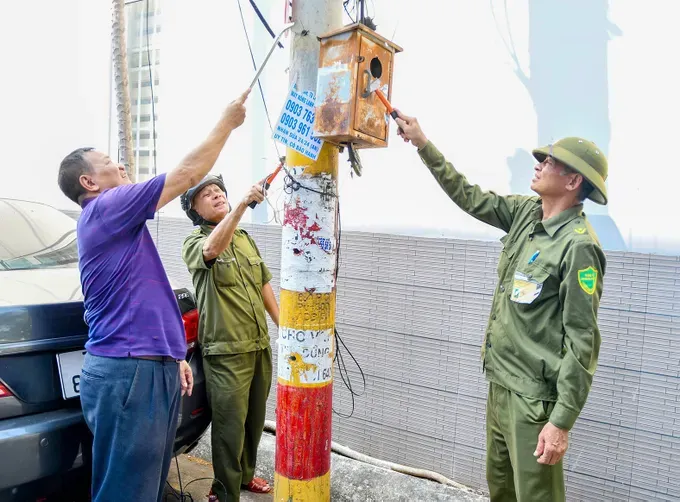
On a brisk weekend morning in Tam Thang Ward, dozens of Ho Chi Minh Communist Youth Union members, local police officers, and a large crowd of residents reportedly gathered in alleyways to strip away illicit advertisements. It’s a true team effort, as some wielded scrapers and others brought paint thinner, while a few used brooms to sweep down the freshly cleaned walls. Up on the utility poles, thick, intertwined layers of flyers touting “quick loans,” “financial aid,” and “concrete drilling” were systematically scraped off to get the ball rolling.
Similar scenes are currently popping up across various residential areas throughout HCMC during an intensive 45-day campaign to eliminate unlawful advertising, which kicked off in early May 2026.
The Steering Committee for Crime, Social Evil Prevention and Construction of All-People Movement to Protect National Security (Commune-level Steering Committee 138) citywide has concurrently launched a focused drive to eradicate non-compliant ads across 100 percent of communes, wards, and the special zone. In many localities, this removal work is maintained on a weekly basis, inextricably linked to the criteria of building clean neighborhoods, civilized alleys, and secure urban spaces.
According to the HCMC Department of Public Security, the current crop of illegally posted ads doesn’t just feature mundane classifieds but frequently involves “black credit” operations, loan sharking, shady recruitment schemes, or activities bearing the hallmarks of fraud. Numerous ill-intention actors apparently exploit these scattered flyers to prey on citizens desperate for quick cash, thereby spawning a host of security and public order complications. Consequently, tackling these illegal advertisements serves a dual purpose, both restoring urban beauty and actively curbing grassroots crime.
One of the most noteworthy aspects of the current fight against “trash advertising” is the increasingly proactive involvement of the public. In several neighborhoods across Thu Duc, Dong Hung Thuan, and Binh Tri Dong wards, self-managed Zalo groups have been set up to instantly report any fresh ads that pop up. Quite a few households don’t hesitate to proactively peel off flyers stuck to their front doors, repaint aging walls, and gently remind one another to uphold the shared aesthetic.
For Nguyen Thanh Long, a resident of Phu Cuong 6 Neighborhood in Thu Dau Mot Ward, the battle against “trash ads” demands formidable, deterrent sanctions targeting the individuals and organizations that hire people to recklessly print and plaster these materials. “Safeguarding the urban landscape can’t rely solely on voluntary clean-up drives,” he argued, stressing the need for conscientious behavior from business owners and citizens, coupled with iron-fisted management measures from the authorities.
Back in early May 2026, while patrolling along Hai Ba Trung Street, police forces from the Tan Dinh Ward Public Security Division caught a man red-handed plastering illegal advertisements onto a residential wall. The authorities swiftly drew up an administrative penalty record and compelled the individual to scrub away every single flyer he had stuck up.
Just a few days later, over in Phuoc Long Ward, the local police reportedly discovered a fresh batch of ads that had cropped up overnight. By pulling security camera footage and scrutinizing the phone numbers printed on the leaflets, the functional agencies successfully pinpointed the culprits to penalize them according to the law.
In Binh Tri Dong, Binh Thoi, and Trung My Tay wards, multiple instances of unlawful ad pasting have also been consistently uncovered during nocturnal patrols. Quite a few individuals were subsequently forced to sign pledges vowing not to become repeat offenders.
According to the Thu Duc Ward Public Security Division, while trash ads used to be peeled off one day only to brazenly reappear the next, many perpetrators are now far more wary because the security camera network is constantly being tapped into.
Moreover, alongside the physical removal, numerous localities are rolling out innovative models to maintain the urban aesthetic. As part of this effort, the police forces of Binh Phu, Tay Thanh, Hoa Hung, and Tan Hung wards have been simultaneously mobilized to eradicate illicit ads, pairing this with public outreach to urge residents not to facilitate “trash advertising.”
It appears some areas have even established Rapid Response Teams to immediately tear down new flyers, effectively dodging the old scenario where fresh ads were simply plastered over the old ones. At the end of the day, many neighborhoods are transforming decaying walls into vibrant murals, green alleys, or civilized street corners. Wall spaces that were once plastered thick with hotline numbers for hot loans and financial aid are now cloaked in propaganda paintings, lush greenery, or messaging that promotes urban civility.
The complex task of tackling “trash advertising” obviously can’t be wrapped up in just a few days of deployment. However, the silver lining is that in many HCMC residential quarters, community awareness is gradually shifting. From police officers burning the midnight oil checking cameras to trace violators, to Youth Union members diligently scraping away layers of paper from utility poles; from citizens voluntarily repainting their front walls to neighborhood groups reminding one another to keep their narrow alleys spotless, it’s all coming together to carve out a substantially more civilized facade for the city.












)