By leveraging these strategic sectors, the city aims to enhance its competitiveness and reinforce its position as a leading economic center in Asia.
Expanding development space toward the sea
With its gateway location on the East Sea and direct links to the Southern Key Economic Region and the Mekong Delta, Ho Chi Minh City is well-positioned to develop a large-scale ecosystem encompassing seaports, logistics and international trade.
One of the city's greatest advantages is its location along major international shipping routes connecting Asia with Europe and the Americas. Surrounding its port system is a vast economic hinterland that includes key export-oriented industries and large-scale agricultural and seafood production, providing a substantial source of cargo.
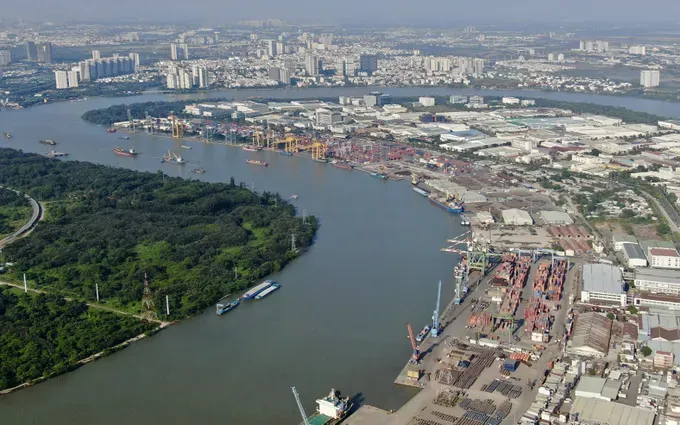
The Cai Mep–Thi Vai deep-water port complex has already established itself as a major international maritime gateway for the Southern region. Under national development plans, the Can Gio International Transshipment Port is expected to complement Cai Mep–Thi Vai and form a large-scale international transshipment hub with regional and global significance. The project is considered a strategic step toward expanding Ho Chi Minh City's maritime economy, logistics services and international trade capacity.
Under Prime Ministerial Decision No. 148/QD-TTg, the Can Gio International Transshipment Port will cover approximately 571 hectares with a minimum investment of VND50 trillion (US$1.9 billion). The port will be capable of accommodating container vessels of up to 250,000 DWT, equivalent to around 24,000 TEUs, placing it among the world's largest container ports.
The project will be developed in seven phases, with the first phase scheduled to begin operations in 2027 and full completion targeted for 2045. Once operating at full capacity, the port is expected to generate annual revenue of VND34 trillion to VND40 trillion (US$1.3 billion- US$1.5 billion) and create tens of thousands of jobs in logistics, transportation, trade and port-related services.
Experts note that the project's significance extends beyond logistics. With its long coastline and UNESCO-recognized mangrove biosphere reserve, Can Gio has the potential to evolve into a modern coastal eco-city integrating seaport operations, logistics, ecotourism, commerce and green economic activities.
According to Mr. Huynh Phuoc Nghia, Director of the Center for Economics, Law and Governance at the University of Economics Ho Chi Minh City, the Southeast region is currently Vietnam's largest production and export hub. Once the international transshipment port network is completed, import-export cargo flows will be optimized, reducing transportation costs, enhancing business competitiveness and attracting higher-quality investment.
However, experts emphasize that transport connectivity remains the decisive factor. Despite its advantageous maritime location, Ho Chi Minh City and neighboring provinces continue to face traffic congestion, limited rail connectivity and a shortage of value-added logistics services.
Mr. Pham Anh Tuan, General Director of Portcoast, said that priority should be given to completing strategic infrastructure projects such as the Bien Hoa–Vung Tau Expressway, Ben Luc–Long Thanh Expressway and Ring Roads 3 and 4 to strengthen regional connectivity.
Similarly, architect and urban planning expert Ngo Viet Nam Son stressed the importance of accelerating investment in a multimodal transportation network that includes roads, railways, waterways, metro lines and modern logistics centers.
A modern and efficient transportation network is essential for converting seaport advantages into tangible economic competitiveness. With stronger connectivity, the Can Gio–Cai Mep–Thi Vai port cluster could emerge as a key international shipping hub serving southern Vietnam, integrated with Long Thanh International Airport and the industrial ecosystem of the Southeast. Such infrastructure would also support the development of a dynamic coastal growth corridor from Can Gio to Vung Tau, Long Hai, Ho Tram and Phan Thiet.
Building a logistics–finance–trade ecosystem
Seaports serve as gateways for trade flows, while finance supplies the resources necessary to sustain growth and investment. Recognizing this synergy, Resolution No. 09 introduces a forward-looking development model centered on the convergence of logistics, international commerce and global financial services.
This vision is supported by Ho Chi Minh City's progress in developing an International Financial Center. On December 21, 2025, the Government officially announced the establishment of the Vietnam International Financial Center (VIFC) in Ho Chi Minh City and Da Nang under a "one center, two destinations" model. The Ho Chi Minh City branch is expected to serve as a key gateway for international capital flows.
According to Associate Professor Nguyen Huu Huan, Vice Chairman of the Executive Board of VIFC-HCMC, the center aims to attract global capital, reduce dependence on bank lending and expand funding channels for businesses. To date, it has secured approximately US$19.1 billion in committed capital from international investors and financial institutions, with a target of converting around US$10 billion into actual disbursements in 2026.
VIFC-HCMC plans to focus on financial technology (fintech), digital assets, asset tokenization, cross-border payments and green finance to establish a competitive advantage among emerging financial centers worldwide.
Recent policy developments have gradually created a legal framework for regulatory sandboxes that allow controlled testing of innovative financial models. Resolution No. 09 further expands institutional flexibility by granting Ho Chi Minh City greater autonomy to develop policies tailored to its growth objectives.
Experts believe the sandbox approach could extend beyond finance to sectors such as logistics, technology, e-commerce and innovation, helping attract global technology firms, fintech companies and international investors.
Alongside the International Financial Center, the proposed Cai Mep Ha Free Trade Zone is poised to become a strategic driver of growth, strengthening the Southern region’s trade, logistics and investment landscape.
According to Dr. Huynh Phuoc Nghia, the free trade zone could function as an "institutional laboratory" where advanced policies on taxation, customs procedures, foreign exchange management and administrative reform are piloted. Such mechanisms could significantly enhance the region's attractiveness to high-quality foreign direct investment as multinational corporations continue to restructure global supply chains.
Direct connectivity between the deep-water port system, Long Thanh International Airport and the International Financial Center would create a fully integrated development ecosystem. Goods would move efficiently through the port network, logistics services would support supply chains, and financial institutions would provide international payments, maritime insurance, trade finance and specialized financial products.
The integration of ports, trade and finance has been a key factor behind the success of many of the world's leading economic centers. Rather than developing each sector independently, connecting them into a unified ecosystem generates greater value and stronger economic efficiency.
From the Can Gio–Cai Mep–Thi Vai international port system to the Cai Mep Ha Free Trade Zone and the VIFC-HCMC, a new development architecture is gradually taking shape. Supported by modern infrastructure and breakthrough institutions, Ho Chi Minh City is positioning itself not only to reinforce its role as Vietnam's economic engine but also to emerge as a leading logistics, financial and trade hub in Asia.