On December 22, Deputy Director of the Ho Chi Minh City Department of Construction, Bo Ky Thuat, stated that after reviewing and coordinating with relevant units, the department has provided information on projects classified as national key works, as well as large-scale and technically complex constructions. It has also proposed to the State Inspection Council for Construction Acceptance to include these projects in the list of works to be inspected by the council in the near future.
The first proposed project is the construction of the highway segment from the Saigon River to the Thay Cai Canal, also known as the DATP 2-3 project, to be implemented under a public-private partnership (PPP) model.
The project spans Tay Nam Ward, Nhuan Duc Commune, and Tan An Hoi Commune in Ho Chi Minh City and Hau Nghia Commune in Tay Ninh Province. The project’s investor is the city’s Transportation Works Construction Investment Project Management Board.
The total preliminary investment is approximately VND7,969 billion (US$302.6 million), including VND3,035 billion (US$115 million) from the city budget and around VND4,934 billion (US$187.2 million) from private investors.
In its first phase, the project will construct a four-lane highway designed for a speed of 100 km/h, with a roadway width of 25.5 meters, in accordance with current national technical standards and regulations. The project is expected to commence in 2026.
The second project is Ho Chi Minh City Metro Line 2 (Ben Thanh–Tham Luong), managed by the Ho Chi Minh City Urban Railway Management Board, with a total length of 11.68 km. Of this, approximately 9.33 km runs underground, 0.28 km is a transition section, 1.61 km is elevated, and 0.46 km runs at ground level to the depot.
The line will feature 10 underground stations, including the central Ben Thanh station, one elevated station, and a depot. The project also includes the supply and installation of advanced integrated systems, such as locomotives, carriages, electromechanical systems, communications, signaling, control, monitoring, and automated ticketing systems.
Metro Line 2 is scheduled to commence on January 15, 2026, and will be implemented during the 2026–2030 period.
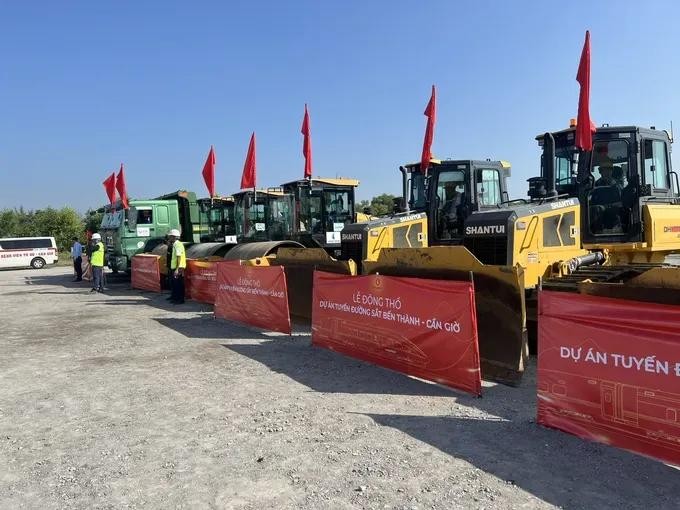
The third project is the Ben Thanh–Can Gio metro line, a large-scale transport initiative of strategic importance, connecting central Ho Chi Minh City with the southern region of the city.
The project is led by inSpeed High-Speed Rail Investment and Development Joint Stock Company and will be constructed as a double-track, electrified line with a standard gauge of 1,435 mm. The main line spans approximately 54.062 km, with a design speed of up to 350 km/h and an axle load of 17 tons per axle.
According to the plan, the project will feature two stations in its first phase, including Ben Thanh and Can Gio stations. Four additional stations, consisting of Tan Thuat, Tan My, Nha Be, and Binh Khanh, will be added in phase two as demand arises.
The project also includes a depot and an Operations Control Center (OCC), both planned to be located in Can Gio Commune. The Ben Thanh–Can Gio metro line officially commenced on December 19, 2025, with implementation scheduled from 2025 to 2028.