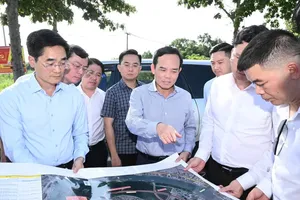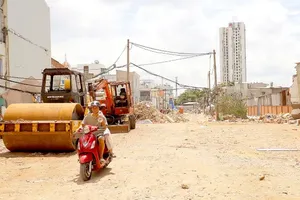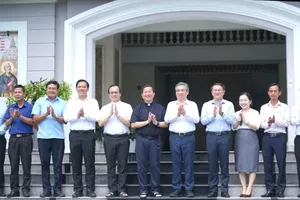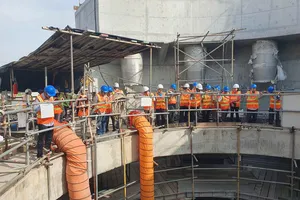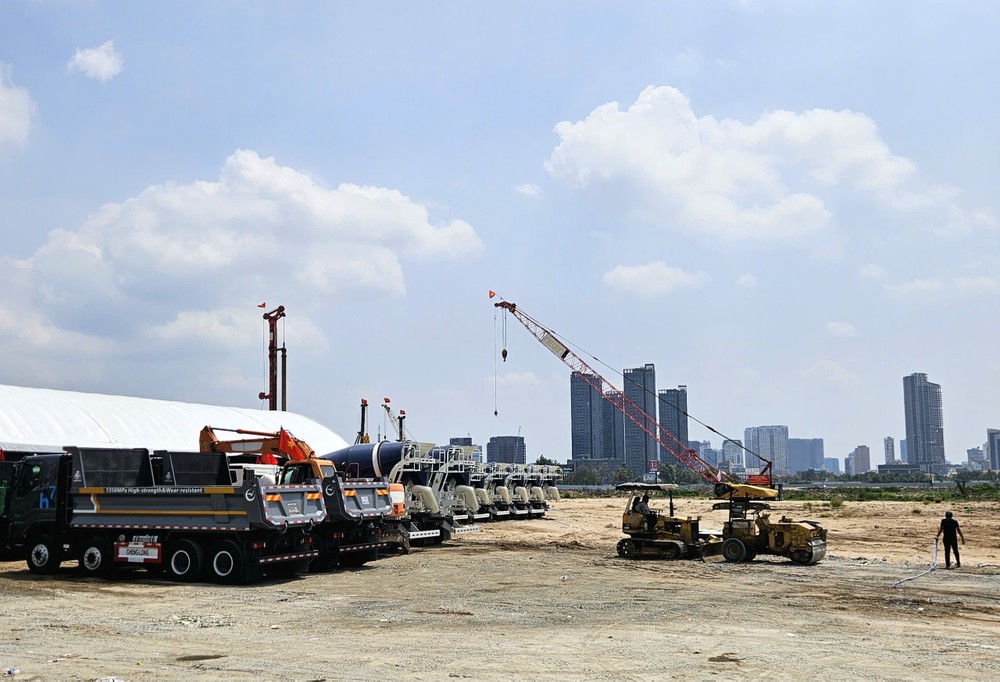
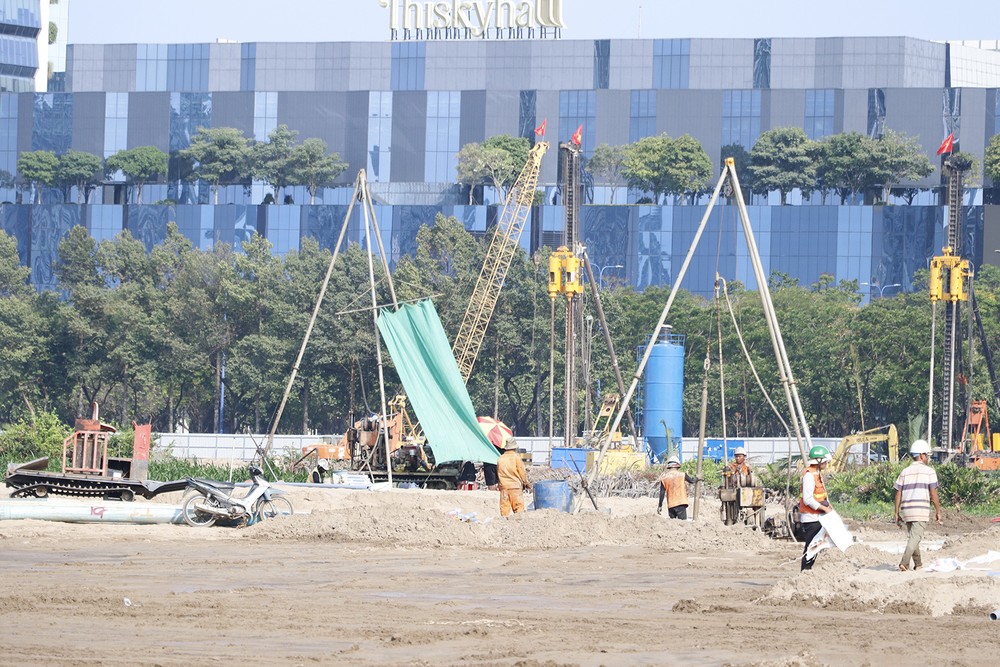
On the afternoon of April 28, many workers and heavy machinery were busily preparing for the groundbreaking ceremony of the City Center Square and the Ho Chi Minh City Administrative Center project in the Thu Thiem New Urban Area, An Khanh Ward. The land area, over 46.7 hectares, surrounded by To Huu, Mai Chi Tho, and Nguyen Co Thach roads, has been cordoned off by workers. Inside, construction teams are continuously carrying out site leveling and connecting electricity and water to serve the project.
This is one of Ho Chi Minh City's key projects, which commenced construction on April 29. The investment in this project comes at a time when Ho Chi Minh City, after its merger, has a population of over 14 million people, an area of more than 6,700 km2, and 168 administrative offices in communes. Consequently, the administrative apparatus has expanded, with over 8,000 officials and civil servants working in dispersed locations across various offices. This project is a strategic solution focusing on online public services and intelligent operations centers (IOCs), minimizing the space required for traditional paper document storage.
According to the Ho Chi Minh City People's Committee, consolidating departments and agencies under a single authority represents a transitional phase from a "dispersed - legacy" model to a "centralized - modern" one. The new Ho Chi Minh City Administrative Center is planned to be modern and centralized, meeting the requirements for housing the offices of state management agencies. This contributes to streamlining the organizational structure and improving the effectiveness and efficiency of state management, reducing the dispersion of administrative offices. This will enhance the quality of public administrative services, making it easier for citizens and businesses to access and complete administrative procedures according to a unified process, shortening processing times, and ensuring transparency and efficiency.
The project also creates a system of green spaces and public spaces, fostering a harmonious ecological environment for the community; contributing to improving the living environment and spiritual well-being of citizens, meeting their needs for daily life, recreation, cultural exchange, and access to public spaces in line with sustainable and environmentally friendly urban development.
The project to renovate and upgrade the Ho Chi Minh Museum - Ho Chi Minh City Branch at Nha Rong Wharf in Xom Chieu Ward not only preserves historical and cultural values but also contributes to the reconstruction of the riverside space in an "open" direction. The project is expected to transform the Saigon riverside area into an iconic cultural and tourist destination, while expanding public space for city dwellers.
Ben Thanh–Thu Thiem metro line breaks ground, completion targeted for 2030
Meanwhile, the Ben Thanh - Thu Thiem metro line project, approximately 6.2km long and entirely underground with 6 stations, has also commenced construction, marking a significant step forward in the development of urban transportation infrastructure. This metro line starts from Ben Thanh station, follows Ham Nghi road, crosses the Saigon River to reach the Thu Thiem urban area, An Khanh Ward, and continues along Mai Chi Tho boulevard to the final station. The project has a total investment of approximately VND46,300 billion and is proposed to be implemented under a public-private partnership (PPP) model, specifically a Build-Transfer (BT) contract, with the investor being Dai Quang Minh Real Estate Investment Company (a subsidiary of THACO).
The project is expected to be completed in 2030 and will be seamlessly connected with other metro lines in the city's urban railway network.
This metro line is considered crucial in connecting the existing city center with the Thu Thiem New Urban Area, an area envisioned to become an international financial and commercial center. The line also links with strategic transportation axes such as Metro Line 2 and the Thu Thiem-Long Thanh railway line, contributing to increased connectivity with Tan Son Nhat Airport and the future Long Thanh Airport. The project is expected to reduce traffic pressure in the city center, especially on routes through the Thu Thiem Tunnel and Saigon Bridge.
The operation of this metro line will contribute to improving public transport capacity, promoting socio-economic development, and enhancing the competitiveness of Ho Chi Minh City. While the Ben Thanh-Thu Thiem metro line is an urban land-based transportation axis, the Can Gio International Transshipment Port project opens up opportunities for development towards the sea. Furthermore, the International University Urban Area project in Xuan Thoi Son Commune is a concrete step in developing a knowledge-based city, providing high-quality education, attracting investment, human resources, and creating a space for innovation for the city.