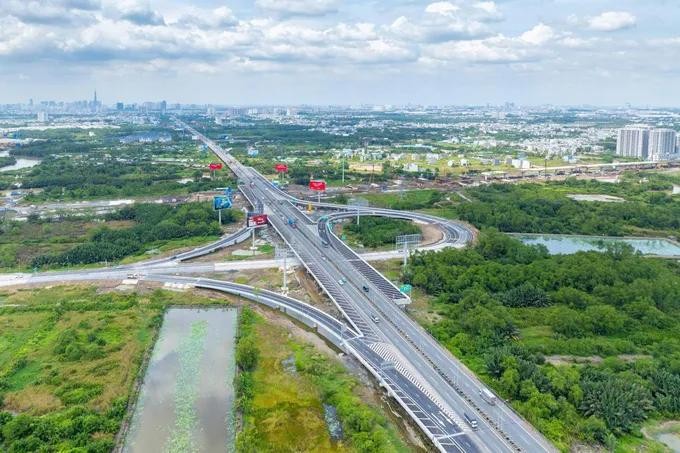
Construction sites along the Ho Chi Minh City – Long Thanh Expressway project in Dong Nai Province have been bustling with activity in recent days, as contractors accelerate work to meet deadlines. Hundreds of engineers and workers, along with heavy machinery and equipment, have been deployed across the sites, working around the clock to ensure progress, quality and safety.
Ho Chi Minh City – Long Thanh Expressway to be expanded to 8–10 lanes
The project to expand the Ho Chi Minh City – Long Thanh Expressway will increase capacity to 10 lanes on the section passing through Ho Chi Minh City and eight lanes on the Dong Nai section. The nearly 22-kilometer route begins at the Ring Road 2 interchange in Long Truong Ward of Ho Chi Minh City, and ends at the Bien Hoa – Vung Tau Expressway interchange in the former Long Thanh District, Dong Nai Province.
With a total investment of more than VND16.3 trillion (US$6.2 billion), the project is being implemented under an emergency mechanism. It is scheduled for completion by the end of 2026 and expected to open to traffic in early 2027.
At the construction sites, hundreds of engineers and workers, supported by numerous machines and specialized equipment, are working simultaneously along the entire route. To ensure traffic safety during construction, metal barriers have been installed along both sides of the road, and the speed limit has been reduced to 90 km/h from the previous 120 km/h.
Nguyen Minh Thanh, a worker operating a piling drill, said construction teams are working overtime and around the clock to complete critical foundation work. “Despite complicated weather conditions and high pressure, everyone is determined to complete the project on schedule,” Thanh said.
Engineer Nguyen Van Nguyen, supervisor of construction package No. 2, said work is being maintained at about 20 hours per day to ensure progress while preserving the durability of equipment, rather than operating continuously for 24 hours to avoid potential safety risks.
According to Pham Thanh Hai, director of the project management board, Long Thanh Bridge is the key component determining the progress of the entire route. Each bridge pier is supported by two to four barges and specialized equipment, with construction organized in three shifts and four teams. Drilled pile installation is strictly controlled, with each pile taking between 10 and 20 hours depending on geological conditions.
Several main pier foundations have already been completed, paving the way for construction of the bridge columns and subsequent girder segments. A representative of the contractor consortium for package XL01 said the goal is to complete the main bridge closure before December 31, 2026, and open it to traffic in early February 2027.
Alongside construction, land clearance work has been closely coordinated between Ho Chi Minh City authorities and Dong Nai province. Many households have agreed to hand over land early, allowing construction teams to operate continuously and helping keep the project on schedule.
Ben Luc – Long Thanh Expressway nearing completion
Along with the expansion of the Ho Chi Minh City – Long Thanh Expressway, the Ben Luc – Long Thanh Expressway project is entering its final stage, with overall construction progress reaching about 97 percent. Several sections of the route have already been opened to traffic.
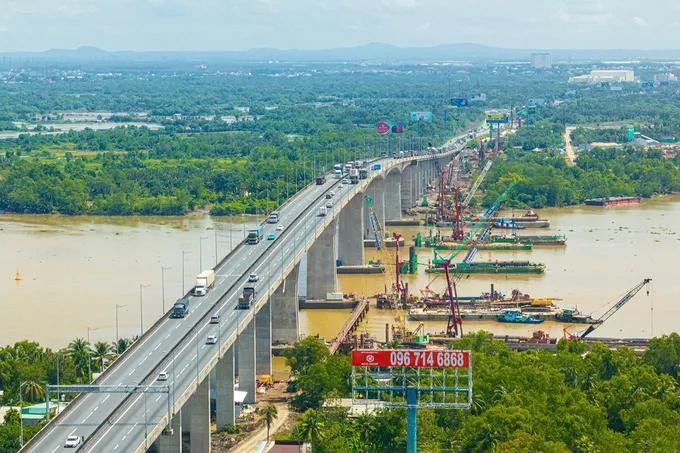
Currently, only two remaining contract packages are under construction: the National Highway 51 interchange and Phuoc Khanh Bridge.
At the construction site of the Phuoc Khanh Bridge, the final link needed to complete the expressway, about 120 engineers, technicians and laborers are working in three shifts across four teams. Dang Huu Vi, deputy director in charge of the Southern Expressway Project Management Unit under Vietnam Expressway Corporation (VEC), said the contractor is focusing on the main span of the cable-stayed bridge, having installed the ninth cable bundle and preparing to carry out the next phases of the approach bridge.
Construction progress is broadly on schedule, with completion expected in September 2026. Meanwhile, the National Highway 51 interchange package has reached about 60 percent of its planned output and is scheduled to be completed in June 2026, without affecting the operation of already opened sections.
The Southern Expressway Project Management Board said that about 55 kilometers of the Ben Luc – Long Thanh Expressway have been completed so far. Of this, 30 kilometers have already been put into operation with toll collection at all seven interchanges. The remaining 25 kilometers have been built, but cannot yet be opened because connecting interchanges are not fully completed.
Dang Huu Vi said VEC has required contractors to commit to specific timelines for each construction component while tightening supervision. Resources are also being mobilized to accelerate remaining works, to open the entire route to traffic in the third quarter of 2026.
Accelerating work on these two key infrastructure projects is expected to help reduce congestion and improve connectivity between Ho Chi Minh City, Dong Nai Province and the southern key economic region. In particular, the projects will strengthen transport links between Ho Chi Minh City and Long Thanh International Airport.
On December 19, 2025, Binh Khanh Bridge, which is one of the two largest bridges on the Ben Luc – Long Thanh Expressway, was completed and inaugurated. Spanning the Soai Rap River, the bridge is 2.7 kilometers long, including a nearly 750-meter cable-stayed section. Access roads and connecting overpasses on both sides extend for more than 2 kilometers.
The bridge was built with four traffic lanes and two emergency stopping lanes, with a total investment exceeding VND3.7 trillion. Notably, the structure features two H-shaped pylons rising 155 meters high and provides a 55-meter navigation clearance, allowing large vessels to pass along the Soai Rap River.