Given the increasingly complex saline intrusion situation during the 2025-2026 dry season, Dong Thap Province is proactively implementing various solutions to ensure the safety of agricultural production, with particular emphasis on protecting over 134,000 hectares of fruit trees, the largest area in the Mekong Delta.
Dong Thap Province is stepping up defenses against saline intrusion as the 2025–2026 dry season unfolds. According to the Department of Agriculture and Environment of Dong Thap Province, saline intrusion during the 2025-2026 dry season was predicted to peak around the 15th day of the second lunar month.
Salinity levels on the Tien River have already reached 1g/L, with intrusion expected to extend to the Xoai Hot sluice gate in Kim Son Commune, a region renowned for durian, Lo Ren star apple, green pomelo, and longan. Farmers here are doubling daily salinity checks, storing freshwater in ditches and ponds, and sealing sluice gates when alerts are issued.
Farmer Pham Van Bay in Kim Son Commune said that normally, he and other farmers measure salinity once a day during high tide. This season, he measures salinity twice a day. Mr. Bay has filled his ditches and ponds with water, ensuring a sufficient supply during this year's drought and salinity season.
In the Ngu Hiep Commune of the province, which encompasses over 3,100 hectares of agricultural land, more than 95 percent of which is dedicated to durian cultivation, the Ngu Hiep islet faces saline water encroachment from all directions during each drought and salinity intrusion period. In preparation for the drought and salinity season of 2025-2026, farmers in Ngu Hiep Commune are adopting various strategies.
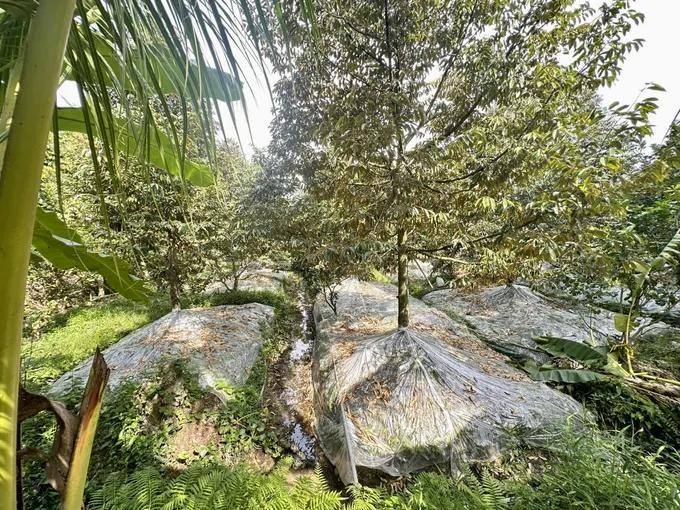
Farmer Tran Van Bon in Ngu Hiep Commune said that his family proactively dredged ditches and stored freshwater before the Lunar New Year to protect 1.5 hectares of durian trees. At this time, he regularly removes water hyacinths and other obstacles in the ditches and ponds in his durian orchard to store freshwater, and also spreads rice husks and coconut fiber around the base of the durian trees, combined with planting grass around the base to retain moisture.
When a salinity increase is announced, he will close the sluice gates in his orchard. In Ngu Hiep Commune, there are currently four sluice gates to prevent saltwater intrusion. When salinity levels increase, the sluice gates will be closed by the relevant authorities. The People's Committee of Ngu Hiep Commune has operated 6 backup pumping wells to avoid being caught off guard if saltwater intrusion becomes severe. In addition, many households in the commune have proactively dug ponds and cleared ditches to store water.
According to Dang Van Tuan, Vice Chairman of the People's Committee of Ngu Hiep Commune, by this time, people have gained experience and are proactively responding to drought and salinity intrusion to protect their agricultural land. The commune has also set up 9 salinity monitoring points twice a day to promptly inform people about drought and salinity prevention and protect the durian-growing area.
Elsewhere in the Mekong Delta, to face with the risk of drought and saltwater intrusion in the 2026 dry season, the Rural Clean Water Center of Vinh Long Province is implementing many solutions, including transporting 39,800 cubic meters of raw water to the water treatment plants when salinity levels exceed 2‰ to ensure a stable supply of drinking water for local inhabitants.
Yesterday, according to Luu Nhuan, Director of the Rural Water Supply Center of Vinh Long Province, due to the exploitation of surface water sources, Area III (formerly Ben Tre Province) is identified as being most severely affected when saltwater intrusion occurs. If the average level of saltwater intrusion is moderate (salinity from 1‰ to less than 2‰), the interconnected water supply networks will transfer freshwater from plants with low salinity to the affected area; simultaneously operating 31 RO desalination systems, backup pumping stations, and purchasing water from neighboring units when needed.
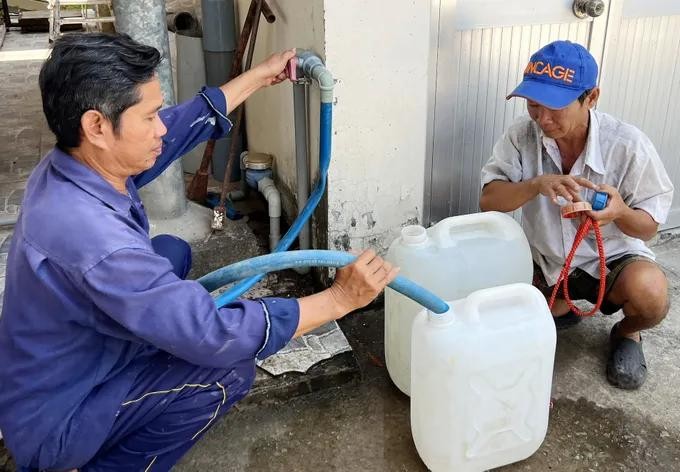
In the peak dry season scenario (salinity above 2‰, expected from March to May 2026), the Center will deploy the transportation of raw water by barge to 5 water treatment plants such as Tan Hao, Luong Phu, Phuoc Long, Long Dinh, and Binh Khanh Dong. The total volume of freshwater expected to be transported in this phase is 39,800 cubic meters, with a cost of over VND1.55 billion.
In Area I (formerly Vinh Long Province), some stations may be affected when salinity exceeds 0.3‰, impacting approximately 20,000 people with localized disruptions lasting several hours a day. The Center will intensify salinity monitoring and measurement, promptly notifying residents to proactively store water.
In Area II (previously known as Tra Vinh Province), the effects are typically minimal owing to the predominant dependence on groundwater, the existence of sluices designed to prevent saltwater intrusion, and the availability of water reservoirs.
Regarding engineering solutions, in 2026 the Center plans to maintain and repair 56 stations; upgrade and expand 25 facilities; install 7,500 new water meters; upgrade nearly 47.8 km of main pipelines; and add high-flow boreholes in key areas.
Water storage and supply initiatives in regions with limited resources are anticipated to deliver fresh water to more than 10,000 households. The overall funding necessary for executing the plan is estimated at around VND221.2 billion, which will be obtained from the unit's operational income, development fund, and the provincial budget.