AI is reshaping filmmaking, from one-person studios in Vietnam to industrial-scale production lines.
Enter the one-person studio
A conventional film begins with a script, actors, a set, and cameras. An AI-generated production can begin with little more than a prompt.
Director Pham Vinh Khuong, one of Vietnam's early AI filmmaking pioneers, demonstrated the process through Du Hanh Xu Thieng (Journey to the Sacred Land). Its female protagonist was created from a detailed prompt describing a high-quality resin character in a chibi style blending hip-hop and jazz, with an oversized head, small body, jade-green eyes, and flowing white hair.
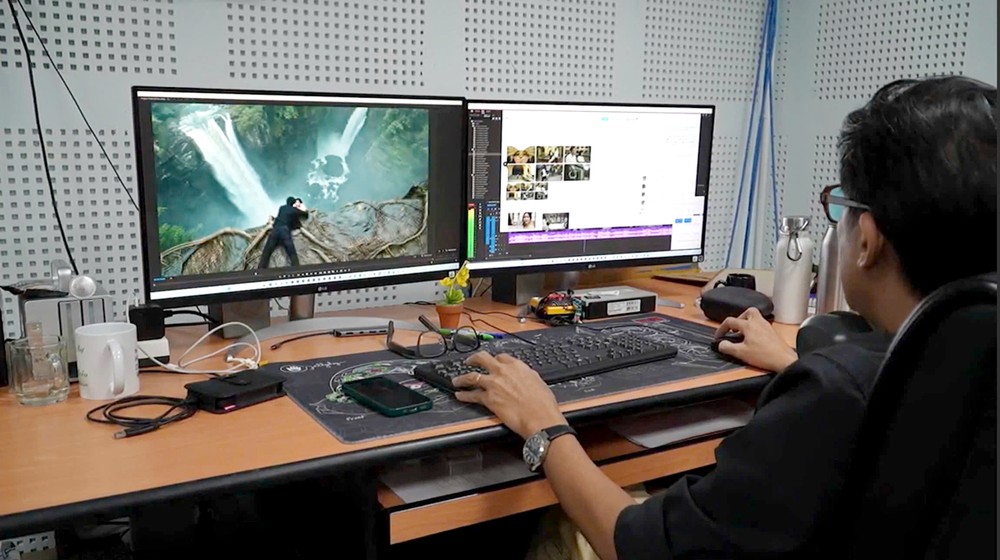
Maintaining visual consistency across scenes requires detailed descriptions of characters, costumes, and accessories, followed by repeated adjustments. Khuong divides the process into five stages: scriptwriting with ChatGPT or Claude; character design with Midjourney, Flux or Gemini; video generation with Seedance, Kling or Veo; dialogue and music with ElevenLabs or Suno; and post-production, lip-sync and color grading with Premiere or CapCut.
Khuong and his colleagues completed the four-minute-plus film in less than two days, compared with the more than six months traditionally required for animation. The model has created the "one-person studio", allowing a single creator to perform tasks once requiring an entire production crew.
But lower technical barriers do not necessarily produce better storytelling.
Writer and screenwriter Pham Ha Thu, who has experimented with AI filmmaking, said many young creators mistakenly equate fast pacing and constant twists with compelling storytelling.
"When dialogue and causes are cut out, a film is left with nothing but consequences, losing both emotion and detail," she said, stressing that characters are often built through small details and moments of silence rather than dramatic events. AI, however sophisticated, relies on statistical patterns rather than an understanding of human pain.
The technology has also raised concerns over creative identity. Because many AI platforms are heavily influenced by Chinese training data, sample scripts and character models, Vietnamese creators can easily fall into a copy-and-paste approach, reproducing pale-skinned characters, foreign costumes and rapid-fire melodrama.
Copyright concerns are also emerging on Facebook and TikTok, where some creators have borrowed the names of popular Vietnamese television productions, including Song Chung Voi Me Chong (Living with My Mother-in-Law), to attract viewers.
The content broadly falls into two categories: Chinese-produced short films translated and dubbed by AI, and Vietnamese-made productions that reproduce foreign scripts, dialogue, and family-conflict formulas almost verbatim.
Some channels, including Cau Chuyen Cua Thao (Thao's Story) and Day Tro Co Sau (Aunt Sau's Boarding House), have introduced local elements such as boarding-house life, traditional home clothes, and neighborhood markets. Much of the online content, however, continues to rely on stylized characters and escalating conflicts designed to keep viewers paying for the next episode.
One young AI filmmaker said the entire process can be condensed into prompts covering the script, characters, settings, and soundtrack, while stories can be sourced freely online.
The question remains whether Vietnamese language and settings alone are enough to make an AI production genuinely Vietnamese.
Automated production, human emotion
What began as isolated experiments is evolving into a production “machine,” with AI enabling creators to generate dozens of short episodes a day. By locking a character’s facial features and automating production, creators can sharply reduce costs and produce content on an industrial scale.
AI can also analyze viewer behavior, including when audiences skip or swipe away from content, allowing producers to insert twists and cliffhangers to keep them watching. But speed and efficiency do not necessarily translate into compelling storytelling.
AI-generated video still struggles with distorted hands, frozen expressions, inconsistent lighting, and continuity errors in clothing and physical details. Director Dung Nghe said AI can create a person who appears to cry or laugh, but producing an authentic gaze that moves an audience remains much harder.
“AI is simply a way of making a film, not the reason audiences will love it,” he said.
Meritorious Artist Trinh Quang Tung, Deputy General Director of the Central Documentary and Scientific Film Studio, also warned that AI can blur the line between illustration and reality, particularly when generated images are presented as genuine events or real people.
“If AI is clearly identified from the outset as a means of illustration or reconstruction, it can be acceptable,” he said. “But if AI-generated images are presented as real events or real people, the line between illustration and truth disappears.”
As AI becomes more accessible, filmmakers’ strongest advantages may ultimately lie in aesthetic judgment, worldview and individual identity. AI can make films faster and cheaper, but moving audiences remains a human responsibility.
A cross-border market takes shape
AI did not create the microdrama market, but it is dramatically accelerating its growth.
Vietnam has begun experimenting with AI-focused film competitions, including Vietnam AI Film 2026, themed around Vietnamese legends through the lens of AI. In late September, TFS Film Studio under Ho Chi Minh City Radio and Television also announced Bai San (The Hunting Ground), an AI film adapted from a novel of the same name by writer Nguyen Dinh Tu.
China, the world's largest short-form market, officially recognized microdramas in 2020. In the first eight months of 2026, the country released 430,000 episodes, 13 times the full-year figure for 2025, with AI involved in more than 90 percent of them. AI has cut production time for a three-to-five-minute episode from about three months to one or two days while reducing costs by up to 90 percent. China's market has surpassed 100 billion yuan (about US$14.8 billion), with more than 800 million viewers.
The boom is spreading globally, with studios in India using AI for production and multilingual dubbing, while major Western companies such as Disney, Fox, Peacock and TikTok explore the sector.
Vietnam is also seeing rapid growth. Short-film app downloads rose 271 percent year on year in the fourth quarter of 2025, while in-app purchases generated US$11.5 million, ranking the category fifth in revenue. Foreign platforms dominated, including DramaWave, ShortMax, NetShort and StardustTV.
The figures underline the emergence of a lucrative cross-border market, but also raise questions over payment flows, platform accountability, copyright, and regulatory gaps.
Global microdrama market outlook
According to Media Partners Asia, microdrama revenue outside China is forecast to reach US$3.6 billion this year and US$9.5 billion by 2031.
Five major platforms currently dominate the market: ReelShort with 29 percent, DramaBox with 21 percent, DramaWave with 13 percent, NetShort with 10 percent, and GoodShort with 6 percent.
In the first quarter of 2026, in-app purchase revenue reached US$750 million. Southeast Asia was the world's leading region for downloads, accounting for 32 percent of the global market.
Sources: ScreenDaily, Sensor Tower