It may also be contributing to a range of modern health problems, from anxiety and chronic sleep deprivation to declining cognitive function. The boundary between harmless entertainment and behavior requiring clinical attention becomes increasingly blurred.
Staying up all night watching AI dramas
During several days of observing audiences hooked on AI-generated short films, reporters encountered viewers from all walks of life.
At a university in Hanh Thong Ward, Ho Chi Minh City, 21-year-old Nhu Quynh hurried from the parking area to class, her backpack still unzipped and her eyes heavy after another night of binge-watching AI-generated videos.
"Some nights, I tell myself I'll watch just a little before going to bed, but one episode leads to another. By the time I realize it, it's already 3 a.m.," she admitted.
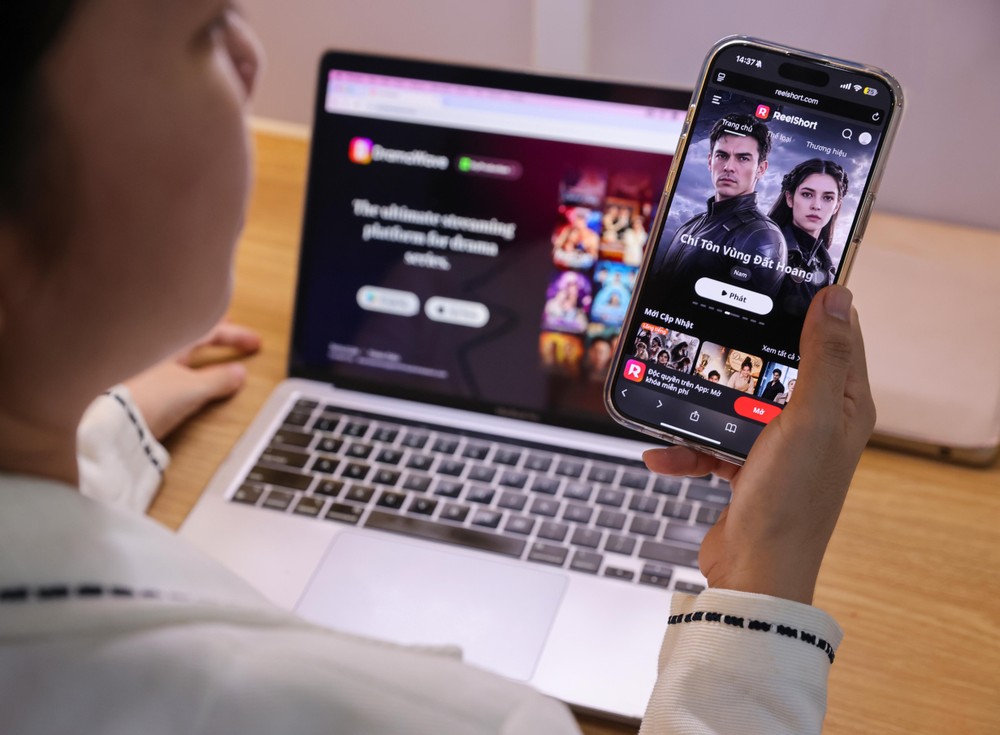
The phenomenon extends well beyond young people. In residential neighborhoods and market areas, older adults and manual workers are also becoming absorbed in AI-generated dramas.
At the reporter's acquaintance's home in a boarding-house neighborhood in Duc Nhuan Ward, Ho Chi Minh City, 55-year-old Minh was looking after her grandchild while glued to her phone.
She was watching an AI-generated drama about a mother-in-law plotting against her daughter-in-law when the child fell off a balance bike and burst into tears. Minh hurriedly put down her phone to comfort the child. Yet within minutes of the crying stopping, the film's narration resumed.

A former AI-drama addict described how the sound of these videos has increasingly become part of everyday domestic life.
"What is finding its way into our homes these days is no longer just the sound of the television. It's the narration of AI-generated films coming from the phones of people of all ages," the person said.
The storylines range from supernatural omens and reincarnation to wealthy, powerful male leads and bitter mother-in-law-versus-daughter-in-law feuds. The more implausible the plot and the more intense the conflict, the more effectively the videos provoke anger, outrage, satisfaction, and curiosity, keeping viewers watching.
"They are a form of mental junk food - easy to consume but extremely difficult to stop," the former viewer said. "We think we are choosing what to watch, but in reality, algorithms are steering us toward content designed to keep us in front of the screen."
A Facebook post warning that many people were staying awake all night watching AI-generated short films had attracted 5,700 likes and 2,200 comments within two days.
"I watch ten AI films a day. Afterward, I'm groggy all day, easily bored by whatever I'm doing, and too impatient to listen to an entire song or finish reading a book," user Nong Thi Ngoc wrote.
Another user, Phan Thao Nguyen, described watching until dawn after drinking half a bottle of energy drink.
"That happened just last night. I ended up watching until 6 a.m.," the user wrote.
Fraying family ties and psychological distress
Conversations with mental health professionals and visits to healthcare facilities point to broader concerns: excessive screen use can strain family relationships, while some users experience behavioral and emotional difficulties that warrant professional assessment.
One afternoon, at the home of 60-year-old Nguyen Hung in Phu Nhuan Ward, Ho Chi Minh City, four family members sat together on the living-room sofa without exchanging a word. Each was absorbed in a phone, wearing headphones or listening to the shrill narration of an AI-generated film.
"Family meals used to be a time when everyone gathered and talked. Now, people eat while staring at their screens. The connection between us has almost disappeared," Hung said with a sigh.
In some households, conflicts over technology use have escalated into serious confrontations, particularly when parents have struggled to supervise their children's online activities.
One mother in Ho Chi Minh City said her family had eventually decided to send her 14-year-old daughter abroad to study after repeated difficulties managing the teenager's behavior.
"If I let her stay at home, I'm losing my child. Her behavior has become too difficult to manage," the mother said emotionally.
Although the family was financially comfortable, both parents were occupied with work and had allowed their daughter extensive freedom to use her smartphone. They initially assumed she was simply enjoying harmless entertainment as she spent hours alone in her room watching AI-generated dramas.
That assumption was shattered when the mother discovered romantic messages on her daughter's phone exchanged with a young man whose identity was unclear.
The girl had begun pursuing romantic relationships at 13, influenced by the familiar tropes of AI-generated dramas featuring wealthy, dominant male protagonists. She appeared to have internalized their exaggerated declarations of possessiveness and jealousy.
Messages included lines such as, "With me here, you cannot belong to anyone else," and "You don't have to be exceptionally beautiful, because I'll get jealous if another man notices you."
The girl had transferred substantial sums of money to the individual on several occasions.
Her parents were even more shocked to discover that this was not her first online relationship of this kind.
The case highlights the potential risks when adolescents confuse fictional romantic scripts with real-life relationships. Without adequate digital literacy and parental guidance, young people may become more vulnerable to manipulation, financial scams, and emotional exploitation.
In Hanoi, another mother sought help from a psychological specialist after her 15-year-old son began refusing to eat with the family and spent his days and evenings glued to his phone.
When his parents tried to intervene, he became enraged, smashed household objects, and accused them of oppressing him, saying he had no respect for them.
Anh Thu, a resident of Binh Trung Ward in Ho Chi Minh City, recounted a separate family experience involving a young relative born in 2007 who struggled with excessive phone use, binge-watching, and emotional outbursts.
The family eventually took the young person to a hospital for psychological assessment.
"After two days there, seeing other patients receiving treatment for mental health conditions and depression was frightening," she said. "Some were shouting, some stared blankly into the distance, while others, despite being much older, were clutching stuffed animals."
Family members warned the young person that a failure to manage their behavior could lead to further difficulties. After returning home, the young person promised to regulate their emotions, and the family observed a noticeable improvement, said Anh Thu.
Dr. Tran Quang Trong, a master's-level specialist in clinical psychology at Le Van Thinh Hospital in Ho Chi Minh City, told SGGP Newspaper that patient confidentiality prevented him from discussing any identifiable case.
He, instead, outlined a composite scenario based on patterns commonly encountered in clinical practice.
A secondary-school student initially watches short videos to relax after class but gradually begins watching late into the night, regularly falling asleep after midnight. The student struggles to wake up, loses concentration, and sees academic performance deteriorate. When parents disconnect the internet, the student reacts angrily, and family conversations increasingly turn into arguments.
A clinical assessment would examine more than the number of hours spent on a phone. It would also consider sleep patterns, mood, anxiety, attention, academic stress, family relationships, and potential safety risks, he explained.
From a medical perspective, short-video consumption may warrant clinical attention when it becomes uncontrollable, severely disrupts sleep, academic performance or work, and is accompanied by symptoms such as anxiety, depression or aggressive outbursts.
Breaking the cycle of AI-generated short films
As AI-powered applications make it possible to generate storylines automatically and reproduce content on an almost limitless scale, a key question is how viewers, particularly young people, can avoid becoming trapped in compulsive viewing patterns.
Dr. Dang Vu Canh Linh, Deputy Director of the Institute for Cadre Training, Development, and Scientific Research under the Central Committee of the Vietnam Fatherland Front, said users should develop their own filters before watching or sharing online content.
The most important step, he argued, is learning to disconnect deliberately: turning off autoplay, hiding harmful content channels, and setting limits on device use.
From a medical and developmental psychology perspective, Dr. Nguyen Quoc Cuong, a master’s-level specialist in the Psychology Department at Children's Hospital 2 in Ho Chi Minh City, cautioned that outright bans and scolding often backfire, provoking resistance and encouraging children to use devices secretly.
Instead, families should adopt practical measures and establish healthier routines.
Parents must lead by example rather than reprimanding children for excessive phone use while continuing to watch AI-generated dramas themselves. Households can establish phone-free periods, particularly during dinner and before bedtime, and keep smartphones out of children's bedrooms.
Parents should also encourage alternatives such as sports, walking, outdoor activities, and face-to-face interaction, giving children opportunities to experience the rewards of real-world engagement rather than seeking constant stimulation from screens.
Technology and artificial intelligence are not inherently harmful. The real danger lies in the endless stream of content that sophisticated algorithms generate and promote to keep users watching. Without awareness and self-discipline, people can become passive captives of digital platforms. Homes should not become places where family members sit side by side yet remain disconnected, with the only sounds they share being the impersonal AI narration echoing from their screens.