Extremely low survival rate
On the night of May 7, 2025, the corridor of the Neurosurgical Intensive Care Unit at Cho Ray Hospital was thick with the choked sobs of 31-year-old Nguyen Thi Hong Dien from Binh Tien Ward of HCMC. In absolute despair, she dragged herself to the hospital courtyard, knelt in the darkness, and begged for a chance for her son to live. The young mother, in that moment, reportedly vowed to shave her head and remain a vegetarian for the rest of her life.
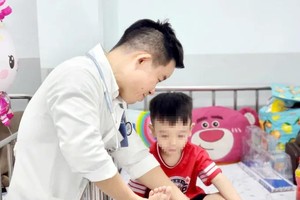
Just a few hours earlier, her 10-year-old son, Tran Ngoc Phuoc Duy, was still laughing and chatting after school. Disaster, it’s reported, came from nowhere. A tree branch, breaking from a height of over 20 meters, fell and struck Duy directly on the head. In the middle of a pouring rain, bystanders rushed him to Cho Ray Hospital. He was in a catastrophic state. His head was deformed, he was in a deep coma, and he had a severe traumatic brain injury, brain contusion, and scattered hemorrhaging. His school PE uniform was soaked in blood.
“The doctor told us to prepare mentally. He said our son might not make it through the night,” Ms. Diem recalled. Level-II Specialist Nguyen Van Nhieu confirmed Duy’s “truly grave” condition: a 4 on the Glasgow Coma Scale, “on the verge of death.”
For 10 agonizing days, Duy lay motionless, despite all efforts. The team was walking on a tightrope, unable to offer promises. Nurses, finding the mother prostrating in the hall, would guide her to the ICU door. Ms. Diem just watched the flashing monitor, knowing that as long as her son was still breathing, hope was still there.
Then, on the 15th day, Duy suddenly blinked, a tiny movement that sent a “jolt of new strength” to the team. He was moved to Neurosurgery, having escaped the brink of death, according to Tran Huy Hoan Bao, MD PhD.
“His head was terribly swollen, and his limbs were tied down,” Ms. Diem shared. “We were at the very bottom of despair.” She expressed deep gratitude, noting Cho Ray Hospital supported the entire cost of treatment, a kindness her family will never, ever forget.
Duy’s head was swelling from a skull fracture and CSF leak. The first surgery patched the dura. But 10 days later, hydrocephalus set in, requiring a second surgery, a shunt, that saved him yet again. The coma broke, and Duy began responding. “This was a rare and extremely complex injury,” Doctor Bao said, crediting the seamless operation for the positive result.
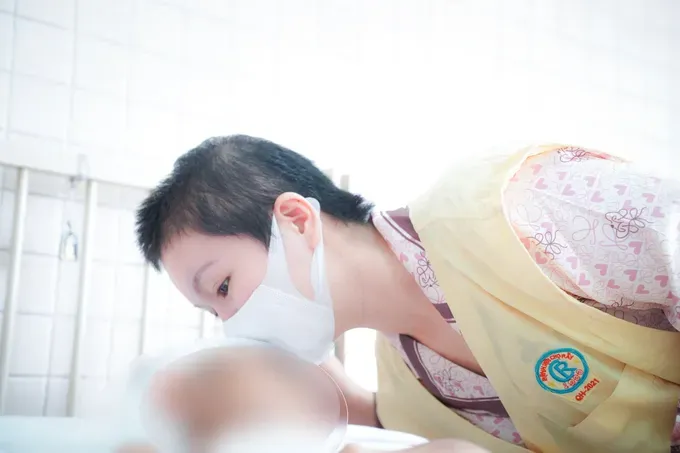
These days, in a cramped rented room, Duy and his mother are reportedly waging a new battle, the arduous, and equally difficult, fight for his rehabilitation.
Lighting hope
If Duy’s story was a race against death, then Le Ngoc Phuong’s one is a “journey of trading her own body to save her children.” After a factory accident crushed her arm and severed her hand, she woke up shocked to find her hand attached to her leg and her arm tucked into her abdomen. Yet when she could feel her 24-week-old twins move, she was instantly calm. “My children are safe,” she whispered.
A factory accident crushed her arm and severed her hand. Rushed to Binh Duong General Hospital, she discovered that standard 6+ hour microsurgery was impossible. The long anesthesia was a huge risk to the fetus, and the crushed wound risked sepsis, losing both mother and child.
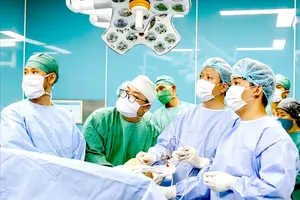
The safe option was amputation, but that meant she would be permanently without her hand. Doctor Vo Thai Trung fretted about what she is facing, both now and as a mother later on. The tense consultation led to a “courageous decision” of temporarily park the hand by grafting it onto her leg to keep it alive. This “exotic” technique was based on the team’s prior success in parking a severed foot.
The team finished the graft in only a few hours, simultaneously using a “pocket technique” to tuck the crushed upper arm into her abdomen. They had protected the patient, the fetuses, and her hope. Two weeks later, the “parked” hand was pink and healthy. The young woman was beaming.
“My mom cried a lot,” she said, “but I choose to laugh. Because when my children are born, I’ll be able to hold them.” With astonishing optimism, she awaits the final surgery, when the twins reach 32 weeks, to return her hand to its proper place.
In the midst of life’s calamities, an effective on-site first aid and emergency response system dramatically increases a victim’s chance of survival. When that system works, the post-accident journey back to a normal life for patients like Duy and Phuong will be that much less arduous. In this system-wide effort, doctors strive every day, every hour to save people, to write these spectacular stories from the brink of life and death. In a place that so often seems like the end of the line, these doctors are quietly planting new beginnings, called life.
In recent times, many out-of-hospital emergency models have been rolled out. In large urban centers like Hanoi, HCMC, Da Nang, and Can Tho, the 115 emergency system operates on a centralized dispatch model, with the 115 switchboard connecting hospitals, traffic police, and local authorities. Satellite emergency models are also helping to expand rapid-response capabilities, especially in industrial parks, dense residential areas, and tourist zones.
Furthermore, air and water rescue models are being deployed in key regions to serve patients in deep-lying or remote areas and on islands. In 2026, the Ministry of Health plans to submit a project to the Prime Minister for the “Development of the Out-of-Hospital Emergency System 2026-2030,” which will focus on building a national emergency network and standardizing the training for emergency personnel, especially in first aid and rapid community response.