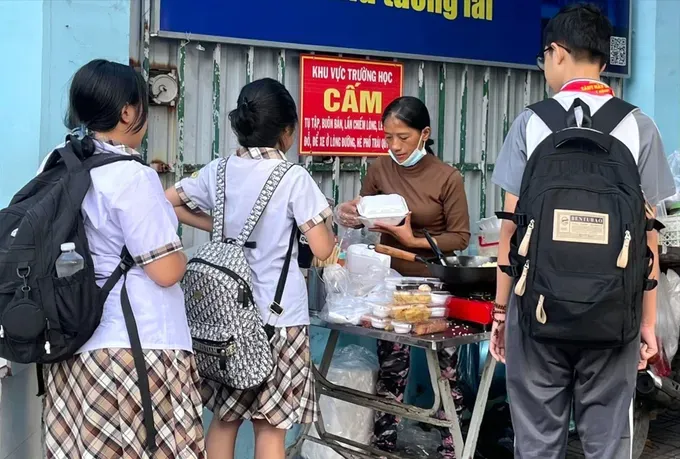
Vendors defying prohibition signs
At dismissal time, the gate of Nguyen Huu Tho Junior High School in Tan Hung Ward transforms into a mini-market, ironically situated right next to a sign reading “Clean, Beautiful, Safe School Gate.” Gia Bao, an 8th grader, quickly picks a hot sausage skewer while waiting for his mother, chatting excitedly with friends. His eyes are glued to the carts selling grilled skewers, rice paper, and stone-grilled sausages, all wafting fragrant aromas.
Right next to the school entrance stands another sign: “Tan Hung Ward Police – No Parking, Dumping, or Trading Here.” As if the sign were invisible, a broken-rice food cart has blatantly set up plastic tables and chairs for convenient business.
Similar scenes are recorded at many school gates across HCMC, such as Huynh Tan Phat Junior High School in Tan Thuan Ward and Nguyen Van Quy Junior High School in Nha Be Commune. Prohibitions are issued, yet sales continue. This paradoxical scene persists at the gates of numerous schools throughout the city.
However, the most unsettling sight is the street vendors appearing in front of major hospitals like the University Medical Center HCMC, Cho Ray Hospital, and the National Hospital of Odonto-Stomatology HCMC.
At these locations, food stalls sit next to trash bins, rice bowls are placed near sewer drains, and the food is of “three-no” quality (no origin, no hygiene, no responsible party). Street dust coats the busy food carts on sidewalks and roadways alike. Despite the presence of hospital security guards and ward security forces, these spontaneous stalls have existed openly year after year.
Chairman of the People’s Committee of Tan Hung Ward Nguyen Duc Tri stated that the locality has included this issue in briefings with the HCMC Traffic Safety Committee, assigning coordination responsibility to school boards, ward police, and traffic police teams under the HCMC Division of Traffic Police. Schools in the ward have surveillance camera systems; when street vendors are detected, they report to the ward police for coordination. However, the situation remains unresolved.
Investigating “magic trick” turning pork into beef
On December 23, HCMC police expanded a probe into a ring producing counterfeit beef. Seven defendants were charged for soaking pork in pig blood and industrial chemicals to mimic beef, churning out 600kg daily for 75 eateries.
Simultaneously, Thanh Hoa police seized nearly 10 tons of Bombay duck fish imported from China. The shipment, transported for a Lang Son firm, tested positive for dangerous levels of formol (90-105mg/kg), a toxic carcinogen capable of causing death. These concurrent busts expose severe food safety violations, revealing how chemically treated meats and toxic seafood are infiltrating the market from local stalls to inter-provincial supply chains.
No effective management plan yet
Unverified ingredients are the most worrying aspect of street food. Observations at the bustling night food area on Do Xuan Hop Street in Phuoc Long Ward show a series of snack carts always crowded with customers despite rudimentary equipment. Dozens of plastic jars containing chilli oil, fried onions, butter, and pork liver paste lack labels, advertised simply as “homemade.”
Many boxes are grime-encrusted, and pans of dark brown oil bubble with fried fish balls and sausages. Ingredient mixtures are tossed in an old plastic basin to make “banh trang tron” (rice paper mixed with customized ingredients), a favorite snack of students.
A frozen goods wholesaler specializing in sausages, chicken feet, fish balls, and pig udders shared that depending on the customer’s request, this person supplies a mix of documented goods and unverified stock, including pig udders imported from China (without invoices). Frozen food is packed in plain plastic bags without brands, yet the seller insists they have clear origins.
Walking along Chin Xien Canal in An Nhon Ward, a pungent stench assaults the nose, mingling with the smell of broken rice and noodle soup. Right at the canal’s edge, many street food spots remain busy. Near this area, Vu Thi Ha, a student at Van Lang University, frequently visits sidewalk stalls to save cooking effort and money.
“I myself have suffered stomach aches and diarrhea from eating out. I just buy medicine and avoid that shop, but I don’t know how to protect myself otherwise,” Ha said.
Under current regulations, street food and small retail businesses do not require a certificate of food safety eligibility, meaning they bypass inspection and licensing. Instead, businesses merely pledge to comply with food safety regulations.
This becomes a loophole to answer such questions as how input ingredients and safety hazards can be controlled when HCMC has over 14,200 street vendors and how food can be recalled if safety violations are detected.
On December 23, the Vietnam Food Safety Authority (under the Ministry of Health) sent a dispatch to the HCMC Department of Food Safety requiring urgent investigation and handling of a suspected food poisoning outbreak after many people ate banh mi at N.H. bakery on 964 Doc Lap Street in Phu My Ward.
The Food Safety Authority requested HCMC to direct medical facilities to maximize resources for emergency aid and intensive treatment to protect patient health. Simultaneously, authorities must urgently investigate and strictly handle food safety violations (if any).
By the afternoon of December 23, Ba Ria General Hospital and medical facilities in Phu My Ward and neighboring areas had treated over 100 patients with suspected food poisoning symptoms abdominal pain and diarrhea) after eating banh mi from N.H. Bakery, an increase of over 30 cases compared to December 22.
On December 19, N.H. Bakery sold about 800 loaves of banh mi. Currently, 9 food samples from this facility have been sent for testing to determine the cause. The Phu My Ward People’s Committee has established interdisciplinary inspection teams to review production and business establishments related to the raw material supply for N.H. Bakery.