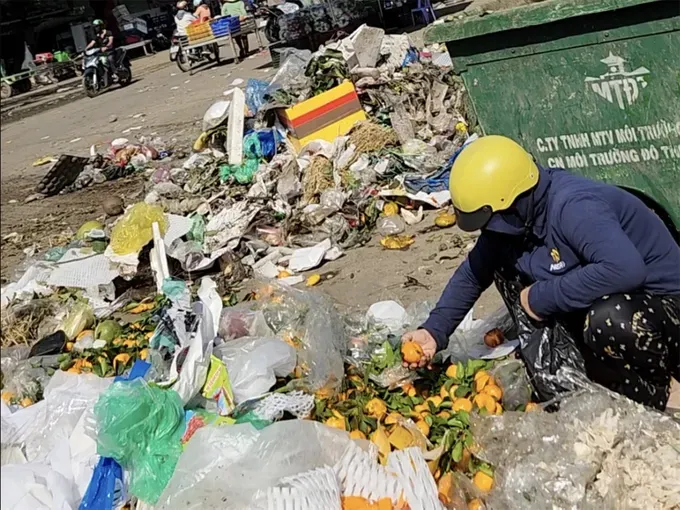
Fruits, vegetables from “reject piles”
Every night, Thu Duc Agricultural Wholesale Market receives approximately 2,500 tonnes of goods, predominantly vegetables, fruits, and flowers. This massive volume of agricultural produce undergoes origin checks and sample testing by the Market Management Board and Team 2 of the HCMC Department of Food Safety. A small portion of produce found crushed or damaged is discarded and piled up.
However, this discarded waste still holds value for many. People diligently scavenge, gathering vegetables and fruits mixed with soil and garbage. Some collect only small plastic bags, while others bring baskets or crates to gather significant quantities for family consumption, or even to “refurbish” and resell. Since activity in this wholesale market generates piles of waste, scavenging reject goods must be swift before the sanitation team gathers it for the waste collection area.
One woman was observed picking tangerines off the dirt before driving 4km to a mobile cart. There, she sold the mushy produce for just VND20,000 (US$0.79) per 3kg. Despite the fruit being salvaged from garbage, she cheerfully assured customers: “Buy with peace of mind, none are rotten, I don’t sell bad stuff, if it’s bad I’ll refund you!”
Aware of this, security forces are deployed throughout the wholesale market, frequently reminding people not to collect discarded fruit. A security guard shared: “This phenomenon has existed for a long time. People and the press take photos and post them constantly. Some pick it up to eat, others sell it all over the place, so we don’t let them pick anymore.”
Long-time vendors at Thu Duc Agricultural Wholesale Market all gave a common answer: “Fruits that are slightly damaged are picked up, peeled, washed, cut, and sold to workers or peddled on the street, still delicious. They earn a few hundred thousand VND a day because they need zero capital; selling cheap is the key. From 1-2 a.m. when vegetable trucks arrive, unsold or defective goods are dumped out, and anyone who wants can pick them up.”
Risk of dirty food from spontaneous markets
Wherever there is a high concentration of laborers, spontaneous markets instantly spring up. Around 5:00 p.m., Street No.1 in My Hiep Neighborhood of Tan Dong Hiep Ward becomes crowded and cramped. As workers clock out, dozens of carts, motorbikes, and tarps spread from the sidewalk to the roadway, offering a myriad of food items amidst noisy hawking. “Mobile vegetable stalls” on carts even weave into residential alleys to solicit customers.
Similarly, at the intersection of Nguyen Chi Thanh and Thu Khoa Huan streets in Thuan An Ward, every late afternoon bustles with residents and workers stopping at roadside vegetable stalls. Sellers pile vegetables into heaps, packed closely together, making it difficult to distinguish between fresh greens and those that are damaged or discarded.
Transactions are hurried and brief as workers race against the clock to prepare dinner after a tiring workday. The sole criterion of the workers’ market is low price; no one questions the origin or quality of the vegetables, meat, or fish.
On Do Xuan Hop Street in Phuoc Long Ward, spontaneous pork stalls attract workers despite lacking veterinary inspection stamps. In residential areas, vendors prepare meat on porches mere inches from cooked food, posing severe cross-contamination risks.
While sellers boast of “clean, home-raised” quality to solicit customers, the hygiene remains unverified. Ultimately, buyers prioritizing convenience over safety allow meat of murky origin to infiltrate the daily meals of many families.
Hang Bong Market in Phu Loi Ward is bustling with buyers and sellers as it is a major agricultural gathering point in the area. A vegetable stall owned by a merchant named L. primarily sells in bulk to food service businesses. Buyers pay no attention to invoices or documents, relying solely on handwritten scraps of paper to calculate the bill.
While many types of vegetables are spread out on the stall for easy selection, herbs are stuffed into plastic bags, some thrown haphazardly on the walkway. Most packaging for vegetables here lacks cooperative labels or planting addresses.
Not far away, a tarp-covered stall sells vegetables on the ground at much cheaper prices. The seller explained: “These are vegetables from China, so they are cheaper than Da Lat vegetables. Don’t worry, people buy loads of them to eat and nobody complains.”
Vice Chairman Doan Dinh Huu of the People’s Committee of Phu Loi Ward stated that although functional forces inspect and remind vendors regularly, spontaneous trading persists.
“People from other places come to sell food products of unclear origin, encroaching on corridors, causing traffic safety issues and affecting urban aesthetics. However, we are not yet equipped with food testing devices to monitor food safety quality, so the main approach remains propagating awareness among the people,” said the Vice Chairman.
According to Level-I Specialist Le Thuan Linh, Head of the Nutrition Department at Thu Duc General Hospital, using bruised and damaged fruits and vegetables carries significant risks due to the intrusion and development of bacteria, mold, and parasites.
The environment of the ground, waste, and wastewater where fruit is dumped can cause cross-contamination of microorganisms, which is very difficult to eliminate. There is even a risk of toxin generation from mold-infected fresh fruit, causing liver and kidney failure in consumers. Mold and bacteria-contaminated food is very hard to detect if the damage is slight, or when it has already been processed into juice and smoothies.