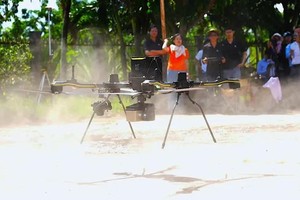
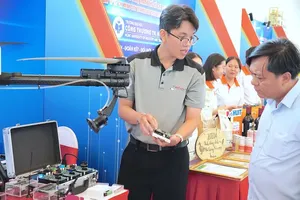
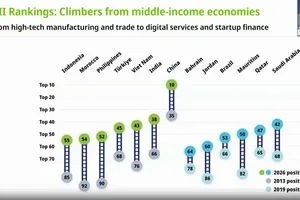
According to the Low Altitude Economy Alliance, the potential of the low-tech industry could reach US$10 billion, and Vietnam is facing many opportunities to become a low-tech industrial hub for the region and the world.
Sharing his views on this prospect, Chairman Truong Gia Binh of the Board of Directors of FPT Group said that the Low Altitude Economy Alliance is coordinating with Ho Chi Minh City to aim for the formation of a $10 billion UAV industry in the next 10 years, creating approximately 1 million jobs.
However, according to the FPT Group Chairman, the biggest bottleneck currently is the lack of technical standards and regulations, as well as licenses or certificates of origin for the UAV sector. In the long term, UAVs will be part of the national defense capability. Vietnam's greatest opportunity lies in manufacturing for the global market where supply is currently very scarce.
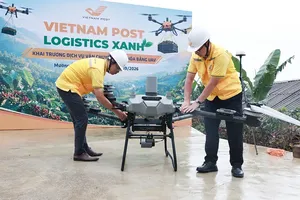
In terms of applications, agriculture is the most promising sector with many successful practical models. Next, delivery by UAVs could be implemented if a standardized digital address system is established for all delivery points.
Meanwhile, the Chairman of CT Group affirmed that the low-level economy is not a separate sector but a comprehensive economic ecosystem, integrating both the green economy and the digital economy. This is an economy that exploits spatial resources, delivering superior productivity compared to traditional models.
For Vietnam, the low-altitude economy serves as a digital map of ground operations elevated into the air spanning agriculture, logistics, energy, tourism, and national security. Industry experts emphasize that integrating these sectors will drive new business models, allowing the country to master critical tech supply chains and secure a distinct competitive edge on the global stage.